
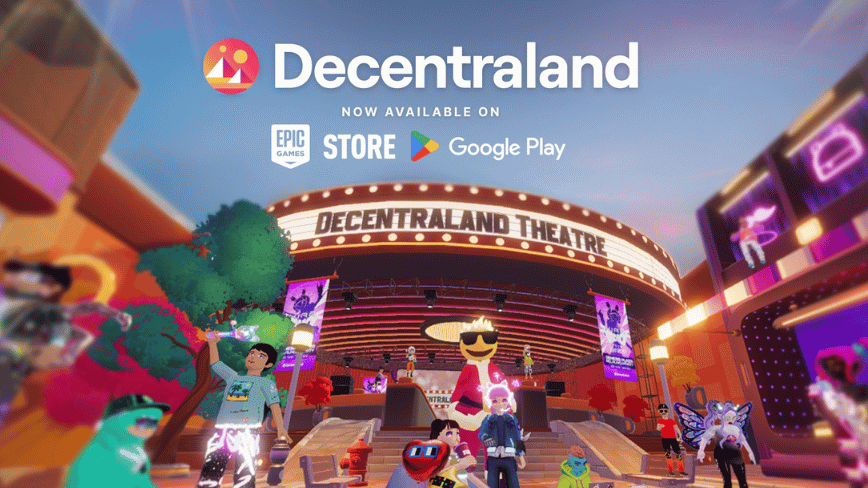

The metaverse was envisioned as a standalone destination, where one could wear a headset, enter a virtual world, and disregard the platform that hosted it. Decentraland, an early decentralized virtual world experiment, seems to have adopted a different approach. On Monday, the project went live on the Epic Games Store and launched an Android app on Google Play, with an iOS version forthcoming. The message is clear: Decentraland aims to reach users where they already are.
The Epic Games Store move is strategically more significant. Epic’s platform had 317 million registered PC users in 2025, with a record of 78 million monthly active users in December of that year, according to the company’s annual review. Third-party game spending exceeded $400 million, rising 57% year on year. For Decentraland, known for its sparsely populated virtual world, sharing a platform with Fortnite and other popular titles is a strategy to tackle a distribution issue that blockchain architecture alone couldn’t solve.
Yemel Jardi, Decentraland’s executive director, emphasized distribution over technology. Epic Games, he noted, has become a key discovery channel for desktop experiences. Being present there enhances visibility and access to Decentraland, aligning with a broader strategy to reach users on other platforms eventually.
The mobile launch follows similar reasoning. Decentraland’s Android app is now available on Google Play, with an iOS version anticipated soon. The project references Mordor Intelligence data showing mobile devices control 71.55% of the social gaming market, and DataReportal stats indicating the average online user spends three hours and 46 minutes daily on their phone. The Consumer Technology Association notes cross-platform play engagement at 61% of gamers. Gino Cingolani, executive director of DCL Regenesis Labs, stated the mobile experience lowers access barriers, allowing spontaneous phone access instead of planned desktop sessions.
The timing is pertinent. In March, Meta, which rebranded itself around the metaverse in 2021 and invested approximately $70 billion in Reality Labs before reversing course, announced plans to close Horizon Worlds on VR headsets. This decision was partially retracted after user backlash, although the platform’s future remains uncertain. Meta laid off 1,500 Reality Labs employees in January 2026, shut down three internal game studios, and cut its metaverse budget by 30%. The company that mainstreamed the “metaverse” term has pivoted towards AI infrastructure and wearables.
Decentraland’s pitch is that this creates an opportunity. While Meta built a proprietary virtual world controlled by one corporation, Decentraland operates as a community-governed platform supported by a nonprofit. Users own land parcels and avatars as Ethereum blockchain tokens. Governance is decentralized, with community votes making decisions. There’s no single entity that can shut it down—a vulnerability Horizon Worlds users faced when Meta deemed the economics unfeasible.
The question remains whether Decentraland’s economics are viable. Its MANA token trades around $0.08, a sharp fall from its peak above $5 during the 2021 crypto boom. Measuring active users has been contentious. A 2022 DappRadar report estimated as few as 38 daily active wallet users, which Decentraland contested, arguing it captured only on-chain transactions, not total visitors. The project reports about 847,000 monthly unique web clients for late 2025, with daily unique visitors rising by 23% since mid-2025 due to a faster, lighter desktop client. In January 2026, the platform held 312 community events, averaging 127 unique attendees per event.
These figures are modest in mainstream gaming but notable for a platform surviving the metaverse downturn relatively intact. In Q4 2025, secondary market sales of Decentraland LAND parcels reached $4.2 million, up 31% quarter on quarter. Founded in 2015 by Argentine developers Ari Meilich and Esteban Ordano, the project raised $26 million in a 2017 initial coin offering and launched publicly in February 2020. It has outlasted or outperformed many of its peers.
The Epic Games Store launch includes a promotional offer: anyone downloading Decentraland via Epic receives an exclusive Epic Arrival Shield wearable item. This small gesture acknowledges that growing a user base in a competitive digital market requires meeting the expectations of platforms where users already spend money. In 2025, Epic’s store ecosystem gave away 662 million free game copies, conditioning its audience to expect upfront value.
Decentraland will celebrate the dual launch with an in-world party on April 2 at 7 PM UTC, with performances by Dúo Dø and DirkNeuenfels, also streaming on Twitch. The event’s cross-platform nature, accessible from desktop, mobile, and stream, embodies the current strategy. The virtual world is the product, with storefronts, app stores, and streaming platforms serving as access points.
Whether