
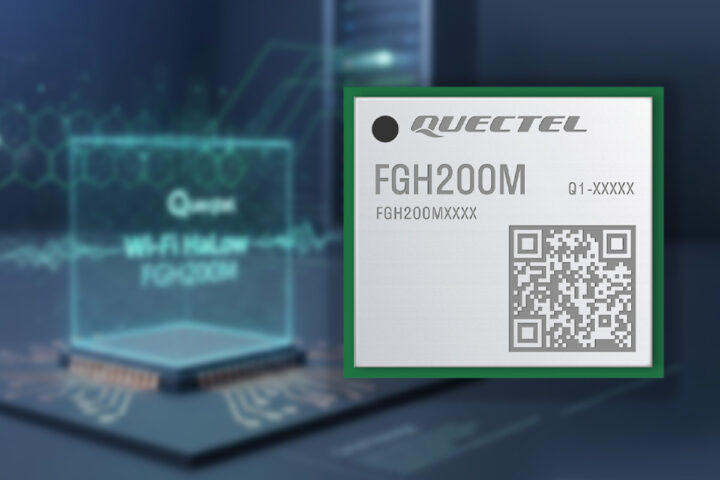

Presented at MWC 2026, the Quectel FGH200M Wi-Fi HaLow module, built on the Morse Micro MM8108 SoC, is an enhanced version of the previously released MM6108-based FGH100M. This module is designed for long-range, low-power IoT connectivity and operates in the sub-1-GHz band (850–950 MHz), with a reach of up to 1 km. It is suitable for smart homes, industrial automation, smart agriculture, smart cities, building automation, warehouses, campuses, and large-area IoT networks.
This module functions on 1/2/4/8 MHz channels with a maximum physical data rate of 43.3 Mbps and offers a transmit power of 26 dBm. It can theoretically support up to 8,191 IoT devices per access point. Connection to the host is possible via USB 2.0, SDIO 2.0, or SPI interfaces. Its ultra-compact LGA package measures 11.0 × 10.0 × 2.0 mm and operates in industrial environments with temperatures ranging from –40°C to +85°C.
Quectel FGH200M Specifications:
– SoC: Morse Micro MM8108 32-bit RISC-V Host Applications Processor (HAP)
– IEEE802.11ah Wi-Fi HaLow standard
– Frequency range: 850-950 MHz
– Supports Access Point (AP) and Station (STA) modes
– Channel width options: 1/2/4/8 MHz
– Modulation methods include BPSK, QPSK, 16QAM, 64QAM, 256QAM
– Data rate: Up to 43.3 Mbps
– Transmit power: Up to 26 dBm
– Antenna: 1×1 configuration with a single Wi-Fi antenna interface
– Host interfaces: USB 2.0, SDIO 2.0, SPI
– Security: AES, SHA-256 / SHA-384 / SHA-512, WPA3, OWE
– Power:
– VDD: 2.25 to 3.6 V (Typical: 3.3 V)
– VBAT: 3.0 to 3.6 V (Typical: 3.3 V)
– Dimensions: 11.0 x 10.0 x 2.0 mm
– Weight: Approximately 0.51 g
– Temperature: -40 °C to +85 °C
– Certifications: CE, FCC, IC, RCM
The module’s firmware implements the IEEE 802.11ah Wi-Fi HaLow protocol, while drivers and higher-level networking stack run on the host system. Supporting both AP and STA modes, it can extend the range beyond traditional 2.4 GHz Wi-Fi technology by up to ten times.
Matched external antennas such as YECN009AA and YENT065W1BM are also available. Despite the official announcement, the datasheet is still labeled as “Preliminary,” and some details like receiver sensitivity for different MCS levels remain “TBD.” Further information can be found on the product page and press release.