
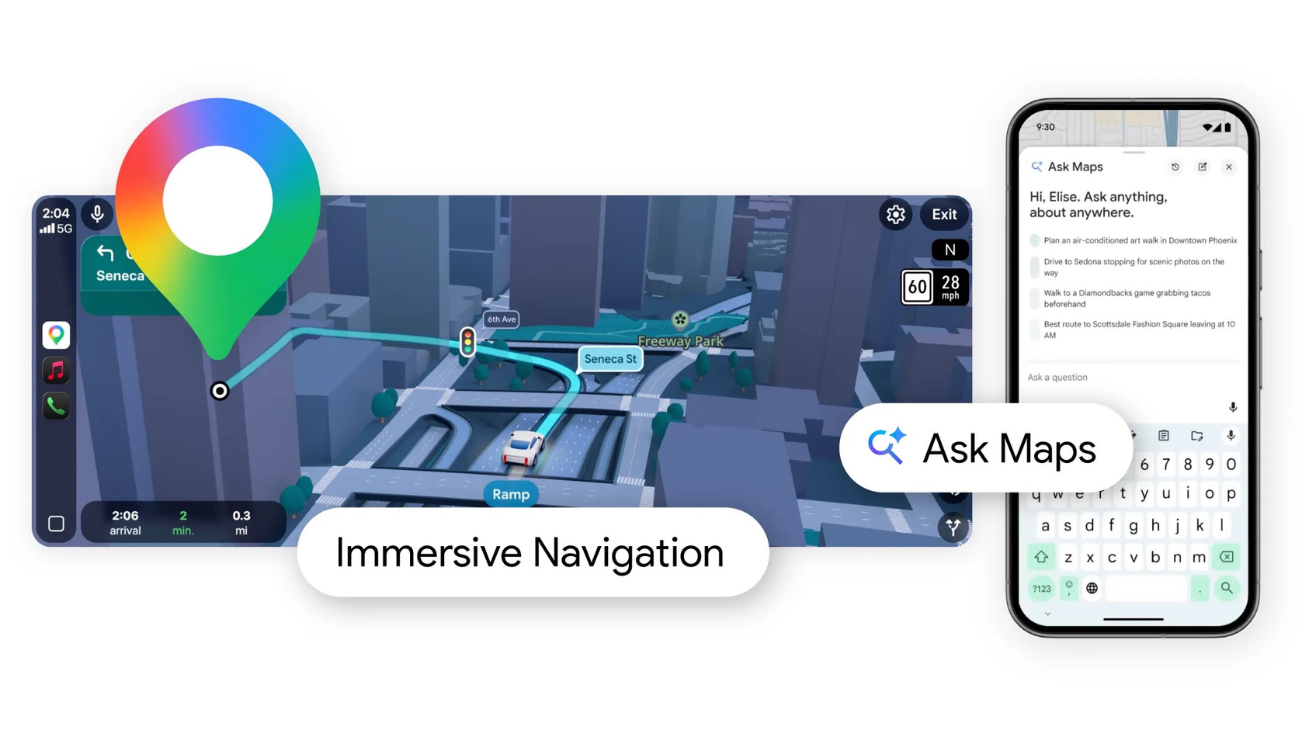

Ask Maps allows users to query the world using natural language, while Immersive Navigation provides 3D reconstructed directions. These updates constitute the most substantial changes to Google Maps since Street View.
Google now prompts its users to ask Maps: “My phone is dying, where can I charge it without a long wait for coffee?” The ability of a navigation app to effectively respond to such a query signifies a crucial advancement in digital map capabilities.
Google has unveiled Ask Maps, a conversational AI feature powered by Gemini, and a revamped Immersive Navigation experience, which introduces photorealistic 3D rendering to directions. This combination is considered Google’s most significant Maps update in over a decade, although the company avoids stating this directly.
Ask Maps enables users to ask intricate, context-based questions instead of searching for specific locations or categories. As an example, Google suggests the query, “Is there a public tennis court with lights on that I can play at tonight?” in a blog post dated March 12.
The system utilizes personalization signals like a user’s saved places and past searches to tailor its responses, ensuring a user interested in vegan restaurants gets vegan-friendly suggestions without needing to specify.
The feature is launching now in the US and India on Android and iOS, with a desktop version anticipated later. Google has not specified a timeline for broader international release.
Immersive Navigation, the second crucial component of the update, swaps the flat-map navigation overlay for a 3D view that includes nearby buildings, overpasses, and terrain. Lane markings, traffic lights, crosswalks, and stop signs are shown as visual cues rather than text.
Voice guidance now employs landmark-based instructions, such as “Go past this exit and take the next one for Illinois 43 South,” replacing distance-based directions.
The redesign aligns Google Maps more with Apple Maps’ established visual approach, which introduced detailed 3D city rendering years ago. Google’s current deployment of similar depth in navigation, rather than the previous separate Immersive View mode, underscores both the computational demands of real-time 3D rendering on mobile devices and the time needed to construct the detailed map data.
Ask Maps is Google’s most direct integration of its Gemini AI into a product used by over a billion monthly users. Previously, Gemini’s inclusion in Maps was limited to AI-powered summaries of locations and reviews. Ask Maps broadens this to comprehensive conversational navigation, putting Google in closer competition with AI-native tools like Perplexity, which incorporate search-style responses for location-based queries.
The update comes as Apple enhances its own Maps intelligence, and OpenAI explores location-aware features in ChatGPT. Maintaining Maps as the leading spatial intent interface is crucial for Google, which derives much of its advertising revenue from local search queries. Ask Maps signifies the company’s intention to maintain its dominant position.
The question remains whether users will engage in conversations with their maps or stick to the familiar search box. Google has previously launched conversational search features, but adoption often lags behind product announcements.
Yet, the infrastructure is now in place. The next question is the one users will eventually ask.