
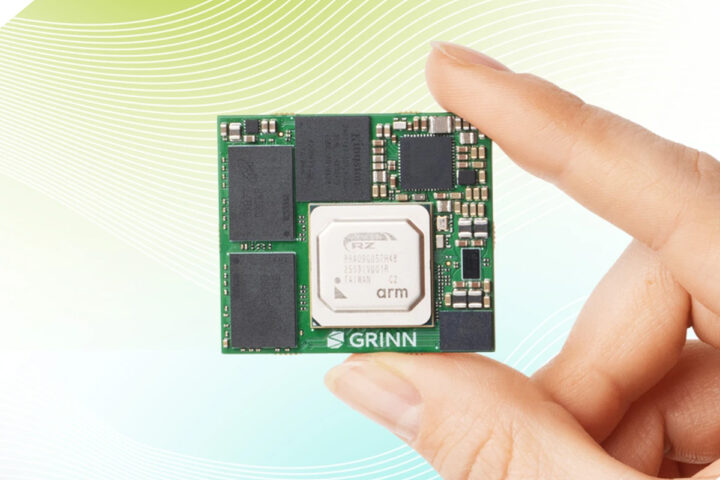

Grinn, a Polish embedded systems company, has unveiled the ReneSOM-V2H, an ultra-compact vision AI System on Module (SoM) featuring the Renesas RZ/V2H vision AI processor. With dimensions of 42.6 x 37 mm, Grinn claims it is the smallest module using this Renesas MPU, designed for space-limited Edge AI uses in smart cameras, robotics, and industrial automation.
The RZ/V2H SoC includes a mixed architecture with 4 Cortex-A55 cores, 2 Cortex-R8 cores, and 1 Cortex-M33 core, coupled with a DRP-AI3 accelerator reaching up to 8 TOPS. It accommodates LPDDR4 memory and eMMC storage, with connectivity options like PCIe Gen3 (4-lane), USB 3.2, USB 2.0, and Gigabit Ethernet. Four MIPI-CSI camera inputs and a MIPI-DSI display output are available for vision-related tasks.
Grinn ReneSOM-V2H specs:
– SoC: Renesas RZ/V2H
– CPU/MCU cores:
– 4x Arm Cortex-A55 up to 1.8 GHz
– 2x Cortex-R8 real-time up to 800 MHz
– 1x Arm Cortex-M33 microcontroller up to 200 MHz for system management
– GPU: Arm Mali-G31
– ISP: OpenCV Accelerator, optional Arm Mali-C55
– NPU:
– DRP-AI3 up to 8 TOPS (INT8) or 80 TOPS (Sparse)
– DRP, a dynamically reconfigurable processor (STP4)
– System Memory: Up to 8GB supported by SoC
– Storage: eMMC flash
– LGA balls:
– Display: MIPI DSI
– Camera Inputs: 4x 4-lane MIPI CSI-2
– Networking: Gigabit Ethernet
– USB: 1x USB 3.2, 1x USB 2.0
– Expansion: PCIe Gen3 (4-lane), 6x CAN FD, UART, I2C, SPI, ADC
– Power: 5V single supply
– Dimensions: 42.6 x 37 mm (LGA design, 260-pin SO-DIMM compatibility)
– Operating Temperature: −40°C to +85°C
The module is capable of managing up to four cameras with high data throughput via PCIe Gen3 and USB 3.2, akin to the NVIDIA Jetson Orin Nano, although with potentially lower raw TOPS. The DRP-AI3 architecture may offer higher efficiency in specific vision pipelines without the need for a fan.
Software details are not provided but should include support for the Renesas ecosystem, including a Linux BSP based on Yocto, DRP-AI drivers, and a DRP-AI TVM backend for TensorFlow models. Additional support entails Flexible Software Package (FSP) components for Cortex-R8 and Cortex-M33, multi-OS or bare-metal development options, and Edge Impulse integration.
Using the ReneSOM-V2H could reduce development cycles by up to 12 months compared to a chip-down approach, as it simplifies the complex process of high-speed routing for the RZ/V2H’s 1368-pin BGA package. Currently sampling, there is no pricing information available, but additional details are on the product page and the official announcement.