
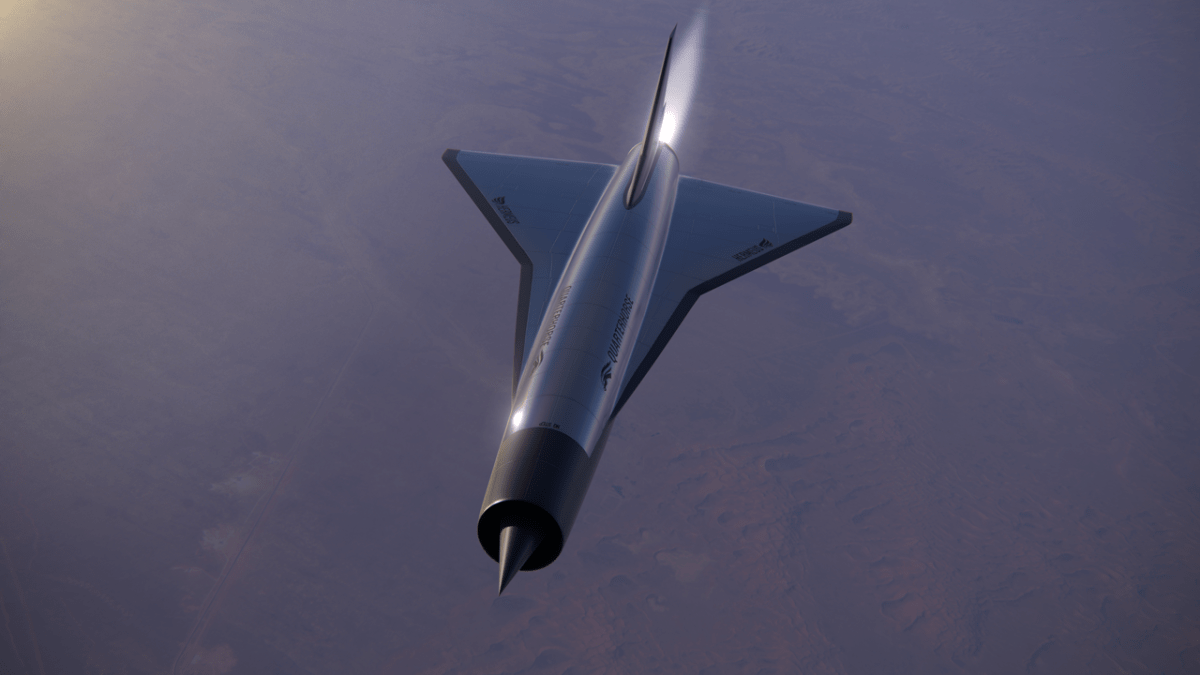

Defense startup Hermeus has secured $350 million in funding to advance its development of the “fastest unmanned aircraft,” elevating its valuation to $1 billion.
The Los Angeles-based company announced on Tuesday that it raised $200 million in equity financing, with Khosla Ventures leading the round. Existing investors Canaan Partners, Founders Fund, In-Q-Tel, and RTX Ventures also participated. Additional funding came from media conglomerate Cox Enterprises’ venture fund, Destiny Tech100, and others.
An additional $150 million was obtained through debt, which Hermeus co-founder and CEO AJ Piplica shared with TechCrunch as a strategy to maintain control amidst an expanding cap table.
“We build a lot of hardware and are expanding our manufacturing capabilities. Financing a large portion non-dilutively is optimal,” he said.
The investment comes at a time when venture and corporate investments in defense startups are surging. Last year, global VC investment in defense tech exceeded $9 billion over 265 rounds, with corporate investors contributing $2 billion across 28 rounds, according to PitchBook.
For Hermeus, success stems from a pivotal technical shift. Initially developing its own engine, the startup shifted to collaborating with RTX subsidiary Pratt & Whitney to adapt the F100 engine for its hypersonic aircraft, a move that accelerated their progress.
“We’re now on a faster track with a proven engine, facilitating easier testing and enabling new U.S. government contracts. Diversifying from solely aiming at a Mach 5 aircraft is strategic,” said Hermeus president Zach Shore.
“This approach hastens our path to Mach 5 and supports business economics while meeting Department of Defense demand. It’s about overlapping circles that strengthen the business, customer relations, and technology progression,” Shore added.
Last month, Hermeus successfully flew a demonstrator as large as an F-16, aiming to make its successor supersonic. A third aircraft is also in development, Piplica disclosed.
Hermeus employs a rapid prototyping strategy, likened to SpaceX’s model of iterative testing and learning. Piplica cites talent cultivation as a key challenge: “There aren’t many places building new full-scale aircraft annually, so developing skilled personnel is crucial.”
The funding will help Hermeus expand its workforce, which is nearing 300. Hermeus has completed two successful test flights, but Piplica emphasizes readiness for failure as a learning tool.
“The challenge is choosing which risks to assume and applying capital to them wisely,” Piplica explained. “Crashing is possible, but safety preparations are in place. More aircraft production reduces timelines compared to lengthy development cycles.”
Correction: The article initially described the Hermeus aircraft as “autonomous.” It is, in fact, unmanned, meaning it is remote-controlled.