
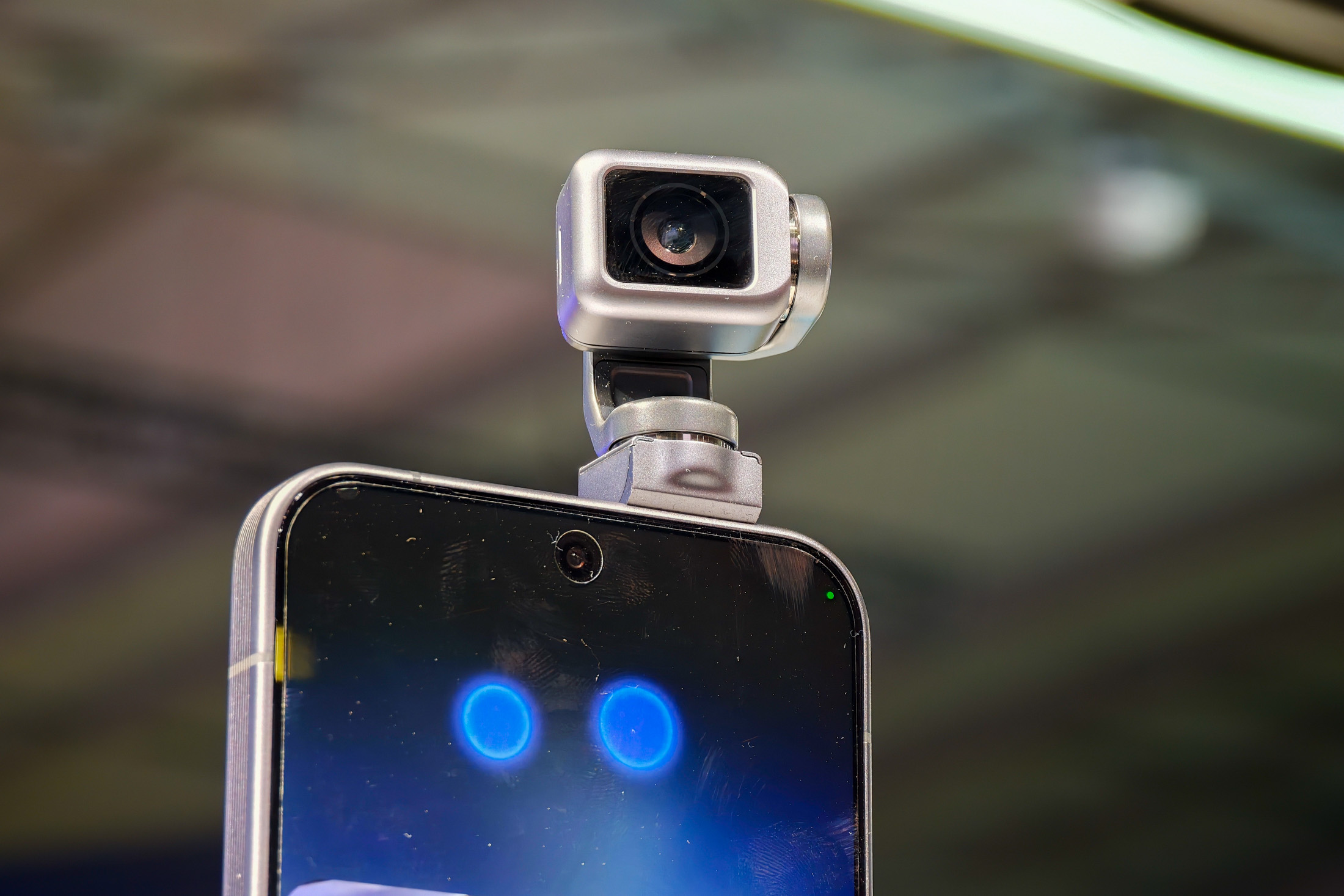

Just don’t call it the Gimbal Phone. After over four months of teasing, I’ve finally been able to see Honor’s Robot Phone in action. It looks pretty legit — just so long as you weren’t actually expecting a robot.
The Robot Phone could more accurately be called the Gimbal Phone, though I suspect the company’s marketing department would disagree. Its big hardware innovation is a 200-megapixel camera mounted on a gimbal arm, which unfolds from the back of the phone when you need it, and retracts behind a cover when you don’t.
It unlocks a set of camera features much like you’d find in a DJI Osmo Pocket. There’s improved stabilization thanks to the gimbal, meaning steadier video output. You can manually control the arm, rotating the camera or turning it up and down, or let the AI-powered subject tracking take care of that for you, with the ability to rotate almost 360 degrees — meaning it doubles as a selfie camera too. Then there are automatic shooting modes, like the swiveling spin shot, and Honor has plans for other automations, including AI video editing.
This alone would make the Robot Phone a pretty appealing prospect for some. Combining that camera with a phone, content creators would be able to shoot and edit entirely on a single device that fits into their pocket, and the rest of us could get a phone with — supposedly — substantially improved video performance and main-camera quality for selfies.
The hardware achievement alone here is impressive. The Robot Phone’s gimbal arm is smaller than any in DJI’s Osmo Pocket line. Honor claims it’s 70 percent smaller than the competition, and is now the smallest 4DoF (four degrees of freedom) gimbal system in the industry, though that’s counting its ability to fold in and out of the phone’s body, with three axes for the main gimbal arm.
Shrinking the gimbal “involved two key hurdles,” according to Thomas Bai, one of Honor’s product experts. “One, sourcing ultra-thin materials to make the motor small and lightweight; two, using ultra-strong materials to ensure rigidity and durability despite the thin structure.” Those are the same hurdles faced when designing a foldable phone, so Honor repurposed the steel and titanium alloy used in the hinge of its Magic V6 when constructing the micro motors that make the arm move.
The risk is that a smaller gimbal turns out to be worse. At its MWC booth, Honor didn’t show the Robot Phone’s camera up against either DJI’s Osmo Pocket 3 or any larger gimbal systems. Instead, it set its gimbal up against a flagship phone from Vivo — long a forerunner in phone camera stabilization — where it seemed to record more stable video.
In a quirk of timing, this has all arrived just days after Samsung revealed its super-steady Horizon Lock stabilization on the Galaxy S26 phones. That does a remarkable job at shooting steady, stabilized video, even as the phone itself shakes or rotates dramatically. One of the tests for Honor now will be whether its hardware solution delivers enough of a boost in quality to justify it over Samsung’s software solution. Much of that depends on the camera itself, but beyond the megapixel count, Honor hasn’t shared details about the specs.
Honor’s gimbal-equipped phone delivers more than just stabilized video. The subject tracking seemed fast and fairly effective, though it was possible for someone to move quickly out of frame. The stable gimbal arm should help improve low-light photography, though Bai said that isn’t the Robot Phone’s focus because it’s a problem the company’s flagship phones have “already solved,” while stable video shooting is “much, much harder.”
This is reflected in local rival Vivo’s MWC announcement. The company took to Barcelona to tease its upcoming X300 Ultra, set to launch in Europe for the first time, and with a renewed focus on video. Vivo’s approach is more focused on integration into complex, professional workflows than simple content creation, but it reflects the same outlook: If you want your phone camera to stand out, video performance is the way to do it.
I’ve avoided talking about the robot of the Robot Phone until now, and intentionally so. The demo Honor showed was a glorified LLM chatbot app — using a Chinese model that Honor declined to name — which occasionally made cutesy noises and gestures. You can ask it about your outfit, and it might nod while complimenting your dress sense, or if you play music, it might dance along — though in its demo version, it exclusively favors Imagine Dragons.
Bai mentioned the company is developing an accessory to clip the phone to your backpack, potentially narrating your surroundings if you’re exploring a new place. “Rather than reacting solely through screens and voice commands, Robot Phone perceives and responds through motion,” Bai says. “Multimodal perception means it can identify sounds, track motion, and