
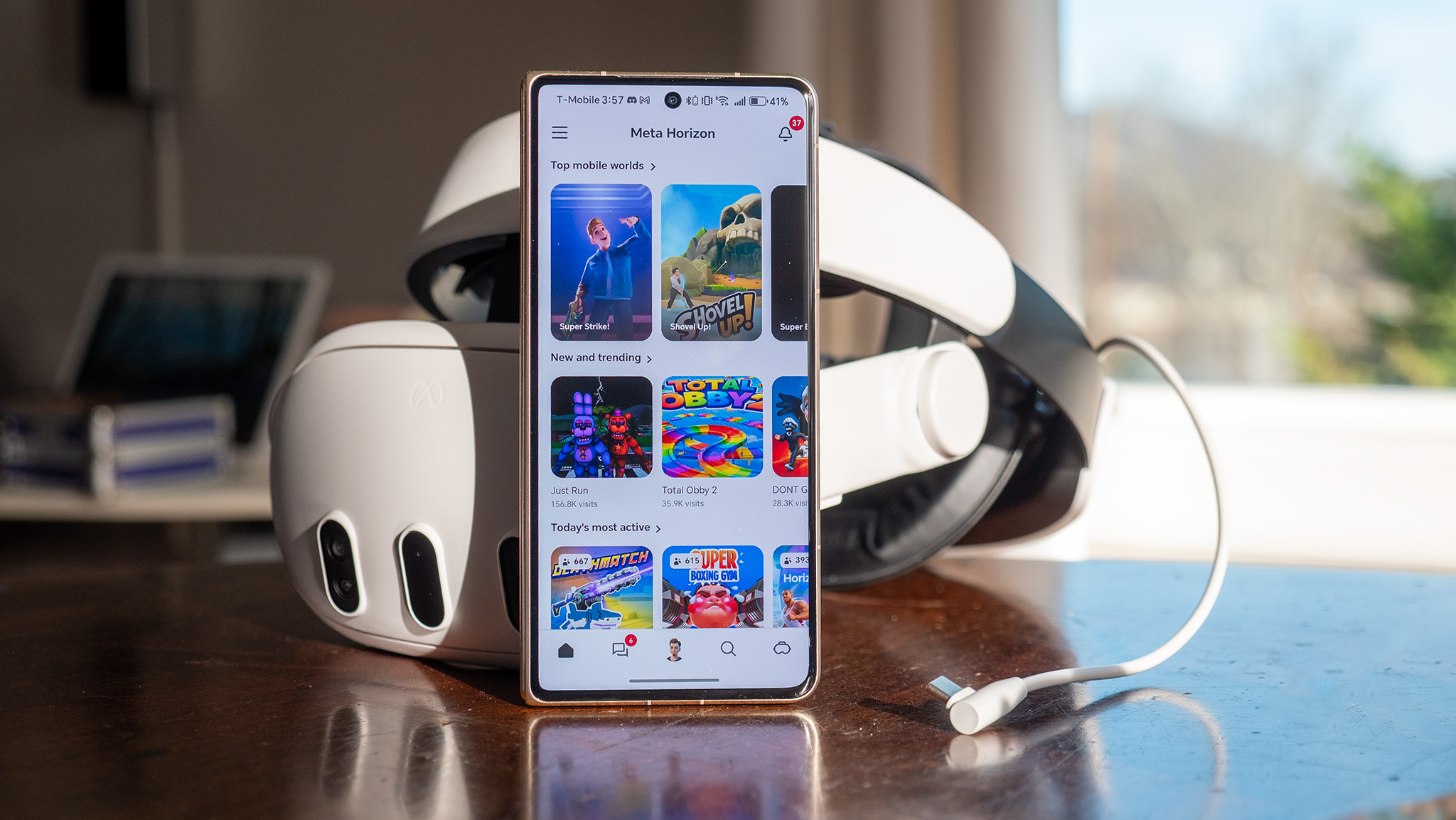

This week, Meta unveiled the newest development in its Metaverse approach, and although it’s not entirely unforeseen, it is nonetheless somewhat surprising. Horizon Worlds, Meta’s Metaverse platform akin to Roblox for Meta Quest headsets, is officially being discontinued on Meta’s VR system, with services ceasing on June 15, 2026. This was outlined in a message sent to Meta Quest account holders:
“Beginning June 15, 2026, you will no longer have the ability to create, publish, or update VR worlds. Additionally, access to Meta Horizon Worlds on Meta Quest headsets will no longer be available. After this date, you can still enjoy worlds on the Meta Horizon mobile application.”
Meta dedicated much of 2024 and 2025 to deeply embedding Horizon Worlds into the Meta Quest experience, even going so far as to rename the Meta Quest’s operating system to Horizon OS and featuring Horizon Worlds as the initial interface in the headset and on the companion mobile app. Meta has recently declared that the Horizon feed would be retired, and now it is completely shutting down everything related to the Horizon Central social hub and the Horizon Worlds app.
In essence, the Meta Quest experience is reverting to the golden era of 2022 when it was primarily a gaming platform. This is a decision many (myself included) have been advocating for years, and it demonstrates that Meta is indeed clearing out the clutter and returning to fundamental principles with the Quest.
What ‘gaming-focused’ truly signifies
Back in December, I discussed how Meta was “eliminating the excess” and returning to basics. Based on my understanding, that indicated a shift away from an integrated Metaverse towards producing major games to draw in large numbers of players. Regrettably, I misjudged the latter part of that assessment. Meta is not becoming the next Nintendo or Sony, which is disappointing given the quality of the games produced by its first-party studios over the past decade.
Instead, Meta will concentrate exclusively on funding external games and studios; however, even then, it will not operate as the “lucrative opportunity” it has been in recent years. Meta announced that Oculus Publishing delivered over 140 games in 2025 and has numerous more slated for release this year, suggesting that while blank checks may cease, the company still seems committed to funding game development.
Regrettably, the modifications being made to Horizon Worlds also imply that several promising projects will be abandoned. In November, Meta introduced social Hyperscape worlds utilizing the upgraded Horizon engine, enabling users to engage in hyper-realistic social settings. This service will be shut down alongside Horizon Worlds, but at least the scanning and construction of Hyperscape environments within the original application will remain.
While it’s unfortunate to lose some of these elements, the truth is that they must be eliminated to preserve the remainder of the ecosystem. Meta CTO Andrew Bosworth has frequently stated that Meta “is a large company and has the capacity to work on multiple initiatives concurrently,” but users have limited time and attention, and it is evident that Meta’s focus on a Metaverse-centered platform has not been what is attracting gamers to the platform.
The gamers have made their voices heard
To illustrate that the Quest is a gaming-centered platform, Chris Pruett, Director of Games at Meta, spoke at GDC about the state of the Quest ecosystem. “Quest usage has been rising year over year, and in 2025, we reached our highest ever unique user numbers in our history.” That’s not indicative of a failing platform — quite the opposite.
In 2025, “more than 100 titles generated over $1M in gross revenue,” and Pruett clarified that “premium app sales remain the primary revenue source for our ecosystem, but IAP saw significant growth in 2025, exceeding 10%.” This is excellent news for gaming, and notably, Pruett does not mention Horizon Worlds revenue even once. Meta is no longer attempting to justify financing a feature that lacks user interest.
Therefore, rather than seeing subpar free content shoved in your face as soon as you power on the headset, Meta appears to be returning to the promotion of actual games that consumers are willing to spend significant amounts of real money on.
To support this, Meta will keep expanding its Meta Horizon+ gaming subscription, which grants players access to over 100 games for merely $8 monthly. To enhance matters, Pruett mentioned that Meta provided over $20 million to developers who took part in the program in 2025, demonstrating that there is indeed profit to be earned for developers via the service.
Meta continues to assert that its promotion of Horizon Worlds had a minimal negative effect on game sales, but the data contradicts what developers have communicated to me and other outlets. Pruett indicated that despite the low impact, featuring Horizon Worlds prominently “was universally