
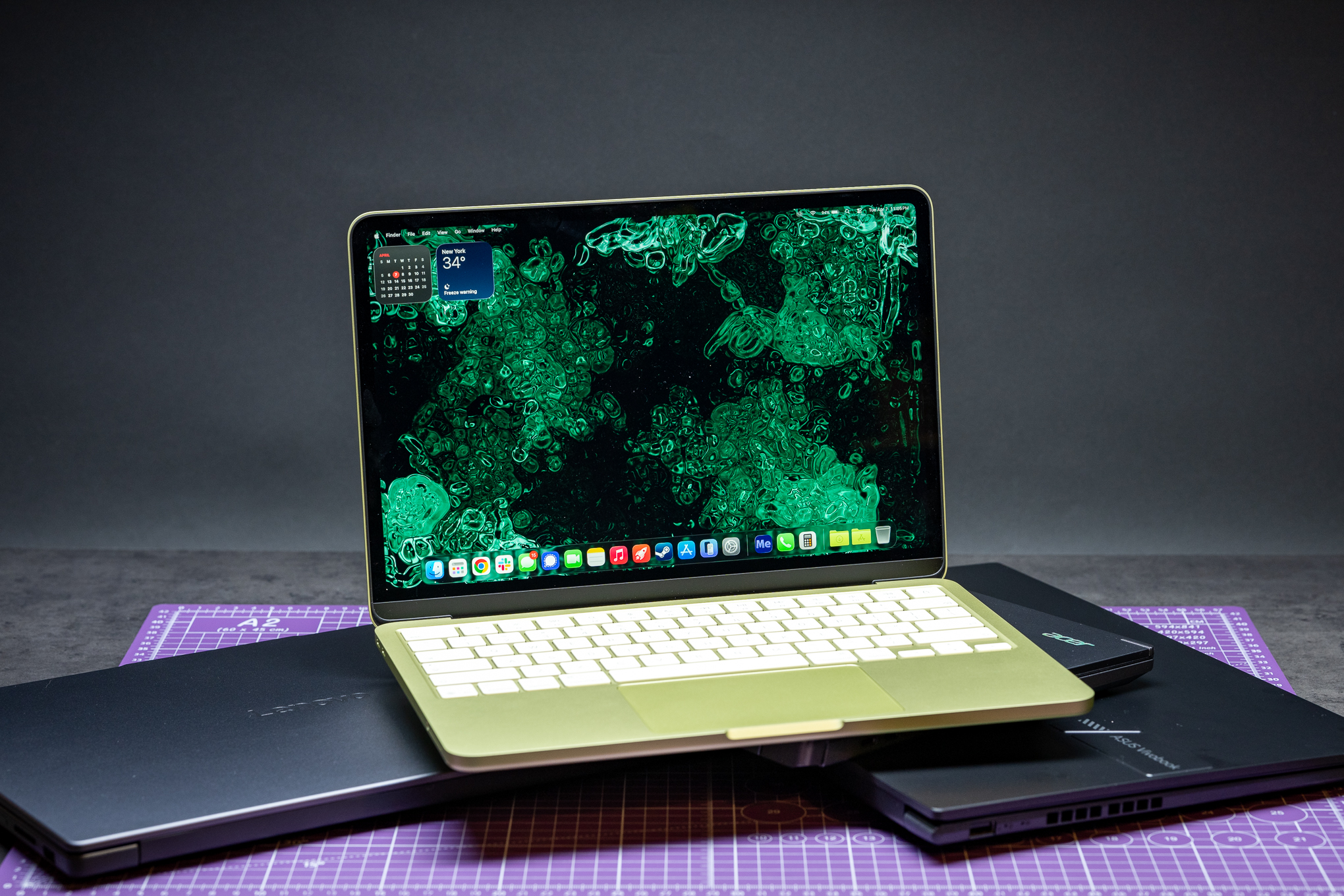

The edges on laptops from Asus, Lenovo, and Acer are glaring when placed beside the Neo.
When the MacBook Neo launched last month, I foresaw challenges for Windows laptop makers. Priced at $599, the Neo offers excellent build quality and robust performance in a sleek, portable design. Windows laptops in the same price bracket usually appear unattractive, feel cheap, and perform slightly sluggishly.
Despite longstanding rumors, the MacBook Neo caught the Windows ecosystem by surprise. I predict suitable rivals will emerge as soon as companies can develop them, but I was curious to assess the current PC competition.
I requested various laptop manufacturers to present their best alternatives to the MacBook Neo.
The MacBook Neo is a 13-inch, 2.7-pound, all-aluminum laptop equipped with an A18 Pro iPhone chip as its processor and 8GB of RAM, starting with 256GB of (slow) storage. Priced at $599 (or $499 for students and teachers), an extra $100 upgrades the storage and adds a Touch ID fingerprint sensor on the power button. There are no all-aluminum, 13-inch Windows laptops available for $600. All the Windows laptops I evaluated have MSRPs over $600 but are generally cheaper.
Asus offered a $700 Asus Vivobook 16 with an AMD Ryzen 7 processor (now $530), Lenovo proposed a $750 Lenovo IdeaPad Slim 3x with a Snapdragon X chip (now $550), and Acer supplied an Intel Lunar Lake Acer Aspire 14 AI, reduced from $1,050 to $530. Dell and HP are transitioning between laptop generations and couldn’t provide current models.
For Windows budget laptops, these offer decent value. On paper, they appear competitive. Each features an eight-core processor (compared to Neo’s six), 16GB of RAM instead of 8GB, and storage ranging from 256GB to 1TB — the slowest being double the speed of Neo’s storage.
Starting with the cheapest, the Asus Vivobook is a large 16-inch laptop with a lackluster, plastic feel. Its chassis creaks and flexes with minimal pressure. The screen is large but displays content dimly and lacklusterly. The 1920 x 1200 resolution is barely adequate on a 14-inch screen, let alone stretched across 16 inches.
Elsewhere, the trackpad produces a hollow sound upon clicks, and the keyboard feels slightly mushy. Its speakers are equally disappointing, with audio sounding empty. During calls, the 720p webcam provided a low-res, noisy image, struggling with lighting from a window behind me, varying from too dark to excessively bright.
Though the Vivobook has an AMD Ryzen 7 7730U processor with eight cores, Neo’s performance is 75 percent faster. The Ryzen CPU is functional for basic web browsing and apps, but its slower single-core performance sometimes delays app launches despite 16GB of RAM. Battery life is mediocre too, maxing out at six hours on mixed usage. Despite its flaws, the Vivobook offers decent port options, such as three USB-A ports (one 2.0 and two 3.2), a headphone jack, HDMI 1.4, and one USB-C that also supports charging.
Priced at $749.99, the Lenovo IdeaPad Slim 3x features a slightly smaller but marginally better screen than the Vivobook, plus it’s the only one with a touchscreen. Still, at 300 nits, the 15.3-inch display is similarly dim and of average quality. It does have a keyboard with some tactile feedback and deeper key travel, typical of Lenovo, but this is the only standout aspect of its build.
The trackpad is stiff and challenging to use, and the speakers are the worst of the bunch. While listening to electronic music, the speakers produced thin, treble-heavy audio that led to headaches rather than focus.
The IdeaPad Slim is powered by a highly efficient Snapdragon X1-26-100 Arm-based chip. Although it’s the entry-level in Qualcomm’s X1 series, it handles daily tasks adequately. With an Arm chip, you may experience app compatibility issues, but they’re rare in normal work.
The standout feature of the IdeaPad and its chip is battery life. It consistently lasts a full workday and beyond on a single charge, and it performed the longest in the battery rundown web-browsing test, exceeding 21 hours. This negates the need to carry its barrel charger, which is fortunate, as it’s another barrel plug like the Asus. Both laptops have a decent assortment of ports, with USB-C that charges the laptop, two 5Gbps USB-A, HDMI 1.4, a 3.5mm audio jack, and an SD card slot.
The Acer Aspire 14 AI stands out as the smallest and fastest Windows laptop I evaluated, with the