

Tech giants’ push to expand AI use in India might reach a crucial phase as companies conclude free promotions, aiming to transform the world’s fourth-largest economy into a base of paying subscribers.
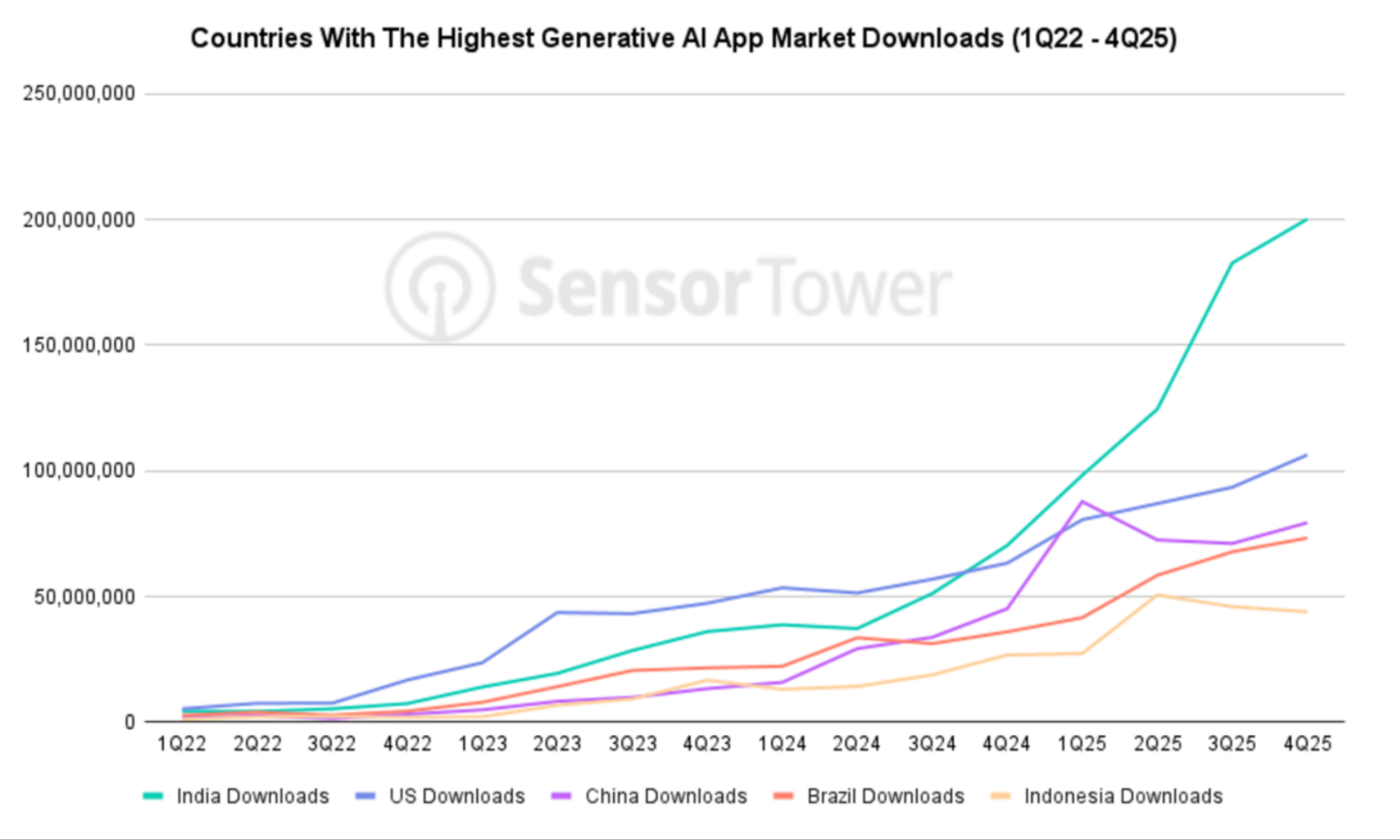
By 2025, India had become the largest market for generative AI app downloads, according to Sensor Tower, surpassing the U.S. with a 207% year-over-year increase in installs.
Firms like OpenAI, Google, and Perplexity offered extended free premium access to boost growth in the value-sensitive market. Leading AI firms also support India’s goal to become a global AI hub. A major AI summit in New Delhi recently hosted leaders like OpenAI’s Sam Altman and Alphabet CEO Sundar Pichai, signifying India’s growing influence in the global AI race.
Some early promotional efforts are ending. Perplexity discontinued its bundled Pro offer with Airtel, and OpenAI’s free ChatGPT Go in India is no longer offered, paving the way for evaluating how many users will become paying subscribers.
Despite strong download figures, India contributes a small portion of AI app revenue, representing about 1% of in-app purchases while accounting for 20% of global GenAI app downloads, highlighting monetization challenges in the rapidly growing market.
India’s GenAI app uptake accelerated through 2025, peaking in September and October with growth rates of about 320% and 260%, respectively, per the data. However, this usage boost didn’t fully translate into revenue. AI app in-app purchase revenue declined by 22% and 18% month over month in November and December 2025. ChatGPT’s revenue fell even further by 33% and 32% following its free sub-$5 ChatGPT Go launch, highlighting the short-term effects of aggressive promotions.
ChatGPT still leads with over 60% of GenAI in-app revenue in India, meaning changes in its pricing will greatly impact the overall market.
Sensor Tower attributed the GenAI app surge in India last year to new product launches, like DeepSeek, Grok, and Meta AI, and upgrades to major chatbots like ChatGPT and Perplexity. Interest in AI-generated content boosted adoption, with content creation tools among the most downloaded GenAI apps in 2025.
India represented about 19% of the global user base for leading AI assistant apps in 2025, surpassing the U.S. at 10%, according to Sensor Tower. ChatGPT remains the leader in India by monthly active users, with competitors like Google’s Gemini and Perplexity growing rapidly after promotional offers. ChatGPT was the most downloaded GenAI app in India and globally in 2025. OpenAI’s CEO recently stated that ChatGPT has over 100 million weekly active users in India.
The promotional efforts in India illustrate AI firms’ broader strategy to reduce pricing obstacles in a highly value-conscious market, hoping early adoption will lead to stronger retention after free access ends, said Sneha Pandey, insights analyst at Sensor Tower.
India’s appeal is its vast digital user base, with over a billion internet users and 700 million smartphone owners, making it a prime market for AI services globally.
Yet, Indian user engagement trails mature markets. In 2025, U.S. users of leading AI apps spent 21% more time weekly and had 17% more sessions on average than Indian users, per Sensor Tower.
“AI in-app revenues are expected to improve gradually as users integrate more with these platforms, emphasizing the importance of sustained engagement,” Pandey told TechCrunch.
She noted that pricing pressure in India is likely to stay high due to the youthful, value-focused user base, highlighting the need for lower-cost options, telecom bundles, and micro-transaction models for long-term retention.
ChatGPT led the Indian market entering 2026, with 180 million monthly active users in January, followed by Google’s Gemini with 118 million, Perplexity with 19 million, and Meta AI with 12 million, underscoring both India’s AI opportunity and the challenge of converting rapid adoption into lasting revenue.
Google, OpenAI, and Perplexity did not provide comments.