
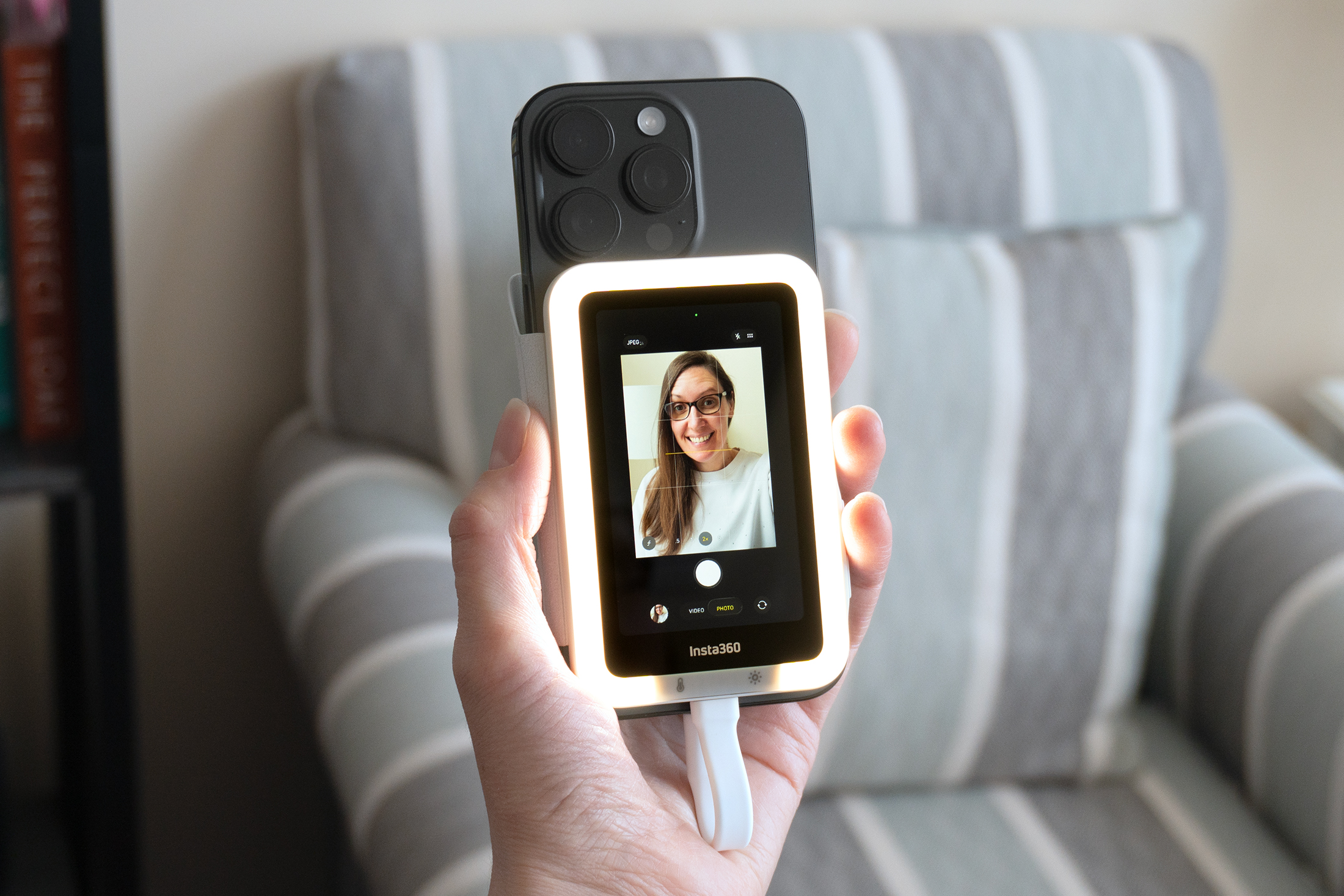

The Insta360 Snap attaches to the back of your phone and includes an adjustable ring light for enhancing selfies.
Insta360 has introduced the Snap, a new smartphone accessory designed to enhance selfie quality. It functions like a digital mirror that attaches magnetically to the back of your Android or iOS smartphone, allowing you to preview and frame shots using its more advanced rear cameras. Touchscreen functionality enables control of camera apps without constantly flipping your phone. After testing the Snap with my iPhone 16 Pro for a week, I found it an effective way to leverage my phone’s rear cameras for selfies, albeit with some minor annoyances.
Available today through the company’s online store, the Insta360 Snap Selfie Screen comes in two versions: a $79.99 standard model and an $89.99 version featuring an integrated ring light around the screen. The Snap connects to compatible phones with video output over USB-C via a short integrated cable, avoiding the potential complexity and lag of wireless Bluetooth or Wi-Fi connections. Its 3.5-inch touchscreen powers on and connects automatically when plugged into my iPhone.
iPhone users need to enable the screen’s touchscreen functionality by accessing iOS’s accessibility settings and activating the zoom feature. For Android phones, once screen mirroring or casting is approved, touchscreen functionality works automatically. The Snap doesn’t have its own battery, instead drawing power from your phone, with continuous use potentially resulting in a 15 to 20 percent battery drain. However, the ease of connection and not worrying about a dead battery outweighs the additional phone battery drain.
Insta360’s Snap may be a better choice than screen-equipped smartphone cases like Dockcase’s Selfix, not only due to its wider compatibility but also because it allows interaction with your entire phone screen. The Snap screen’s aspect ratio isn’t as tall as modern phones, offering the choice between viewing the entire phone screen with black sidebars or a zoomed mode filling the Snap’s screen. Though making small text and buttons challenging to read, the full-screen approach is more user-friendly. The zoom option enlarges the camera app preview but cuts off the top and bottom of the phone’s screen, sometimes making buttons inaccessible.
Switching between zoom modes is easy with one of the two side buttons on the Snap, while the other, a mirror button, reverses the screen — useful for correcting an upside-down preview when taking horizontal selfies. Despite occasional confusion when flipping the preview, photos remain unaffected.
The $10 premium for the version with a built-in ring light is worthwhile, adding only 6mm thickness but providing five brightness levels and three color temperature settings — neutral, cool, and warm — adjustable with buttons below the screen. Helpful in poor lighting, the ring light also offers more illumination than most phones’ back LED lights.
The main challenge is holding your phone backward without touching its screen. The Snap’s flexible cover can fold back to protect your phone’s screen, minimizing accidental interaction, but isn’t large enough to cover the entire screen, inadvertently triggering swipes or button presses. Disabling the phone screen while using the Snap could solve this but isn’t possible.
The Insta360 Snap Selfie Screen isn’t perfect for rear camera selfies, but it’s among the best available, considering iOS and Android screen mirroring limitations. It’s compatible with any phone supporting video output over USB-C and provides full touchscreen access, enabling selfies and videos with any camera app, even Instagram. Though not as slim as a smartphone case with a screen, being able to adjust settings, edit photos, and switch apps without flipping the phone makes it a worthwhile upgrade.
Photography by Andrew Liszewski / The Verge.