

Detach swiftly from a chaotic world.
My Starlink Mini has significantly transformed my lifestyle. It’s the primary reason I’m able to work remotely from my customized van, ensuring a fast and dependable internet connection in locations beyond the reach of typical 4G and 5G networks. Peakdo’s newest LinkPower battery enhances the smallest Starlink terminal by liberating it from power cables for extended periods.
Though it may not initially seem significant, it truly is. I can park in shaded areas and position the Mini at a distance to avoid obstructions, as long as it’s within Wi-Fi range. It even functions on my dashboard without tangled cables, offering reliable data while navigating secluded mountain routes, with my wife working from the passenger seat.
Recently, I’ve been testing PeakDo’s second-generation LinkPower 2 battery during my travels around the Pyrenees along the French-Spanish border. Priced at $219 — an increase from last year’s $119 model — it’s frustrating, yet many Starlink Mini users may consider the cost worthwhile.
The Verge Score: 8
Pros:
– Provides over 5 hours of wireless Starlink Mini Internet.
– Charges while powering Starlink for continuous use.
– Includes a new magnetic breakaway charging dongle.
– Simplifies Starlink placement without lengthy cables.
Cons:
– Pricey for a 99Wh power bank.
– Poor web app experience.
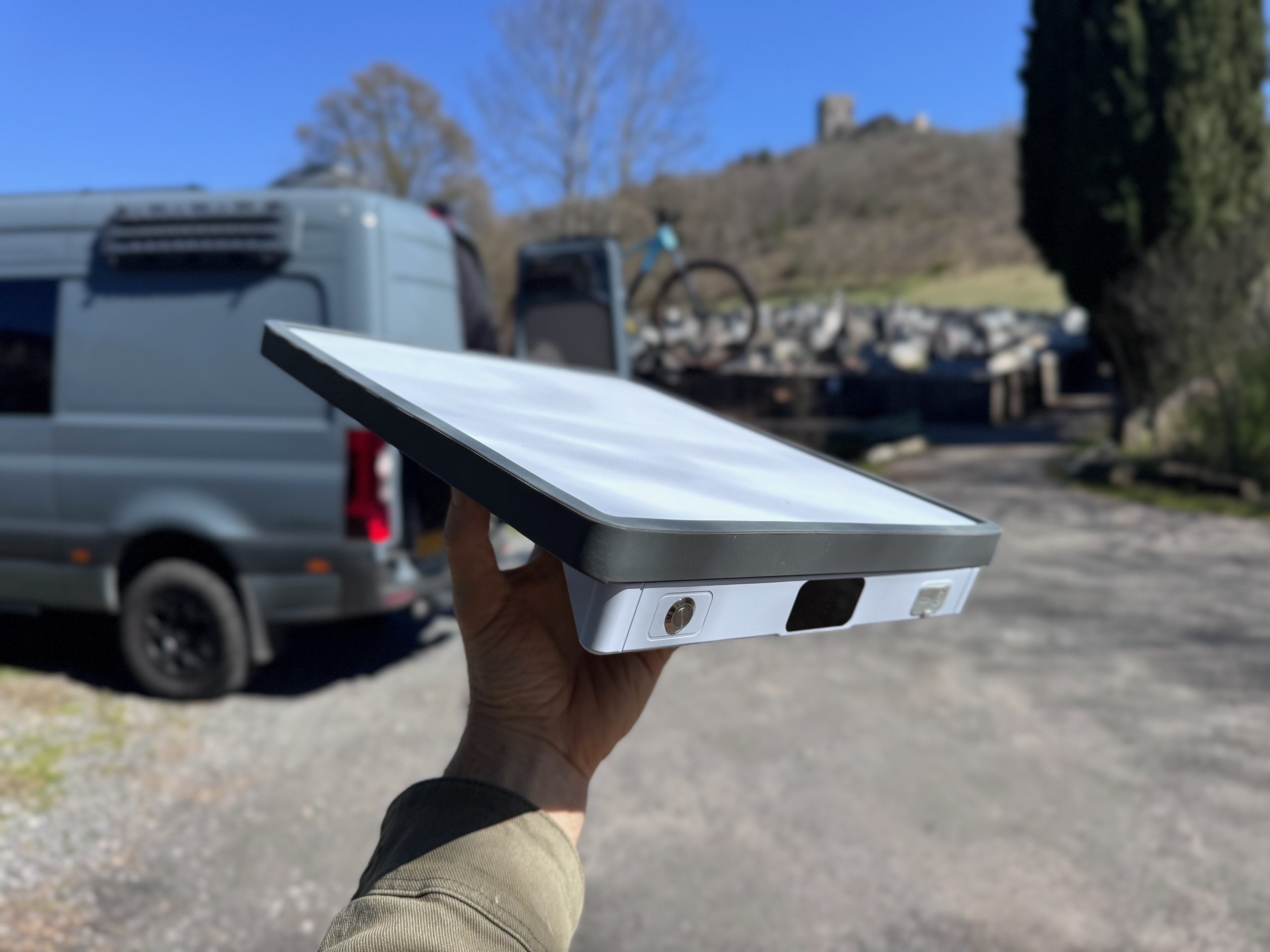
The LinkPower 2 battery attaches to the Starlink Mini like a regular SpaceX mount. Although the connection is sturdy, using additional support on a moving vehicle’s roof is advisable. For such use, PeakDo offers a compatible suction mount.
To ensure true wireless capabilities, a short DC-to-DC barrel cable connects the 99Wh battery to the Starlink Mini. The unit is sized similarly to the original and offers remote Bluetooth control through a web app, though iPhone users must download a specific app.
Besides USB-C, LinkPower 2 introduces a native DC barrel input aligning with Starlink Mini’s power port, enabling recharging with the included Starlink dish cable. The box also includes a new breakaway magnetic dongle, protecting the device from sudden drops if the cable is pulled.
A battery bypass mode powers Starlink Mini directly when LinkPower 2 is connected to a power source, reducing battery wear and controlling temperature with no need to disconnect the battery repeatedly.
Testing revealed a consistent runtime of about 5 hours and 30 minutes on a full charge, an hour longer than the initial model. Keeping the battery connected to the Starlink Mini allows for continuous power from various sources, such as USB ports in vehicles, older power banks, or solar panels.
On one sunny day, I extended the Starlink Mini’s operation beyond seven hours using a small solar panel attached to LinkPower 2’s USB-C input. While the Starlink Mini averages 18W in remote settings, the 28W production from my van’s USB-C ports easily offsets the load when placed on the dashboard.
Without LinkPower, you must use a suitable power bank delivering 100W (20V/5A) as per Starlink Mini’s requirements. Charging the LinkPower 2 via USB-C maxes at 65W, needing around 100 minutes to fully recharge. For faster charging, an expert mode enabling 100W is available, albeit at the potential cost of battery longevity. USB-C charging is quickest, trailed by the 57W over the DC barrel jack and 55W via the magnetic dongle. Additionally, the USB-C port serves as a traditional power bank for devices like phones or laptops at up to 65W.
PeakDo claims an IP65 rating for dust and water resistance, adequate for stationary showers but not when mounted on a vehicle in motion; the rating excludes the period when charging cables are connected.
So impressed by this battery, I’ve kept the LinkPower 2 attached to my Starlink Mini constantly, even when using external power sources. While the power bank adds 667g (1.47lb) to the 1.1kg (2.43lb) Starlink Mini, it remains manageable. I secured it with a magnet to prevent potential dislodgement while driving.
The original LinkPower was $119, making the increase to $219 for LinkPower 2 daunting, especially when comparable 99Wh power banks with 100W USB-C PD outputs cost significantly less. The previous LinkPower 1 remains available for $159. I’d endorse buying the cheaper version unless you specifically need features unique to LinkPower 2, like extended battery life, the breakaway dongle, or battery bypass capability.
Photography by Thomas Ricker / The Verge