
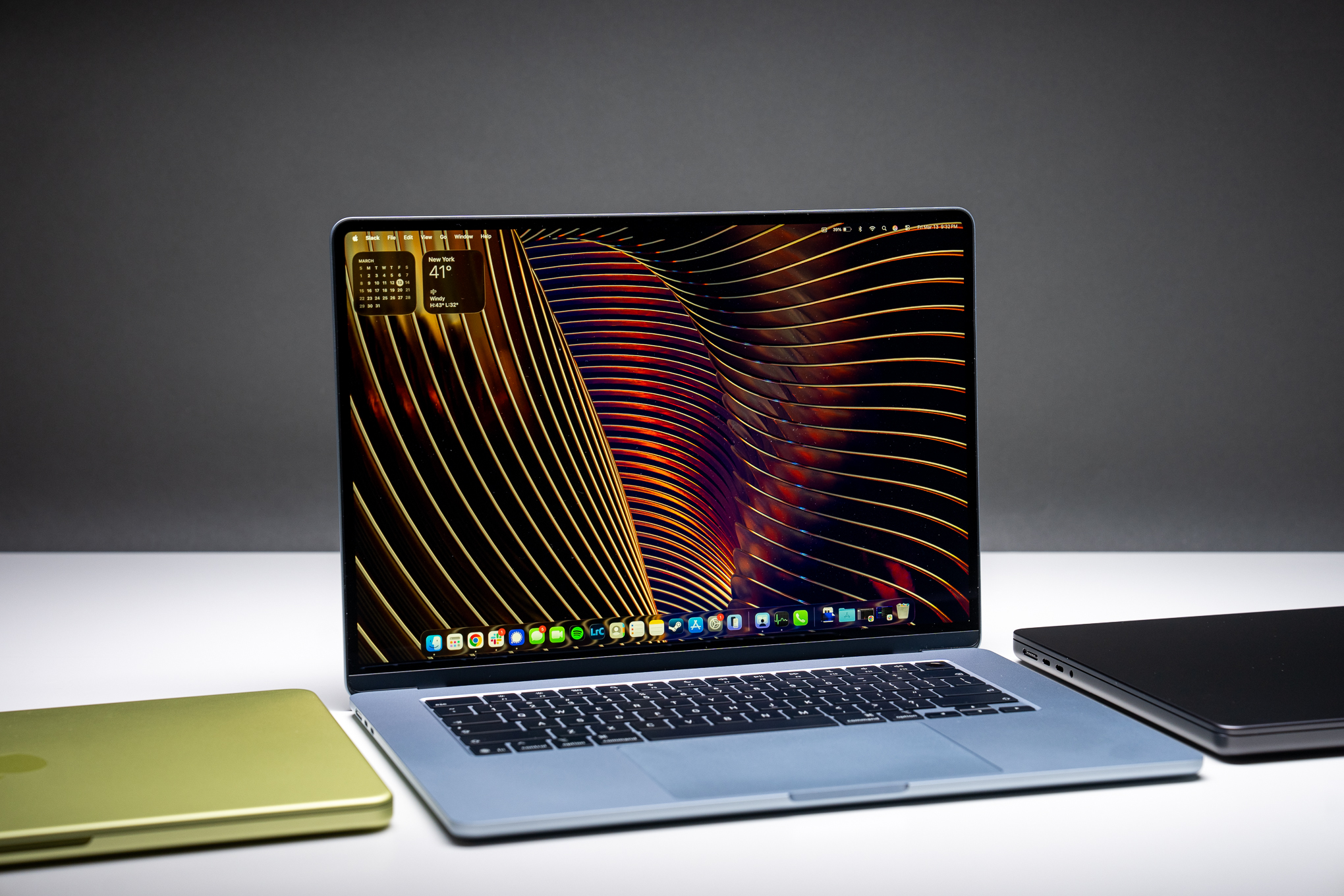

The Air cannot overlook the $600 option now available beneath it, but it remains the right choice for many buyers.
Not much has changed in the 2026 MacBook Air: it features the M5 chip, Wi-Fi 7, and faster storage starting at 512GB instead of 256GB. It’s as outstanding a computer as last year’s model, despite the $100 price increase.
A significant development is the arrival of the MacBook Neo, offering a capable option at $500 less than the base 13-inch Air. The Neo’s affordability does not render the Air obsolete or pointless and likely won’t significantly impact Air’s sales. The Air remains a faster, more capable, and sleeker machine—its position now as an upgrade from the Neo leaves room for the more robust MacBook Pros higher up.
The question arises if the Air is now an awkward middle child or the perfect middle ground, and I have reassuring news on that.
All observations from my review of the 13- and 15-inch M4 MacBook Airs hold true for the new M5 model. The screen remains bright and accurate for color-sensitive tasks, the keyboard is solid, and the 12-megapixel Center Stage camera continues to be the best built-in webcam available. The battery can easily last a full work or school day and beyond, with my testing achieving 13 to 14 hours from a full charge during daily tasks. The six-speaker setup on the 15-inch model continues to deliver impressive sound for such a thin laptop.
The main improvements in the new MacBook Air focus on speed, making an already well-performing laptop even faster. The M5 chip, with a 10-core CPU and GPU, is akin to the one in the 14-inch MacBook Pro, with the Air scoring slightly lower in benchmarks due to the Pro’s enhanced cooling. The M5 Air is marginally faster than last year’s M4 Air, particularly in GPU performance and some multicore tests.
One of the most significant enhancements for the M5 Air involves its storage speeds, with testing showing read and write speeds more than twice those of the M4 Air, aligning it with the M5 MacBook Pro’s performance and nearing that of the high-end M4 Max I examined in 2024. While performing heavy tasks simultaneously (like managing large photo imports, video exports, and numerous open tabs), the Air handled maxed RAM and heavy swap memory use without crashing, though if such heavy tasks are common, a MacBook Pro would be advisable.
For current M4 MacBook Air owners, there’s minimal incentive to upgrade unless facing performance issues with older M1 or M2 models. The new M5 Air’s advancements in processor, storage, and connectivity offer increased future-proofing, but the Neo’s price point makes it an attractive option for entry-level users. For creative work, spending extra on the Air is worthwhile, while more demanding users will find value in higher-tier MacBook Pro models.
Apple’s upgrade system offers options to suit every need, with each step providing more features such as a larger display, greater storage, more RAM, and superior processing power. The MacBook Air, once the default choice at around $1,000, now competes with the $600 Neo for lighter users, with the Pro range catering to professional and tech-savvy users.
The MacBook Air currently serves as an optimal mid-range choice. It’s exceptionally thin and portable, provides excellent general performance, and offers useful features like Thunderbolt 4 ports, MagSafe charging, a large trackpad, and a backlit keyboard. For these reasons, I recently recommended a 13-inch M4 Air to a friend instead of the Neo, acknowledging his need for performance and longevity.
With the Neo now available, the MacBook Air stands as a versatile, top-quality laptop, well-suited to ensure years of reliable use. Despite sitting between the Neo and Pro models, it remains an ideal “just right” choice for many users.