

MimiClaw is an AI assistant inspired by OpenClaw, built for ESP32-S3 boards, and serves as a bridge between the Telegram messaging app and Claude online LLM to manage hardware via chat.
We recently covered PicoClaw, a minimal AI Assistant for affordable Linux boards requiring only 10MB of RAM. Influenced by Nanobot, a compact assistant in Python, its codebase is significantly smaller than OpenClaw’s original project. Due to most processing being handled by messaging apps and LLMs, it was inevitable that this solution would be adapted for microcontrollers.
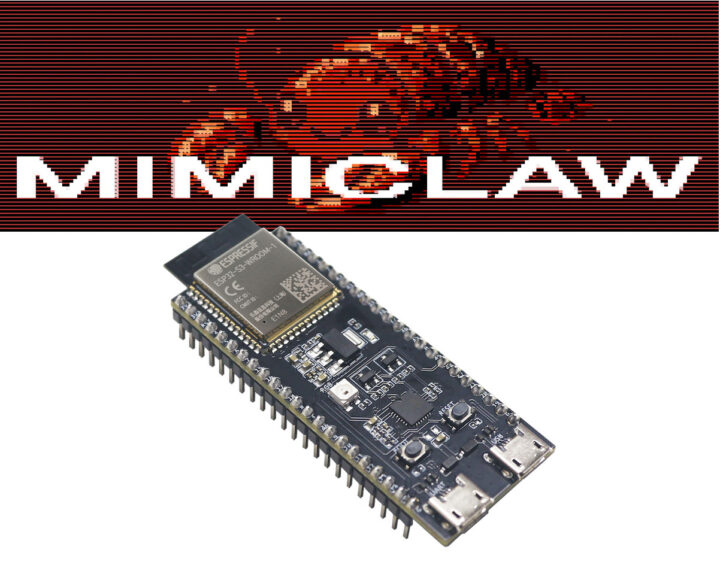
MimiClaw highlights:
- Written in C; utilizes the ESP-IDF 5.5 framework
- System requirements – ESP32-S3 board with 16 MB flash and 8 MB PSRAM, like the LILYGO T7-S3, FireBeetle 2 ESP32-S3, ESP32-S3-DevKitC-1-N16R8, Seeed Studio’s XIAO ESP32S3 Plus, among others.
- Integrates with Telegram and Claude, requiring a @BotFather bot token and Anthropic API key
- Stores data across reboots
- Consumes low power – 0.5 Watt
A diagram below illustrates how it works. Users send a message on Telegram, which the ESP32-S3 picks up over WiFi and processes through an agent loop connected to Claude. It handles high-level requests like appointment reminders and hardware control (GPIO, sensors, actuators), such as reading temperatures or toggling switches for lights and fans, all within the Telegram app.
