

I published [The Software Engineer’s Guidebook](https://www.engguidebook.com/?ref=blog.pragmaticengineer.com) two years ago. I shared more details on how I self-published the book, and the learnings from publishing [in this post.](https://newsletter.pragmaticengineer.com/p/the-software-engineers-guidebook?ref=blog.pragmaticengineer.com)
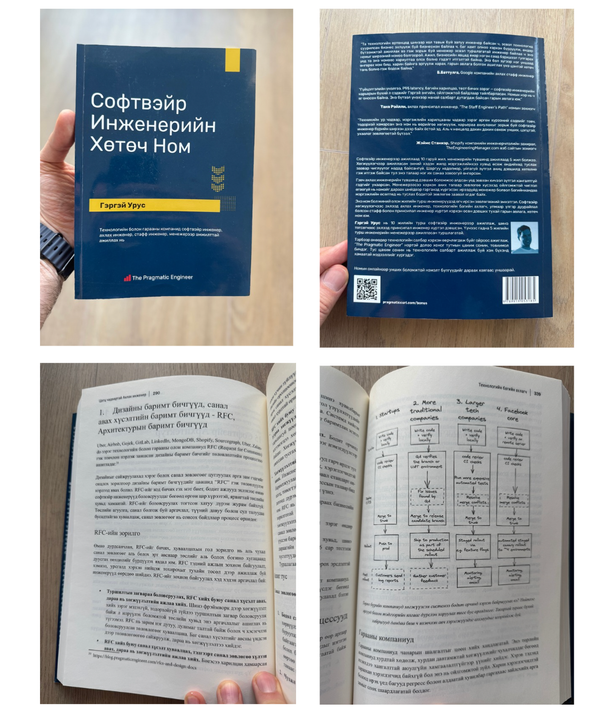
An unexpected highlight of publishing the book was ending up in Mongolia in June of this year, at a small-but-mighty startup called [Nasha Tech](https://nashatech.com/?ref=blog.pragmaticengineer.com). This was because the startup translated my book into Mongolian. Here’s the completed book:

Here’s what happened:
A little over a year ago, a small startup from Mongolia reached out, asking if they could translate the book. I was skeptical it would happen because the unit economics appeared pretty unfavorable. Mongolia’s population is 3.5 million; much smaller than other countries where professional publishers had offered to do a translation (Taiwan: 23M, South Korea: 51M, Germany: 84M, Japan: 122M, China: 1.43B people).
But I agreed to the initiative, and expected to hear nothing back. To my surprise, nine months later the translation was ready, and the startup printed 500 copies on the first run. They invited me to a book signing in the capital city of Ulaanbaatar, and soon I was on my way to meet the team, and to understand why a small tech company translated my book!
### Japanese startup vibes in Mongolia
The startup behind the translation is called [Nasha Tech](https://nashatech.com/?ref=blog.pragmaticengineer.com); a mix of a startup and a digital agency. Founded in 2018, its main business has been agency work, mainly for companies in Japan. They are a group of 30 people, mostly software engineers.

Their offices resembled a mansion more than a typical workplace, and everyone takes their shoes off when arriving at work and switches to “office slippers”. I encountered the same vibe later [at Cursor’s headquarters in San Francisco](https://newsletter.pragmaticengineer.com/i/177384640/cursor-push-for-release?ref=blog.pragmaticengineer.com), in the US.
Nasha Tech found a niche of working for Japanese companies thanks to one of its cofounders studying in Japan, and building up connections while there. Interestingly, another cofounder later moved to Silicon Valley, and advises the company from afar.
**The business builds the “Uber Eats of Mongolia”.** Outside of working as an agency, Nasha Tech builds its own products. The most notable is called TokTok, the “UberEats of Mongolia”, which is the leading food delivery app in the capital city. The only difference between TokTok and other food delivery apps is scale: the local market is smaller than in some other cities. At a few thousand orders per day, it might not be worthwhile for an international player like Uber or Deliveroo to enter the market.

The tech stack Nasha Tech typically uses:
– Frontend: React / Next, Vue / Nuxt, TypeScript, Electron, Tailwind, Element UI
– Backend and API: NodeJS (Express, Hono, Deno, NestJS), Python (FastAPI, Flask), Ruby on Rails, PHP (Laravel), GraphQL, Socket, Recoil
– Mobile: Flutter, React Native, Fastlane
– Infra: AWS, GCP, Docker, Kubernetes, Terraform
– AI & ML: GCP Vertex, AWS Bedrock, Elasticsearch, LangChain, Langfuse
AI tools are very much widespread, and today the team uses Cursor, GitHub Copilot, Claude Code, OpenAI Codex, and Junie by Jetbrains.
**I detected very few differences between Nasha Tech and other “typical” startups I’ve visited, in terms of the vibe and tech stack.** Devs working on TokTok were very passionate about how to improve the app and reduce the tech debt accumulated by prioritizing the launch. A difference for me was the