
The DART mission by NASA has revealed significant findings. The spacecraft intentionally collided with an asteroid, successfully altering the trajectory of not just a single asteroid but affecting the entire asteroid system it was a part of. This discovery solidifies NASA’s methods of planetary defense, confirming the capability to redirect a potential threat to Earth. The DART mission’s primary goal was to speed up the orbit of Dimorphos around Didymos by 33 minutes, a success quickly announced by astronomers. The study revealed the system experienced a small yet pivotal change in its solar orbit speed, marking a critical step in asteroid deflection strategies. The impact resulted in some debris from the smaller asteroid, Dimorphos, escaping and contributing additional momentum to the duo, effectively doubling the influence initiated by the DART spacecraft. This momentum enhancement factor was pivotal in amplifying the mission’s outcomes. Observations indicated that Didymos is denser in comparison to its lighter, less compact partner, Dimorphos, suggesting Dimorphos may be a fragment of Didymos. Despite the massive size difference, this research demonstrated that the system’s motion was slightly altered by the impact. As a follow-up, the European Space Agency’s Hera mission is set to inspect the aftermath of the collision to gain deeper insights. This experiment proves that with advanced technology, humanity can alter natural space objects. While the asteroid duo remains no threat, these findings enrich future planetary defense plans, especially if redirected threats toward Earth become necessary.
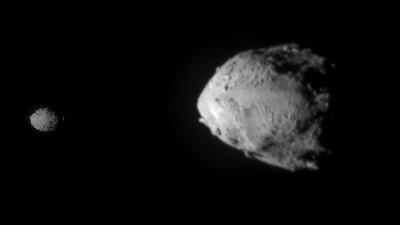
NASA Shows Humanity Can Potentially Stop Earth-Bound Asteroid

2 Min Read