Blog Posts

Blog Posts

$15 STM32U575 Board Offers FPC Display Connector, microSD Slot, Dual 48-pin GPIO Headers – CNX Software

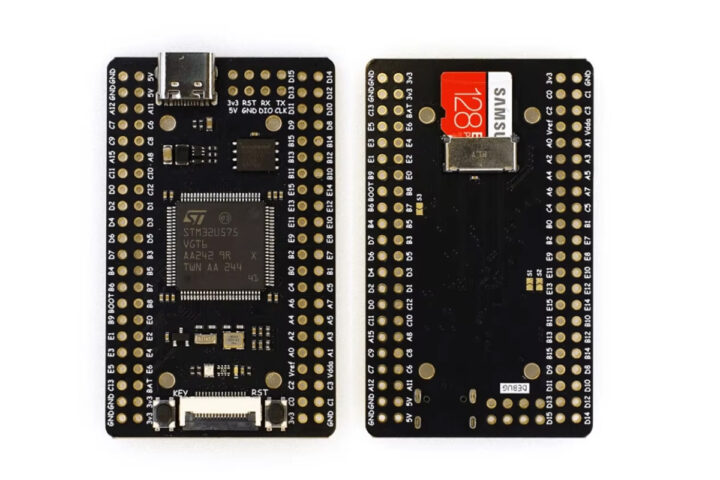
STM32U575VGT6 development board

A few days ago, we looked at the WeAct Studio STM32U585CIU6 development board, which features an ultra-low-power STM32U5 Cortex-M33 MCU and was added to MicroPython v1.28. If you’re looking for another STM32U5-based option, especially for compact UI projects, Maker Go now offers an STM32U575 board with a display connector, a microSD card slot, and many more GPIOs While the STM32U585 on the WeAct board features cryptographic accelerators, the STM32U575VGT6 MCU on the Maker Go board is closely related and still offers the same high-performance Cortex-M33 core running at 160 MHz, along with ultra-low-power capabilities. This new board also adds 8MB of external flash and is designed to accept 1.47-inch or 2.0-inch LCDs directly via a ribbon cable. STM32U575VGT6 board specifications: Microcontroller – ST STM32U575VGT6 Core – Arm Cortex-M33 Armv8-M core clocked at up to 160 MHz with FPU, Arm TrustZone Memory – 786 KB SRAM Flash – 1024 KB (1 […]

The post $15 STM32U575 development board features FPC display connector, microSD card slot, two 48-pin GPIO headers appeared first on CNX Software – Embedded Systems News.

DeepMind’s RAG System Featuring Animesh Chatterji and Ivan Solovyev – Software Engineering Daily

Retrieval-augmented generation, or RAG, has become a foundational approach to building production AI systems. However, deploying RAG in practice can be complex and costly. Developers typically have to manage vector databases, chunking strategies, embedding models, and indexing infrastructure. Designing effective RAG systems is also a moving target, as techniques and best practices evolve in step

The post DeepMind’s RAG System with Animesh Chatterji and Ivan Solovyev appeared first on Software Engineering Daily.

Is the ‘Holy Grail of batteries’ finally ready to bless us with its presence?

Earlier this year, a relatively unknown startup from Finland made a startling announcement: It had finally solved solid-state batteries. Not only that, but Donut Lab, a spinoff of Verge Motorcycles, said that its solid-state battery – long considered the “Holy Grail of batteries” for their high-density, durable, fast-charging abilities – would go into production later […]

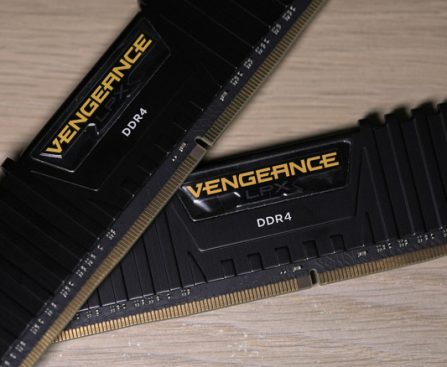
Assessing the Feasibility of Acquiring DDR4 RAM in 2026

persistent AI-associated chip deficit, prices for computer components such as RAM and graphics cards have surged dramatically, with DDR5 RAM projected to increase further, potentially reaching 63% as per TrendForce. If you’re considering assembling a new PC in the near future, you have a couple of alternatives. You could opt for slightly older components, which might be available at a lower cost, or you can invest significantly more than you would prefer in the latest parts. But do older components still hold value? And primarily, is DDR4 RAM still a worthwhile purchase? Here’s what you need to understand.

Initially, it’s crucial to highlight that DDR4 remains pricier than it ought to be, as all RAM prices have escalated due to heightened demand. For instance, a 32GB DDR4 RAM kit on Amazon was approximately $170 back in January 2026. However, owing to the rising demand spurred by AI advancements and data centers, the cost of that same RAM kit has soared to as high as $260 before stabilizing around $220.

In contrast, a 32GB DDR5 RAM kit has consistently been over $360 since January, with prices peaking at $439.99. Although the pricing seems to have stabilized somewhat, with a slight decrease in market rates, it remains uncertain whether the demand for DDR5 will diminish significantly enough to impact prices. Furthermore, this doesn’t even consider the escalating costs associated with SSDs.

DDR4’s absence of future-proofing

Amazon Luna Library to Encounter Heightened Limitations

Stop purchasing games on Amazon Luna — they’ll be unavailable after June 10.

Purported Performance Metrics Emerge for Samsung’s Imminent Exynos 2700 SoC

An initial listing provides some insights into what’s brewing.

An early purported performance listing for Samsung’s Exynos 2700 indicates it will feature a 10-core configuration, with its most powerful core reaching approximately 2.88GHz. The chip was also identified with the Xclipse 970 GPU, while additional speculations suggest it might achieve a 12% performance enhancement. A Samsung executive mentioned earlier this year that the company is dedicated to advancing future Exynos chips, which it intends to integrate into multiple Galaxy devices.

It’s customary to anticipate a new SoC for smartphones each year, and it appears Samsung is maintaining its momentum with the Exynos 2700’s development.

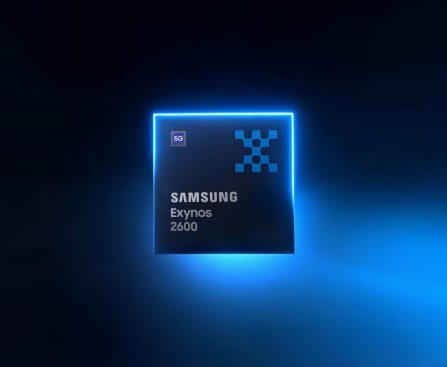
Earlier this week, GSMArena reported that Samsung’s upcoming chip, the 2nm Exynos 2700, seemingly made an appearance for its Geekbench performance assessment. The most intriguing aspect here is what the listing allegedly reveals: Samsung’s core architecture for this version. The outlet claims to have observed the chip featuring a 10-core CPU, akin to the Exynos 2600 that powers the Galaxy S26 series in South Korea.

Some of these clock frequencies raise some concerns for me. Based on my calculations, a few of these asserted speeds fall short compared to the 2600. The publication notes that this listing was derived from an “engineers” build, so perhaps these figures might not be entirely accurate. I certainly hope that is the case, too.

It has been noted that the Exynos 2700’s highest cores are clocked at approximately 2.88GHz. The article further mentions that its other cores, possibly focused on efficiency, operate at around 2.4GHz. The complementary component is the Xclipse 970 GPU, which may accompany the SoC upon its release. GSMArena reports there are rumors that the Exynos 2700 could build upon the 2600 by delivering a noteworthy 12% overall performance gain.

What’s been revealed at this moment is data from preliminary test results, so it’s prudent not to leap to any conclusions just yet. However, a couple of reports could aid in shaping our perception of the Exynos 2700.

Exynos for everyone

In early March, reports emerged after Samsung’s vice president of hardware for Samsung’s MX division, Moon Sung-hoon, began discussing the future of its Exynos chipset. Moon expressed that the company was initiating a “mid to long-term strategy” for developing new chips. More significantly, this would expand the Exynos chips into a broader range of Galaxy devices throughout Samsung’s ecosystem.

Samsung is committed to an Exynos-centric future. I believe the key factor will be its ability to compete effectively. The Galaxy S26 doesn’t utilize the Exynos 2600 in all markets. It’s absent in the U.S., where we have the Snapdragon 8 Elite Gen 5. Sure, it’s “For Galaxy,” which means it’s overclocked, but it’s still a Qualcomm chip. Samsung takes this approach because it understands market reactions. I wonder if we’ll reach a stage where it can compete and stand as robustly as Qualcomm.

Despite Moon indicating that developing chips is “challenging” and demands “several years” of effort, Samsung aims to pursue this endeavor for Exynos. Shortly thereafter, rumors about the Exynos 2700 surfaced following a South Korean publication’s report that it may address its heat generation. Allegedly, Samsung is advancing its HPB technology to minimize how hot the chip can become and enhance cooling efficiency. Exynos chips have grappled with high temperatures for years, so this is encouraging news, even if it remains speculative.

The Exynos 2600 launched late last year, showcasing a remarkable 39% improvement in CPU performance.

Instagram Unveils Option to Correct Mistakes in Comments

Correcting mistakes, one adjustment at a time.

Essential information

  • Instagram declares that it is launching an edit feature for comments on social media posts later this week.
  • Users will discover the button directly below their comment, allowing 15 minutes for any modifications before it becomes final.
  • Instagram introduced editable DMs two years ago, functioning similarly to the comment edits.

Instagram is entering the weekend with a feature that could help you avoid awkward moments in the replies.

Interestingly, Instagram revealed through a Threads post that it will be implementing an edit button for comments posted on the platform (as reported by The Verge). The thread further mentions that users can adjust their Instagram comments within 15 minutes of posting. The Verge contributes by sharing a screenshot of this functionality. After submitting your reply, users will notice an “Edit” option positioned beneath their comment.

This will bring up your keyboard, along with your previous text, featuring a distinct “editing comment” banner above the text area. All that’s left to do is click the check mark, and your amended comment will be posted without anyone being the wiser. The publication managed to speak with Nicole Rechtszaid, a representative from Meta, regarding the new edit button. Rechtszaid stated that modified comments will display an “Edited” label in gray alongside the content.

Article continues below