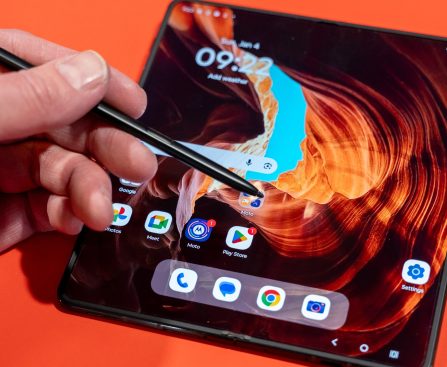
Xiaomi and Leica’s long-running phone partnership just got a little closer. Alongside the new international release of its 17 Ultra flagship, Xiaomi has been entrusted with manufacturing a separate version that is the first Leica Leitzphone to release outside of Japan, following three Sharp-made models exclusive to the country. In truth, the Leitzphone is a […]

Blog Posts
Blog Posts
Xiaomi’s Tracker Clips to Your Keys Without a Case
Xiaomi has announced its first Bluetooth tracker, and while the Xiaomi Tag has a more elongated design than the Apple AirTag, that lets you use it in more places right out of the box. On one end of the tracker you’ll find an integrated metal loop that can be attached to a keyring or clipped […]
Travel Velocity of a US Navy Supercarrier to the Middle East
the U.S. Navy is developing a new supercarrier that is set to join the fleet in 2027. Should the United States dispatch another Navy supercarrier to the Middle East, one might wonder how long the journey would take.
The contemporary supercarriers of the U.S. Navy are nuclear-powered giants that can weigh upwards of 100,000 tons. The USS Gerald R. Ford stands as the largest warship in the world and exemplifies the capabilities of a supercarrier. A Ford-class aircraft carrier can achieve a maximum “flanking speed” of around 30 knots (about 35 miles per hour). Ships departing from Naval Station Norfolk in Virginia must cover more than 5,900 miles to arrive at the Suez Canal. The canal measures 120 miles in length, and vessels then need to traverse the 1,200-mile Red Sea and the 920-mile Gulf of Aden to access the Arabian Sea, where the U.S. military is active in the Middle East.
This implies that a Navy supercarrier traveling at 35 mph could reach the Middle East from the United States in under 10 days without any hindrances. A nuclear-powered supercarrier could complete the 8,140-mile trip to the Arabian Sea without stopping or concerns regarding fuel. It may take decades before these carriers need to consider refueling, even though refueling a supercarrier can be a lengthy process when necessary.
What allows a Navy supercarrier to reach the Middle East so swiftly?
Devices to Steer Clear of Connecting to Your Router’s USB Port
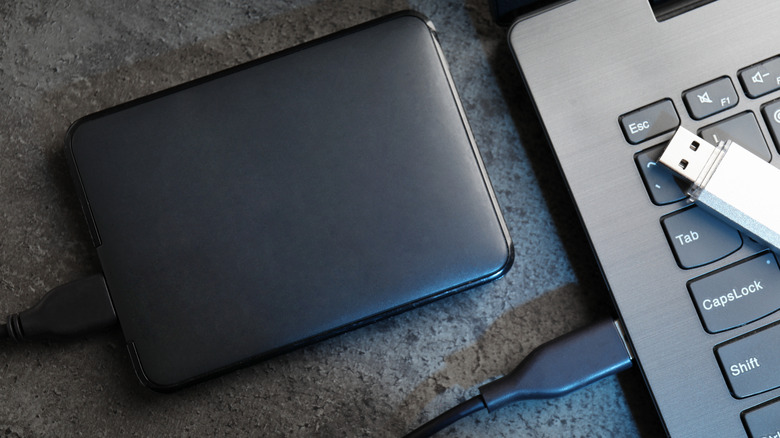
anager-hard-drives-and-solid-state-drives-1771958492.jpg” alt=”Flash drives, hard drives, and solid state drives”>
An unoccupied USB port on your router can seem like an underutilized chance — an option that could have been harnessed to connect storage devices, smartphones, or other USB peripherals. After all, it appears identical to the USB-A ports found on your laptop or desktop. Since you may connect any device to a laptop without a second thought, why not extend that to the router? There are several reasons against it, and these significantly affect the security and performance of your overall home network.
USB ports on your router lack the same security as those on computers, primarily because your router typically does not receive updates as frequently or thoroughly. They also aren’t designed to supply power, particularly for devices demanding high wattage. Furthermore, your router has limitations in handling multiple tasks simultaneously due to its relatively modest CPU power. When it hits its capacity, you risk experiencing sluggish Internet speeds, intermittent disconnections, instability, or at worst, potential damage to the internal components from overheating.