
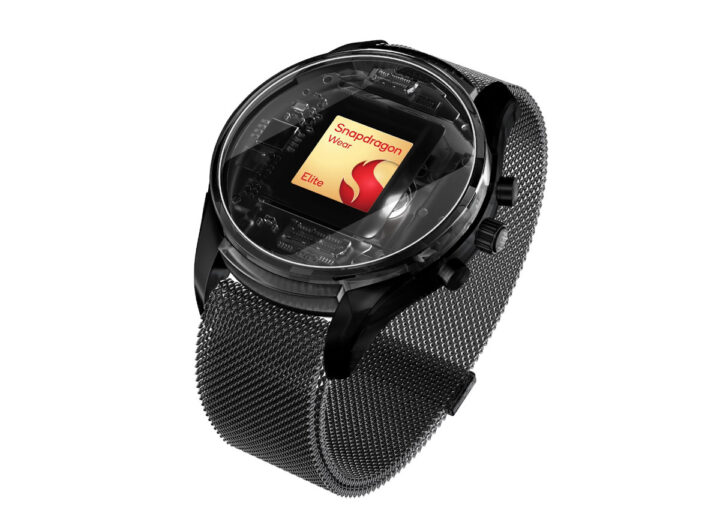

Qualcomm Snapdragon Wear Elite is touted as the “world’s first Personal AI wearable platform,” featuring an NPU for on-device AI, delivering up to 12 TOPS of performance at low power and supporting 2 billion parameter models.
It provides up to 5x single-core CPU improvement and up to 7x faster GPU compared to the previous-generation Snapdragon W5+ Gen 2 Wearable Platform, while offering up to 30% more battery life for multi-day use, thanks to a 3nm architecture. The new Snapdragon Wear Elite platform also supports fast charging, achieving up to 50% charge in under 10 minutes.
Snapdragon Wear Elite specifications:
– CPU: Up to 2.1 GHz
– GPU: Qualcomm Adreno 3D GPU supporting OpenGL ES 3.2, Vulkan 1.2, OpenCL 2.0 APIs; 2.5D GPU co-processor up to 500 MHz
– ISP: Qualcomm Spectra
– AI accelerator: Qualcomm Hexagon NPU; up to 12 TOPS of AI performance; supports up to 2 billion parameter models
– Memory: 16-bit LPDDR5 @ 6400 MHz
– Storage: 32GB eMMC flash
– Camera: 2x CSI 4-lane DPHY/CPHY; Multi-frame Noise Reduction (MFNR), Motion Compensated Temporal Filter (MCTF), Electronic Image Stabilization (EIS)
– Wireless: Qualcomm RF Front-End (RFFE) solution, 5G RedCap, 4G LTE (TDD/FDD), NB-NTN, Tri-band WiFi 6 1×1 MIMO, Bluetooth 5.3, Bluetooth 6.0, UWB, NFC via third parties
– GNSS: Beidou, Galileo, GLONASS, GPS, QZSS, NavIC; dual-band (L1/L5)
– USB: USB 2.0
– PCIe: PCIe 3.0
– Other interfaces: QUP5, SDIO
– Security: Qualcomm Processor Security, Qualcomm Trusted Execution Environment (TEE)
The Qualcomm Snapdragon Wear Elite SoC/Platform supports operating systems like Android, FreeRTOS, Wear OS, and Linux. Its embedded agentic intelligence allows for personalized interactions and assistance based on user preferences and behaviors, ensuring data stays on-device without needing cloud connectivity. The chip is compatible with over 50 sensors for advanced health and fitness tracking, from heart rate monitoring to sleep analysis.
The first commercial devices powered by Snapdragon Wear Elite are anticipated within the next few months, with the next-generation Galaxy Watch among the first to use the new SoC. More details can be found on the product page and in the press release.