

Salesforce went all out to assure investors that the AI evolution won’t be its downfall as it announced fourth-quarter earnings on Wednesday.
Salesforce disclosed a strong quarter with $10.7 billion in revenue, a 13% increase year-over-year. It reported annual revenue of $41.5 billion, a 10% rise from the previous year, spurred by its $8 billion purchase of data management firm Informatica last May.
Net income reached $7.46 billion, with the company offering robust guidance for the coming year, forecasting revenue between $45.8 billion and $46.2 billion, reflecting a 10% to 11% growth. It also mentioned that its “remaining performance obligation” surpasses $72 billion, indicating revenue under contract not yet delivered or recognized.
However, despite the figures, software-as-a-service stocks like Salesforce have faced challenges due to concerns that AI agents will make their per-employee-seat business models outdated. This concern has been dubbed “Saaspocalypse.”
The issue was so prevalent during the earnings call that CEO Marc Benioff mentioned the term multiple times.
“You’ve heard about the SaaSpocalypse? And it isn’t our first. We’ve had a few of them,” he said, adding, “If there is a SaaSpocalypse, it may be eaten by the Sasquatch because there are a lot of companies using a lot of SaaS because it just got better with agents.”
In a bid to demonstrate its vitality, Salesforce included numerous strategies in this earnings report. The company raised its dividend by nearly 6% to $0.44 per share and launched a $50 billion share buyback program, popular among shareholders for creating a stable buyer of shares and reducing shares in circulation, which can elevate the stock price.
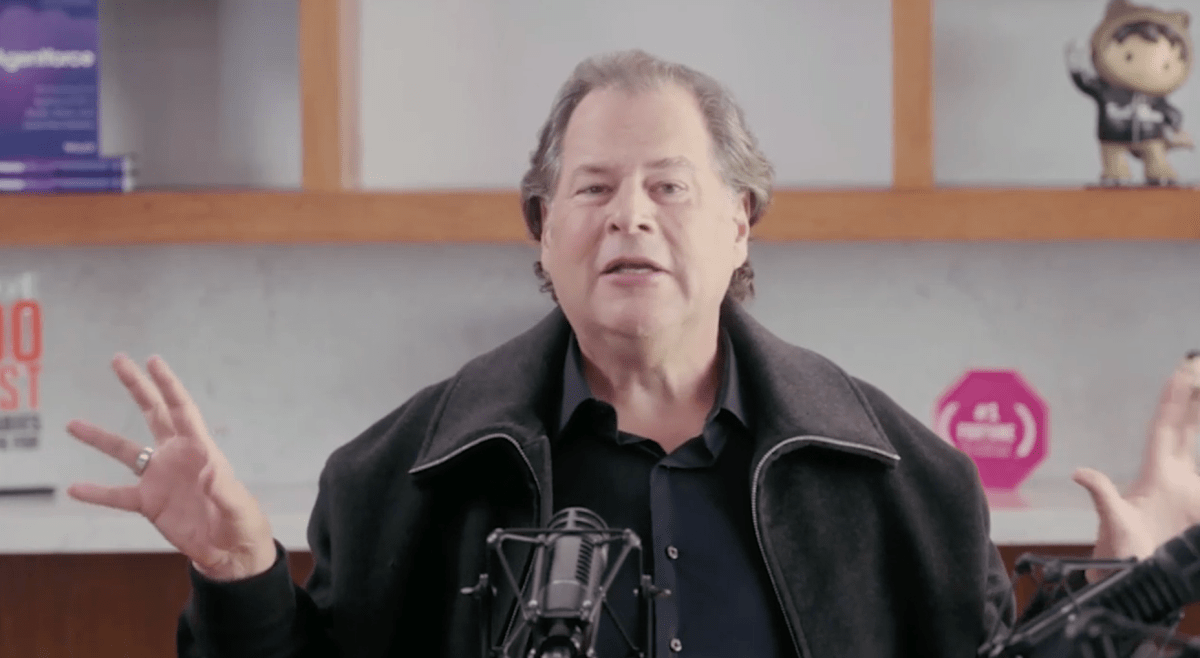
The company also transformed the earnings call format. It included elements of a podcast, an infomercial, and the usual Q&A session with questions from Wall Street analysts.
Instead of merely discussing numbers, Benioff interviewed three Salesforce customers on-camera to share their enthusiasm for its new agentic features: the CEOs of SharkNinja, Wyndham Hotels and Resorts, and SaaStr, a software conference and media company. To summarize the interviews briefly: they all praised Salesforce’s AI agent offerings.
Salesforce unveiled a new metric for its agentic products, known as Agentic Work Units (AWU), designed not just to count “tokens” (the standard AI processing volume unit) but to assess whether an agent accomplished a specific task, such as writing to a record, rather than merely generating text. (Salesforce registered 19 trillion tokens last quarter, a figure that seems high but is not particularly notable in the AI sector.)
“You can ask it a question and it can write you a poem, but that’s not really all that valuable in the enterprise world,” Salesforce President and CMO Patrick Stokes noted during the call. AWU aims to measure when the agent writes to a record or completes another verifiable task.
Additionally, Salesforce presented its own architectural vision for the prospective world of agents. It illustrated SaaS software like itself as taking ownership of most of the tech stack, with AI model creators relegated to underlying, interchangeable, and commoditized work engines.
This countered earlier concerns of a SaaSpocalypse sell-off after OpenAI launched its enterprise agent platform, Frontier. OpenAI’s vision depicted OpenAI as owning much of the stack, leaving systems-of-record SaaS providers, where companies store core data, as the unseen engines.
For a final impression on investors, Benioff adorned a black leather jacket, mimicking the distinctive style of Nvidia’s Jensen Huang, a leading figure in the AI sector.