
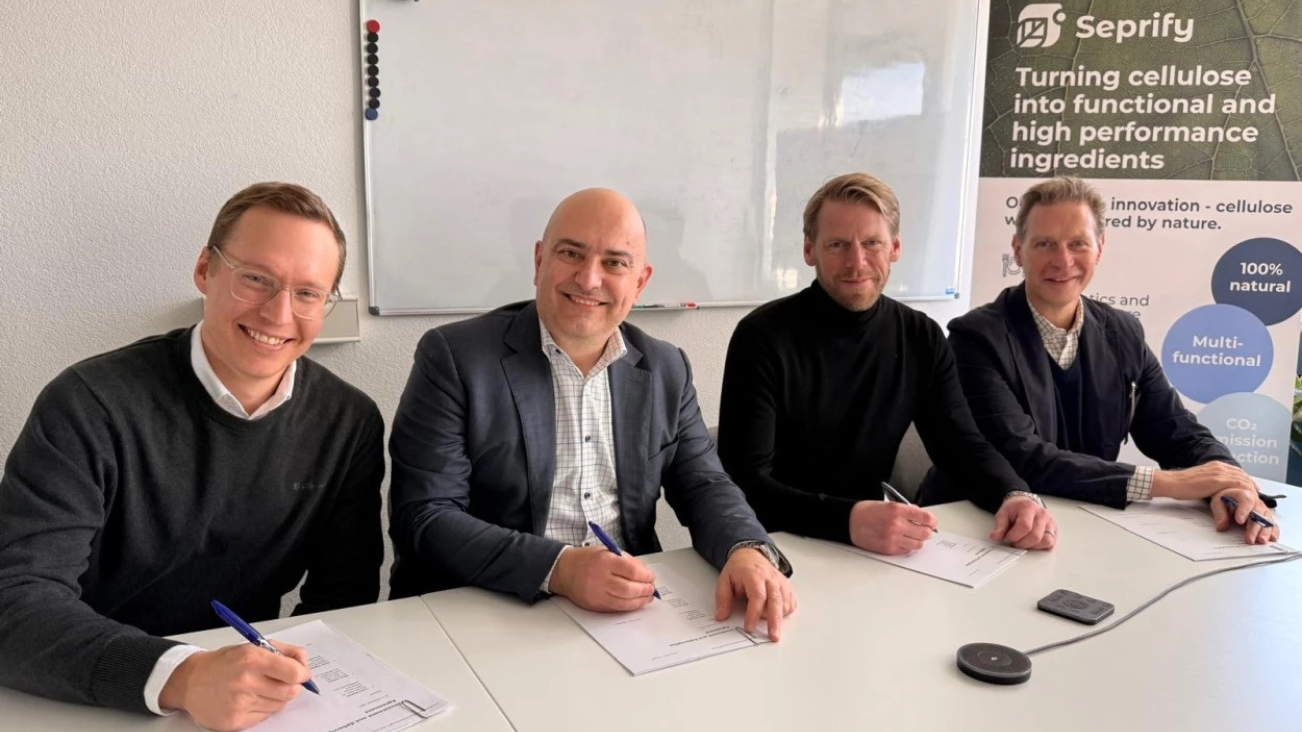

Swiss startup Seprify has secured €13.4 million to advance a cellulose-based alternative to a widely used and increasingly banned industrial whitener. IKEA supports it.
In Southeast Asia, a beetle named Cyphochilus exhibits the whitest surface in nature, achieved through the microscopic structure of its scales scattering light efficiently. For Lukas Schertel, then a postdoctoral researcher at the University of Cambridge’s Bioinspired Photonics Lab, it served as an engineering blueprint.
Schertel and his co-founder Oliver Polcher began with a simple question: if a beetle can achieve optical whiteness through cellulose microstructure alone, why do food and cosmetics industries still rely on titanium dioxide?
Previously, there was no viable alternative. Seprify, formerly Impossible Materials and established in 2022 as a spinout from Cambridge and the University of Fribourg, aims to change that.
On Tuesday, the company announced a €13.4 million Series A to expedite the shift from pilot validation to industrial production. Inter IKEA Group is a strategic backer in this round, alongside Una Terra Early Growth Fund, Zürcher Kantonalbank, Cambridge Enterprise Ventures, and Kickfund, among other circular-economy investors. The total funding now tops €22 million, according to the company.
Titanium dioxide, known as TiO₂ or E171, represents a $16 billion global market. It’s used to whiten and opacify food and confectionery, enhance the SPF of sunscreens, and brighten paints and coatings. For years, it was deemed inert and unremarkable.
However, Europe’s food safety authority revised that view, indicating it should no longer be considered safe as a food additive due to concerns over body accumulation. The EU and Switzerland banned TiO₂ in food in 2022. Regulators in other sectors are observing closely.
The ban left manufacturers with few clean alternatives. Existing options, such as calcium carbonate, rice starch, and other mineral compounds, often fail in optical performance, face their own regulatory issues, or require substantial reformulation. Seprify proposes that cellulose, the most abundant biopolymer, can accomplish the task more effectively.
The platform precisely controls the microstructure of cellulose particles to scatter light like TiO₂, achieving whiteness, opacity, and UV-boosting via physical structure instead of chemistry. The company has developed three product grades: SilvaAlba, a food-grade whitening ingredient; SilvaLuma, a natural SPF booster for suncare; and SilvaFolia for coatings and inks. All derive from FSC-certified virgin wood pulp and reportedly cut CO₂ emissions by an estimated 80% compared to traditional TiO₂.
The technology has reached technology readiness levels seven to nine, indicating advancement beyond the research lab into real-world industrial environments through partnerships with manufacturers like Danish color company Oterra, which initiated a commercial collaboration with Seprify last year to bring cellulose white into mainstream food and beverage formulations. Over 100 customer organizations are engaged, spanning active evaluations to early commercial supply.
Inter IKEA Group’s involvement signifies more than a financial investment. IKEA, through Inter IKEA, the owner of the IKEA concept and franchise system, has been investing in sustainable materials compatible with existing manufacturing and recycling infrastructure. Coatings and surface finishes are natural extensions.
Seprify enters a market with many incumbents and well-funded competitors, but it stands out with a commercial partner of IKEA’s magnitude, regulatory-grade product validation, and a foundational insight inspired by a beetle.