

Shield AI, a defense tech company from San Diego known for its autonomous pilot system Hivemind, announced raising $2 billion in funding at a $12.7 billion valuation. Part of the funds will go towards acquiring Aechelon Technology, a simulation platform for the Pentagon’s Joint Simulation Environment. The funding includes a $1.5 billion Series G led by Advent International and co-led by JPMorgan Chase’s Security and Resiliency Initiative, and $500 million in preferred equity from Blackstone, with an additional $250 million in a delayed-draw facility. David Mussafer of Advent will join Shield AI’s board as Todd Combs from JPMorgan becomes a board observer.
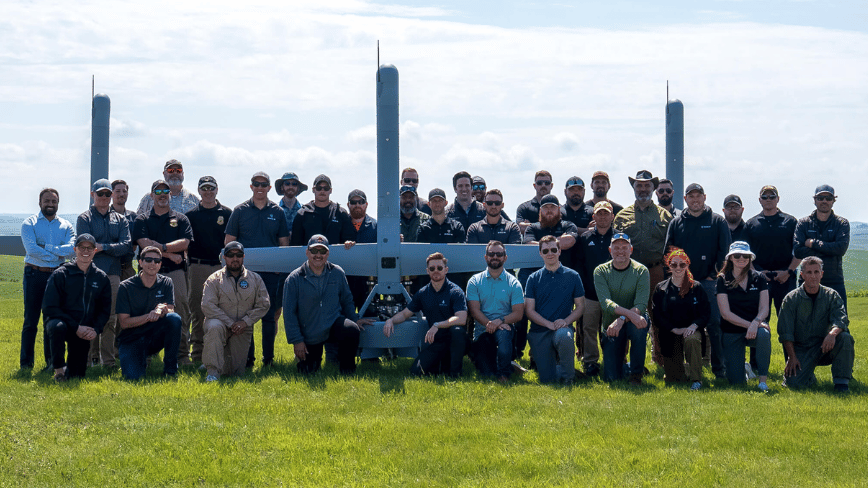
Shield AI’s valuation has surged, having been valued at $5.3 billion as of March 2025 after a $240 million F-1 round with L3Harris and Hanwha Asset Management. Prior fundraising in October 2023 saw a $200 million raise at $2.7 billion. Founded in 2015 by the Tseng brothers and Andrew Reiter, Shield AI focuses on recon and strike in GPS-inaccessible, communication-limited environments termed DDIL. Hivemind, its AI pilot, uses onboard sensors and reasoning for autonomous flight. Shield AI’s Nova quadcopter was deployed in combat in 2018, and its V-BAT drone has operated over 130 missions in Ukraine since June 2024. Hivemind has also been used on F-16s in DARPA tests and Anduril’s Fury drone trials.
The X-BAT, a new VTOL stealth fighter drone requiring no runway and operated by Hivemind, is slated for a test flight this year and operations by 2028. This move into strike capabilities and the acquisition of Aechelon Technology, which provides high-fidelity simulation environments for pilot training, fit into Shield AI’s broader strategy. Aechelon’s platform aids in autonomous systems testing and supports the Pentagon’s Joint Simulation Environment.
Shield AI’s funding comes amidst record investments in defense technology, with VC deals reaching $49.1 billion in 2025. Anduril, Shield AI’s competitor, secured $2.5 billion in June 2025 and is eyeing $4 billion at a $60 billion valuation. Helsing, a European defense AI firm, also raised significant funds. Factors such as the Ukraine war, Pacific tensions, and bipartisan U.S. political support for tech startups in defense have driven this investment. NATO’s DIANA initiative is an example of the shift towards tech startups.
The question remains if these valuations are based on real revenue or speculative enthusiasm like past defense cycles. Shield AI has proven technology, a Ukraine track record, and U.S. Department of Defense contracts, but its jump from a $2.7 billion to $12.7 billion valuation within two and a half years is notable. Advent International’s investment suggests confidence that Shield AI is nearing its production phase. The success of X-BAT’s 2028 timeline and Hivemind’s scalability will prove pivotal in justifying this confidence.