
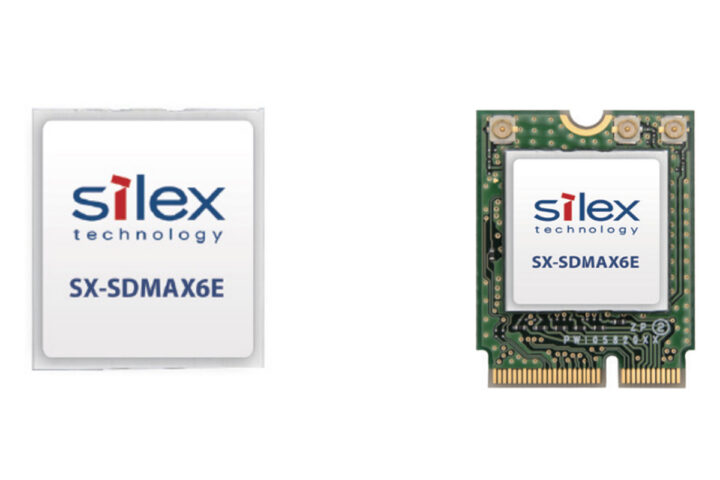

In August last year, we discussed NXP’s IW623 tri-band Wi-Fi 6E and Bluetooth LE Audio SoC, but no modules based on it were available then. Now, NXP and Silex Technology have introduced the SX-SDMAX6E module, offered in an LGA package or an M.2 2230 Key-E card.
The module provides Bluetooth 5.x via UART and Wi-Fi via SDIO, operates from a 3.3V supply with 1.8V support for the LGA version, and has an industrial temperature range of -40°C to +85°C. It’s designed for high-throughput and low-power applications and harsh environments, with various antenna options and fast roaming.
Specifications include:
– Wireless chipset: NXP IW623 tri-band SoC
– Connectivity:
– Wi-Fi: Tri-band Wi-Fi 6E (2.4 GHz, 5 GHz, 6 GHz), IEEE 802.11a/b/g/n/ac/ax compliant, 1×1 or 2×2 MIMO, Channel bandwidths of 20/40/80 MHz for 2.4GHz, 20/40/80 MHz for 5GHz, and 20/40/80 MHz for 6GHz, Fast roaming support (802.11k/v/r).
– Bluetooth: Bluetooth 5.x (BR/EDR/LE).
– Host interface: Wi-Fi via SDIO 3.0, Bluetooth via UART.
– Miscellaneous: RF pads on BGA module, MHF1 connectors on M.2 module.
– Power: 3.3V main supply, 1.8V support for LGA version, 1.8V/3.3V for GPIOs.
– Form factors: SX-SDMAX6E-2530S – 44-pin LGA (17 × 18 × 2.65 mm), SX-SDMAX6E-M2 – M.2 2230 Key-E module.
– Operating temperature: -40°C to +85°C.
– Humidity: Up to 95% RH (non-condensing).
Silex provides datasheets for both versions, currently in Japanese. The block diagram for the LGA module incorrectly mentions the IW693 instead of the IW623, suggesting a possible variant.
Software support details are limited. Silex notes the drivers are optimized for NXP’s i.MX9x platform. The module is designed for mission-critical applications, requiring low latency, minimal interference, and stable connectivity.
Earlier, we discussed simpler modules like Ezurio Sona NX611 with IW611 and Bluetooth 5.3, u-blox MAYA-W2 IoT module, and the Murata Type 2EL with IW612, which also supports 802.15.4. The SX-SDMAX6E stands out with the IW623 tri-band Wi-Fi 6E module for battery-powered devices.
The module and development board will be released in spring 2026. More information is available on Silex Technology’s product page and NXP’s press release. The module is supported by NXP’s 10-15 year product longevity program, with Silex ensuring long-term availability by procuring and storing components for continued manufacturing after specific parts reach end-of-life.