
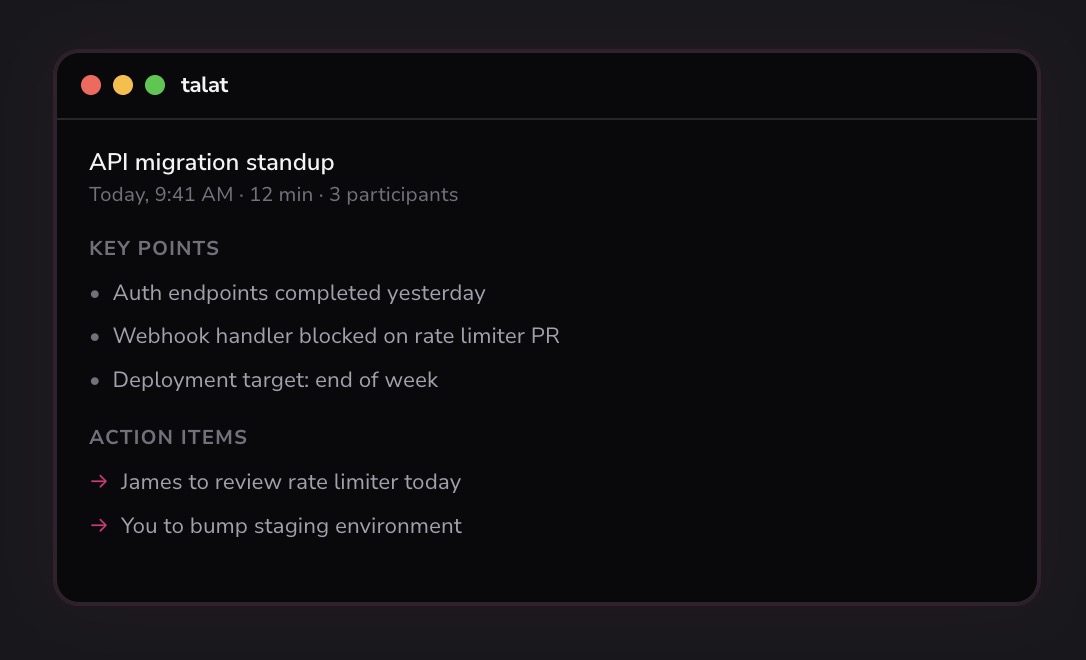

The AI notetaking app Granola, valued at $250 million, has gained popularity among industry founders and VCs. A developer saw the need for a more private, local-only alternative with a one-time fee. This led to the development of Talat, a new Mac app.
Nick Payne, an England-based developer, embarked on creating a local AI notetaker due to a series of fortunate events.
“I think Granola is impressive; it shows what’s possible with an Electron app with ample care,” he stated. “It was fascinating to see it record system audio on my Mac without video—a previous workaround. This led to a lot of research, uncovering a new, poorly documented Apple API.”
To work with the Core Audio Taps API, Payne created an open-source audio library, AudioTee.
“During this time, I was assembling a toolkit, but nothing seemed like a standalone product rather than just a tech demo,” Payne explained. “The transcription models— the same ones used by Granola—are remarkable, letting you see your speech appear onscreen almost instantly. Yet, it bothered me that it required sharing my audio data.”
He discovered FluidAudio, a Swift framework enabling low-latency audio AI on Apple devices, allowing transcription on a Mac’s Neural Engine.
This realization turned his research into a product where audio stays local and isn’t stored externally.
Talat, built with Mike Franklin, emerged from Payne’s audio interest. It’s a 20MB, one-time purchase without accounts or analytics sharing and free from ongoing fees.
While other AI notetakers offer more features, Talat provides core capabilities. It captures audio during meetings, transcribes it in real-time, and identifies speakers. Users can take notes and edit transcript segments. Post-meeting, a local LLM summarizes the session, highlighting key points.
Notes, transcripts, and summaries are searchable in Talat.
Besides privacy benefits, Payne aimed to offer user options.
“We focus on configurability and user control over data: choose your LLM, auto-export to Obsidian, use webhooks for data post-meeting, and an MCP server for on-demand data access,” he explained.
The AI uses a mix of tools, primarily using FluidAudio for support. For summaries, it employs the Qwen3-4B-4bit model, suitable for ordinary hardware.
Users can switch to any cloud LLM provider, choose between Nvidia’s Parakeet models, or use Ollama for local AI models. Talat will add more choices and integrate with apps like Google Calendar and Notion.
At launch, M-series Mac users can trial the app for free with 10 hours of recordings before buying.
Talat is available for $49 in pre-release, with the price rising to $99 at the 1.0 release.
Payne and Franklin are bootstrapping Talat, intending to maintain it as a one-time purchase.