

**Android Central Verdict**
Rating: ★★★★☆
This is the finest slim phone ever created, and it’s not even a close contest. If the iPhone Air and Galaxy S25 Edge’s battery and camera shortcomings held you back from purchasing them, this is the slim phone you’ve been longing for… assuming you can.
**Pros**
– Exceptional battery longevity
– Rapid charging capabilities
– Lively display
– Strong chipset performance
– Superb camera quality
– IP69 rating for protection against high-pressure jets
**Cons**
– Under-display fingerprint reader is positioned slightly low
– Exclusively available in China
—
Having spent 18 years reviewing technology, it’s quite uncommon for smartphones to genuinely astonish or thrill me, but last year was a significant turning point. I have an affinity for compact and slender phones, which goes against the prevailing trend of larger devices, and I was quite taken with the iPhone Air and Galaxy S25 Edge when they were unveiled.
Yet neither transitioned into my primary device for one crucial reason: compromises. Both models entail significant trade-offs in comparison to their non-slim versions, particularly as the latter continue to slim down with each new release.
The reasoning seemed straightforward: a slim design would inherently result in various concessions regarding performance, battery longevity, charging speed, and camera quality. At least, that was the perception until a few weeks prior when I began using a new slim phone that demonstrated that Samsung and Apple missed the mark.
Introducing the finest thin phone ever created: the Honor Magic 8 Pro Air. It’s so impressive, it has become my favorite phone to use at this time.
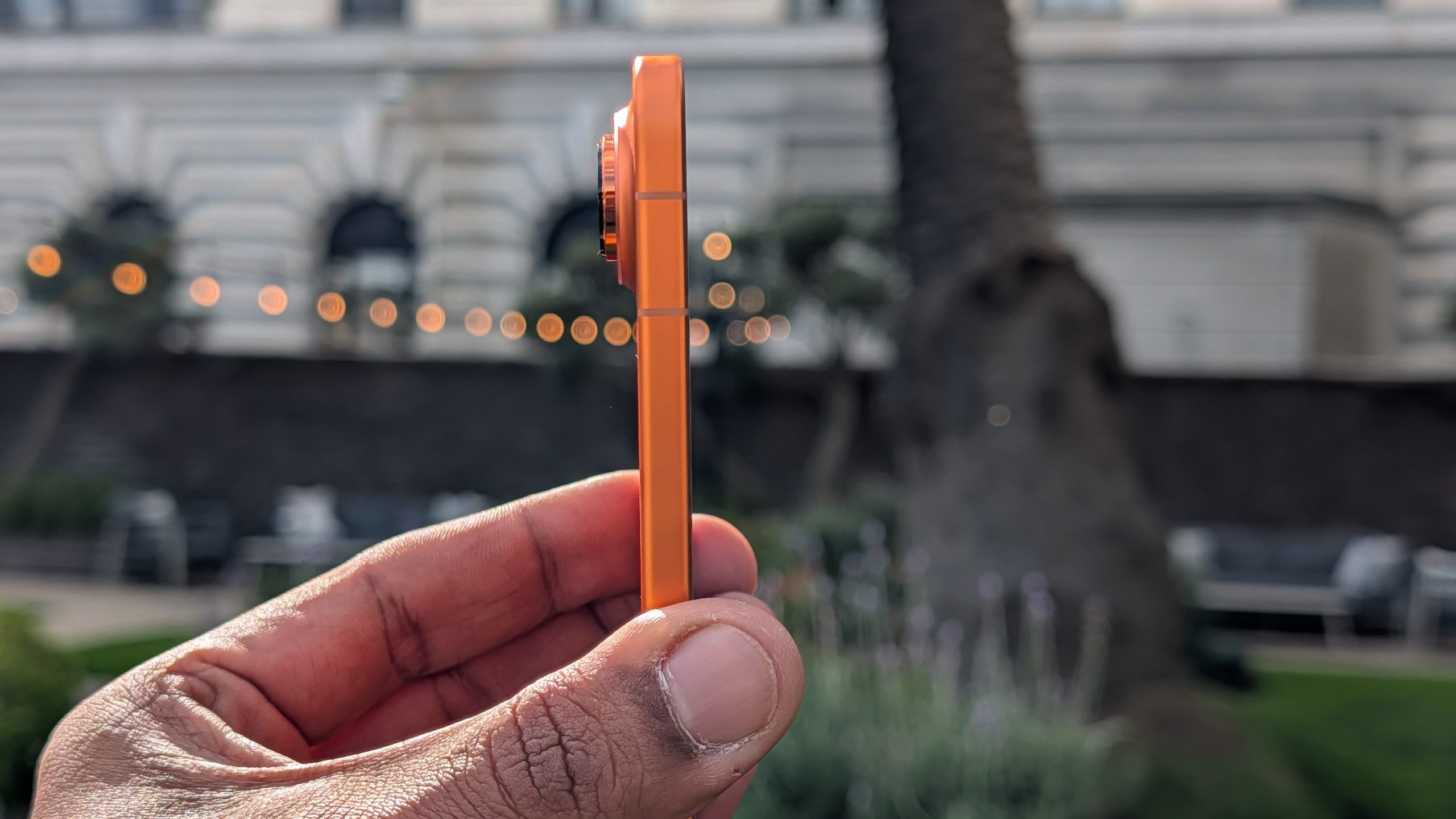
The Honor Magic 8 Pro Air is marginally thicker than the Galaxy S25 Edge and the iPhone Air, but this trade-off is well worth it. The Magic 8 Pro Air measures 6.1mm in thickness, compared to 5.6mm for the iPhone Air and 5.8mm for the Galaxy S25 Edge, but despite being 0.6mm thicker, you will appreciate the difference.
The justification? Significantly improved cameras, a much larger battery, and remarkably faster charging. Consequently, it is the only slim phone that feels like it genuinely maintains the flagship phone experience, especially in comparison to other options.
It’s also worth mentioning that Honor has managed to achieve all of this within a body that is smaller than its rivals, which elevates the user experience of the Magic 8 Pro Air even more.
The Magic 8 Pro Air boasts a brilliant 6.31-inch display, featuring Dolby Vision and peak brightness of 6,000 nits, which resonates with me because I have a preference for compact phones; this is much easier to handle with one hand than the 6.5-inch display on the iPhone Air (which is nearly perfect in size) and the 6.7-inch display on the Galaxy S25 Edge, which I find a bit overly large.
Had Honor opted for a larger display, it might not have been as pleasurable for me, but there’s a good chance they could have made it thinner as well. In any case, this is among the most well-designed phones I’ve encountered in years, and as we’ll explore, it finally addresses the principal compromises found in other thin phones. It is also available in four colors — Black, White, Purple, and Orange — and yes, I’m using the now-familiar Orange variant that appears just as stylish as my iPhone 17 Pro.
Battery and charging are critical areas in which the Magic 8 Pro Air excels when compared to the competition, simultaneously resolving the largest drawback associated with other slim phones.
The iPhone Air has a 3,149 mAh battery, with Apple also offering a separate iPhone Air MagSafe battery pack that nearly doubles its capacity. When connected, this pack increases the iPhone Air’s overall thickness to around 13mm. Meanwhile, the Galaxy S25 Edge has a larger 3,900 mAh battery, but lacks an official Qi2 battery pack.
In contrast, the Magic 8 Pro Air stands out significantly, sporting a 5,500 mAh battery with support for 80W wired charging and 50W wireless charging. For context, this battery is larger than that of the iPhone 17 Pro Max, the upcoming Galaxy S26 Ultra, and even folding devices like the Galaxy Z Fold 7. It takes approximately 50 minutes to fully charge the Magic 8 Pro Air, which is also quicker than both the iPhone Air and the Galaxy S25 Edge.
I was astonished by the battery capacity, and even more surprised when it provided the exact all-day battery life I had been anticipating from a slim phone. Over the past few weeks, the average battery life has hovered around 5-6 hours of screen usage per day, which is more than adequate, but I’ve also seen it exceed seven hours when primarily using Wi-Fi. This is remarkable, and simply put, the Magic 8 Pro Air is the first thin phone to