

An element has been introduced in HTML. Chrome pioneered its integration, and it’s now available in Chrome, with other browsers yet to follow. However, the development process did involve other browser manufacturers, which is promising.
Manuel Matuzović offers a comprehensive introductory blog post.
The element is not compatible within an , preventing an embedded demo here. You can view a small demo here, and access the code here.
Key points to consider:
- It’s essentially a
with a fixed design featuring a map icon and text indicating “Use location.” Addingaccuracymode="precise"changes it to “Use precise location.” - A click on the button will:
- conduct a geolocation and trigger a
locationevent, provided access is granted. - prompt for access if necessary before proceeding.
- remind and request permission anew if access has been previously denied.
- conduct a geolocation and trigger a
- The last bullet point is critical, enabling permission recovery in a manner previously unavailable.
- Employ it using the progressive-enrichment approach, positioning an actual
with event handlers to manage scenarios where permission assurance is lacking. You can also polyfill it. - The implementation enforces stringent accessibility guidelines.
The accessibility enforcement lends itself to interesting exploration. This element’s behavior is somewhat novel in HTML.
The motivation behind these guidelines doesn’t seem to stem from accessibility concerns per se, but from security considerations aimed at preventing unlawful geolocation data requests. Situations like “Click here for 100 free Robux, then accept the next prompt,” illustrate this issue, although such tactics can’t be entirely eradicated.
Accessibility compliance manifests in numerous ways:
Text and Icon Constraints
It’s essentially unmodifiable. The content resides within a user-agent Shadow Root without part attributes for styling customization.
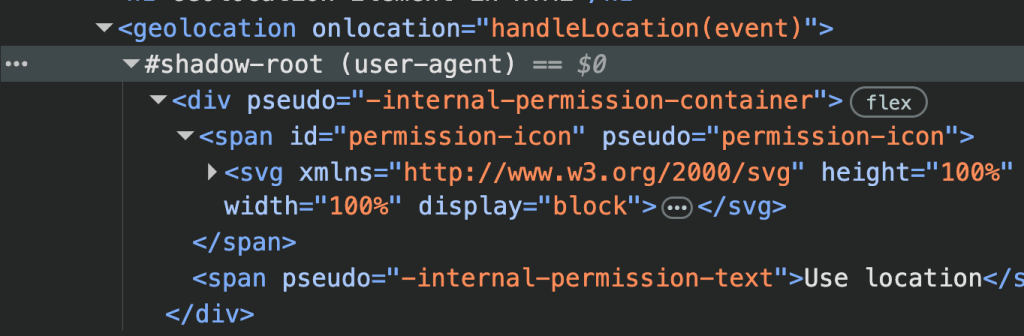
Standard styling methods affecting the Shadow DOM remain applicable, like color adjustments affecting text and the SVG icon set to fill: currentColor; for synchronized color changes.
Automatic localization, enabled by the lang attribute, ensures text displays in the appropriate language.
CSS Restrictions
Some CSS applied to a button is disregarded.
geolocation {
  translate: 100px 100px;
  transform: scale(0);
  opacity: 0.75;
  filter: opacity(0);
  inline-size: 2px;
  clip-path: inset(50%);
}
This isn’t necessarily comprehensive, but when CSS doesn’t function as intended, it’s typically deliberate. Discrepancies exist, such as the Chrome post claiming 2D translates are permitted when they aren’t.
Fenced CSS
This aspect is peculiar.
ge