
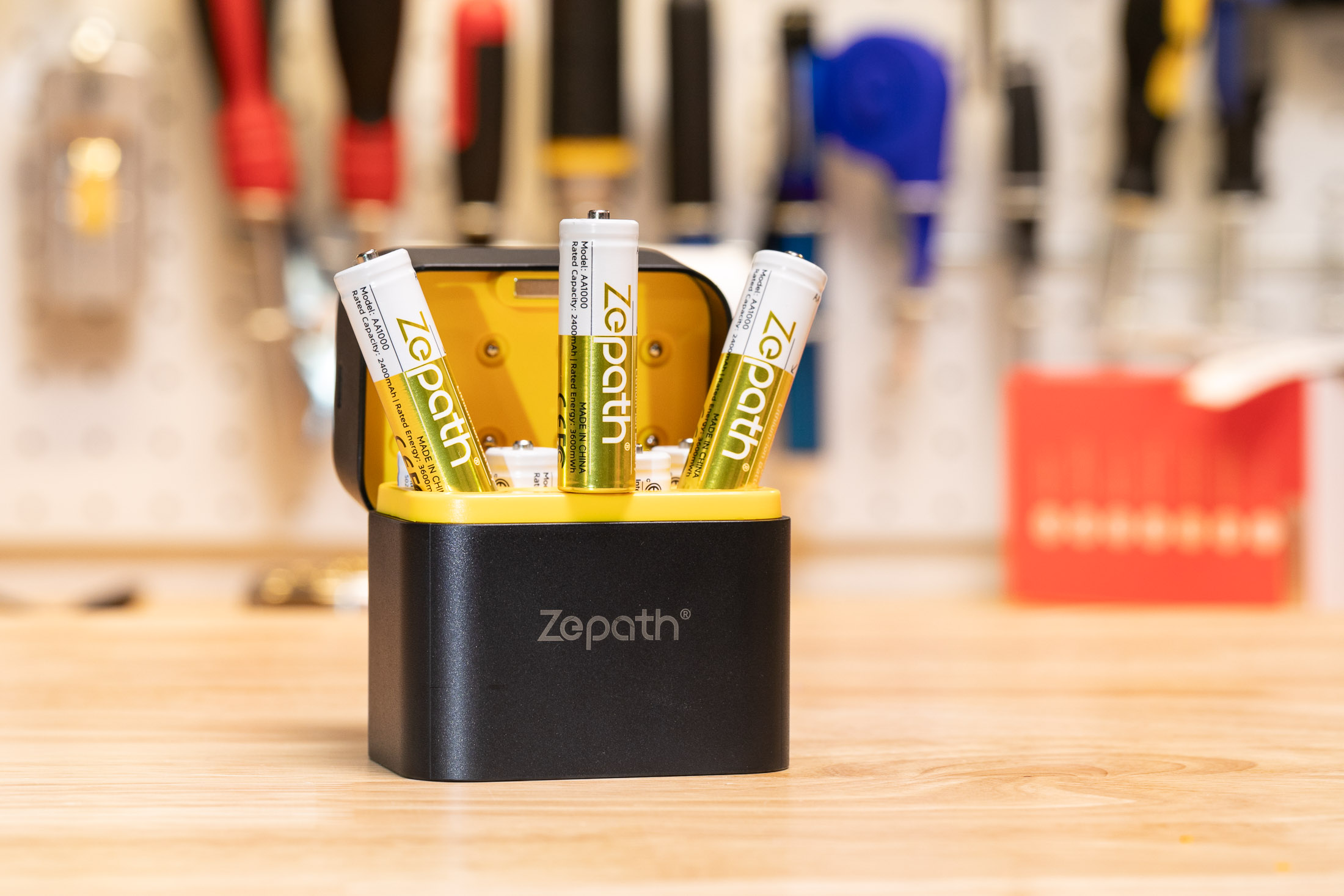

Verge-tested, Lumafield-scanned: USB-C rechargeable lithium-ion AA batteries.
Last September, Lumafield scanned 1,000 cylindrical lithium-ion batteries to highlight hidden risks in cheaper options. At the same time, I tested two new types of AA batteries that recharge using USB-C cables.
This sparked an idea: could we find the best USB-C AA batteries by combining my testing with Lumafield’s scanning tech?
The answer seems to be yes! The Zepath 3600mWh is the only rechargeable lithium-ion AA I’d buy, even though USB-C is in the charger, not each cell.
The Zepath passed Lumafield’s and my tests with flying colors. It has higher capacity, is easy to use, and is incredibly cheap.
These AAs cost just $2.50 per cell, less than Panasonic’s Eneloop batteries, while lasting longer in my Game Boy Advance and high-power flashlight.
It’s $20 for an eight-pack, including a clamshell charger with a magnetic closure. You can charge any number of batteries, even in a zig-zag pattern, pulling about 10 watts for all eight.
The charger prevents charging wrong battery types, signaling green for charging, solid green for charged, and blinking red for rejection.
Though this means the only recommended USB-C AA lacks a built-in USB-C port, good reasons justify this.
Lumafield’s analysis of 12 types of lithium-ion AA batteries showed most, excluding Zepath, were inferior.
Some, like Paleblue, had a tiny pouch cell for the USB-C port. Others, like Coast, had a “can-within-a-can” design.
Lumafield found poor alignment and negative anode overhang in most, except those with charging cases like Philips and Mupoer. But Zepath and Runpower were best, with Zepath being cheaper.
Zepath had straight alignment and good anode overhang. It maximized the can space, earning it a good battery rating.
I had high hopes for Coast and Nitecore, but Coast’s battery seemed “a little wonky” with low anode overhang. Nitecore may have quality issues, with loose assembly and varying scan results.
Avoid Spyong, which had a deformed cell; NTONPOWER, with poor alignment; CZVV, with non-existent overhang; and surprisingly, Paleblue, with anode bending risks.
By the time I had Hao’s results, I didn’t mind the lack of a USB-C port. Built-in ports have two downsides: shorter battery life and fiddly sockets.
Zepath outlasted Coast by an hour and a half in my Game Boy Advance, and even longer in my flashlight. Nitecore didn’t work in some devices.
Sockets are too tight, risking damage, while the charging case, though it requires remembering, prevents cable loss.
Lithium-ion AAs aren’t the ultimate battery; their chemistry is flammable. Flashlights last longer on low with NiMH batteries. While Li-ion works better on high, I’ll keep my Eneloops for now.