
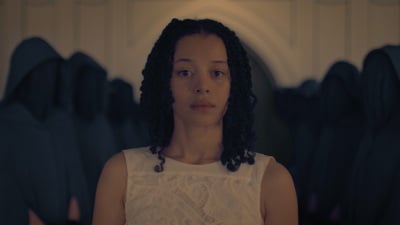

Chase Infiniti takes center stage in this dystopian coming-of-age narrative. By Belen Edwards on April 2, 2026.
All products featured are independently selected by our editors and writers. If you purchase through links, we may earn an affiliate commission.
Honestly, I wasn’t sure we needed more of The Handmaid’s Tale. When Season 1 premiered during the first months of Donald Trump’s presidency, it resonated, reflecting real-world concerns about the erosion of women’s rights and authoritarianism. These issues remain relevant during Trump’s second term, as the administration continues to target women and queer communities, echoing the Christo-fascist nightmare of Gilead.
Yet between these presidencies, and as The Handmaid’s Tale unfolded, the series lost its way. After Season 1, it moved beyond Margaret Atwood’s novel, becoming a grim, self-indulgent spectacle in an attempt to outdo our growing dystopia.
The Testaments, a follow-up series based on Atwood’s 2019 novel, retains some of that grimness but finds new — maybe hopeful — narratives by focusing on younger generations in Gilead.
The Testaments highlights Gilead’s youth. The series introduces the Plums, young daughters of high-ranking Commanders, marked by their purple attire. Unlike the original series’ characters, they didn’t have independent lives before Gilead; they know only the world they’re raised in.
The Plums undergo marriage training at a school run by Aunt Lydia (Ann Dowd), whose role is reduced compared to Atwood’s novel. The series builds on the sickening pageantry of the marriage process between Commanders and child brides. It takes its young ensemble through a fraught coming-of-age journey.
Our introduction to this world is Agnes MacKenzie (Chase Infiniti), the adopted daughter of a powerful Commander, born before Gilead was established but too young to remember it. Raised in a stew of religious, patriarchal propaganda vilifying women as temptresses, Agnes recounts instances like receiving punishment for smiling at a boy, standing with her mouth taped shut, holding a “slut” sign. She also recalls Aunt Vidala (Mabel Li) showing students hanged rapists as a lesson that both men and victim “liked attention.”
These horrifying “lessons” aim to shape perfect cogs in Gilead’s machine. But the girls remain teenagers. In refreshing moments, they act as such — reciting prayers emotionlessly, then eagerly socializing; fretting over outfits and harboring secret crushes; Even Gilead isn’t immune to “mean girl” behavior, as seen through the character Shunammite (Rowan Blanchard), whose shade-throwing adds comic relief.
Despite the marriage market and school environment’s chilling nature, The Testaments proves more reserved than The Handmaid’s Tale, with occasional harsh punishments and fewer graphic depictions of sexual violence. This restraint is its strength — demonstrating that ideology taking root can be more powerful than violence.
Its young ensemble, led by Infiniti’s Agnes, is remarkable. Co-lead Lucy Halliday portrays Daisy, a Pearl Girl from Toronto with rebelliousness that must be tempered for survival. Blanchard’s Shunammite and Mattea Conforti as Becka deliver standout performances, reflecting on the cast’s remarkable portrayal of Gilead’s youth.
At times, The Testaments struggles with its mix of The Handmaid’s Tale’s bleakness and a coming-of-age story, but its focus on young adults who know only authoritarianism delivers a powerful message. This fresh perspective could resonate with younger audiences in ways The Handmaid’s Tale might not.
The first three episodes of The Testaments premiere Apr. 8 on Hulu, with new episodes each week.