
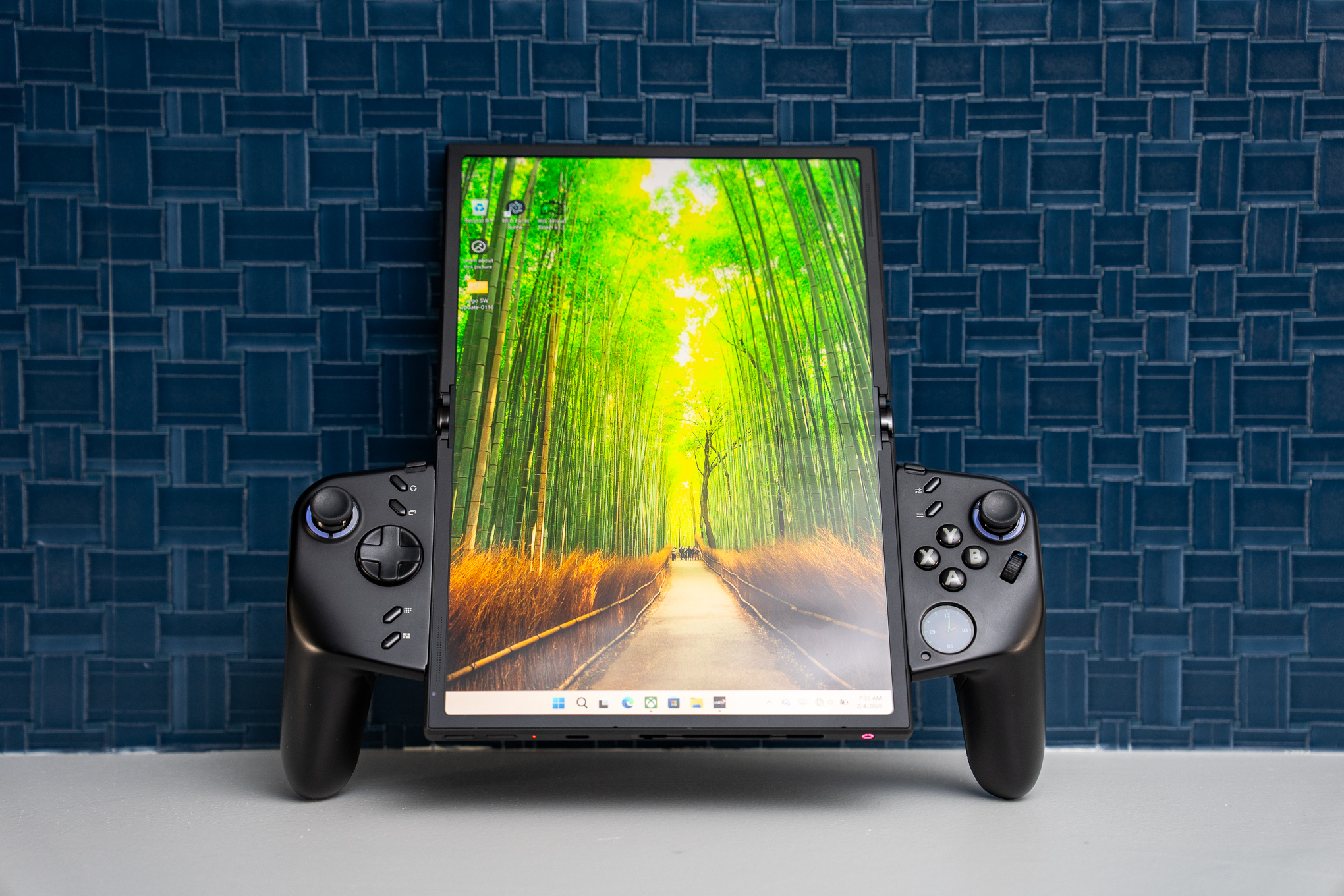

The Lenovo Legion Go Fold Concept transitions from a 7.7-inch display to an 11.6-inch and functions as a laptop. Lenovo integrated a foldable display into a gaming handheld. The Legion Go Fold Concept is a Windows-based handheld featuring a flexible POLED display, detachable Joy-Con-like controllers, and a folio case that transforms it into a mini laptop.
It can be used as a standard Steam Deck-like handheld with the display folded down to 7.7 inches and controllers attached or opened up for a larger experience. When unfolded, the controllers can be adjusted to all four sides, allowing for play in vertical or horizontal orientations.
In vertical splitscreen mode, you can play a game on one half of the screen and display another window, like chat or a game guide, on the other. Horizontal fullscreen mode offers the entire 11.6 inches of display space in a 16:10 aspect ratio. In laptop mode, detach the controllers and place the handheld in a folio case that includes a stand, built-in keyboard, and trackpad. The controllers can be integrated into a separate grip to form one gamepad.
This folding handheld offers multiple uses, including turning one controller into a vertical mouse like other Legion Go handhelds, but lacks the ability to fold down to protect its screen. The Go Fold only folds outward, resembling more of an expansion of a typical gaming handheld rather than a clamshell for portability, as seen in devices like the Nintendo DS. (Though attempts at larger devices have been made before.)
The Legion Go Fold boasts impressive specs: an Intel Core Ultra 7 258V Lunar Lake processor, 32GB of RAM, 1TB of storage, and a 48Whr battery. The OLED screen, covered in plastic, has a resolution of 2435 x 1712 and a 165Hz refresh rate. There’s even a secondary circular touchscreen on the right controller, under the buttons, acting as both a touchpad and an auxiliary display for game interface elements, a clock, system monitoring, or even an animated GIF for fun.
During a brief demo, I didn’t play any graphically intensive games, only Balatro, a lightweight game. The screen appeared sharp, though a noticeable crease down the center, typical of foldables, took some getting used to. The device felt somewhat fragile, and attaching/detaching the controllers was clunky. Hopefully, build quality will improve if this device reaches the market.
The laptop mode was unexpectedly satisfying. I didn’t anticipate a gaming handheld also serving as a conventional computer for productivity. Though setting up the Legion Go Fold’s case took some time to master, it should become intuitive with regular use.
Nevertheless, it’s uncertain if the Legion Go Fold will become a practical device. Though I hope it transitions from concept to reality like other bold Lenovo endeavors, the price might be prohibitive. The Legion Go 2 already exceeds $1,000, and the current RAM shortage crisis could drive the potential cost of an actual Legion Go Fold even higher.
While not the foldable I envisioned, it’s undeniably intriguing. Now, someone please create a folding PC handheld that transitions from somewhat large to really compact. That might be just the thing for me.
Photography by Antonio G. Di Benedetto / The Verge