
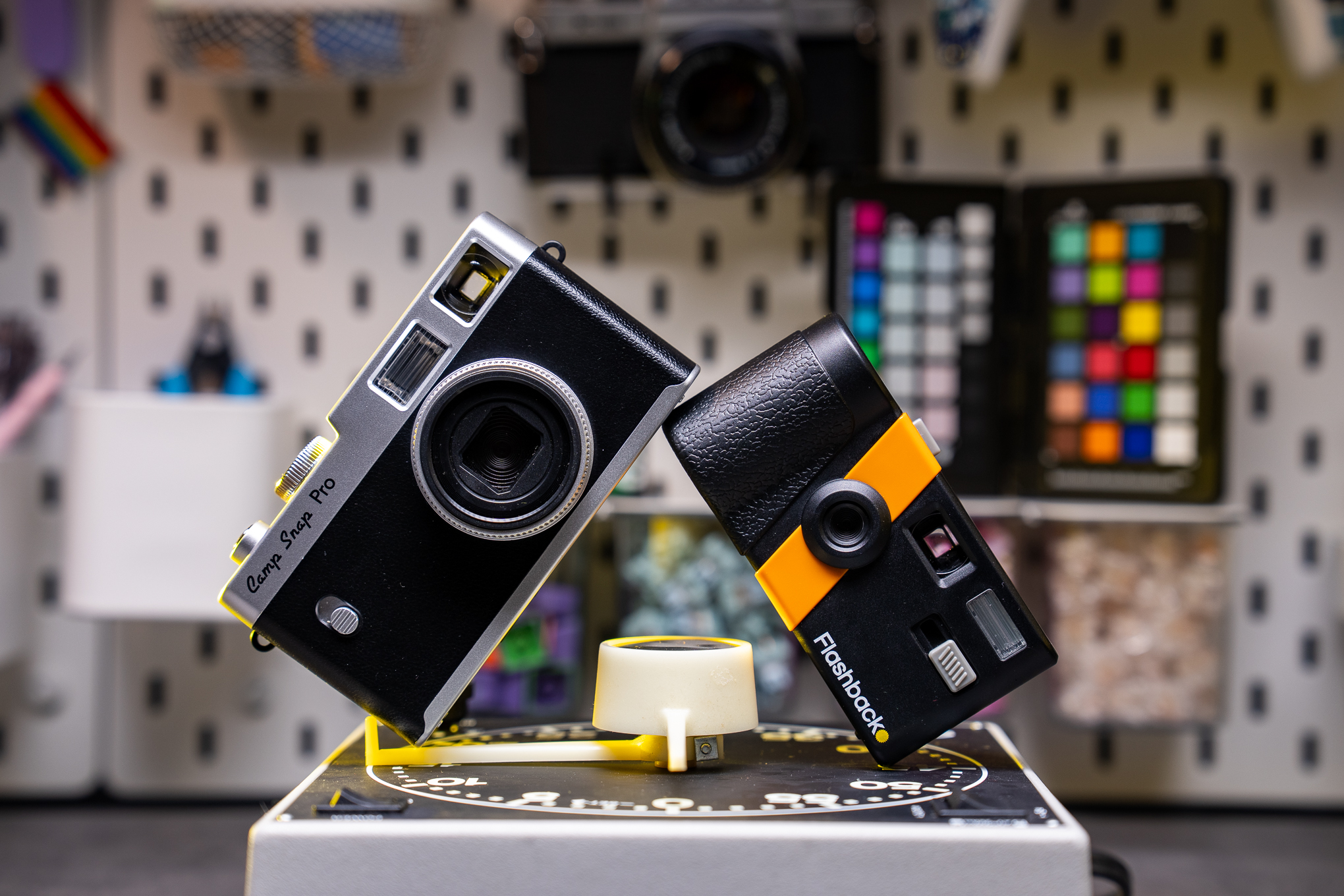

Two fun cameras attempt to merge the charm of disposable cameras with digital convenience. One succeeds.
There’s been a recent surge of interest in inexpensive digital cameras. Younger people are buying old point-and-shoots because they find the aesthetic more authentic and appealing than smartphone images. Companies are even rereleasing old tech at new prices. Cameras like the original Camp Snap, a $70 single-button point-and-shoot with no screen, are designed as modern takes on disposable film cameras. It’s affordable enough for kids and accessible for anyone to enjoy its lo-fi aesthetic.
I’ve been testing two such cameras: the $99 Camp Snap Pro (CS-Pro), an upgrade to the original Camp Snap, resembling an all-plastic Fujifilm X100, and the $119 Flashback One35 V2, which looks exactly like a disposable camera.
Both cameras aim to offer the aesthetics and experience of a disposable film camera with digital convenience. One of them achieves this.
The Camp Snap Pro and Flashback One35 V2 are compact, made from lightweight plastic. The Flashback is smaller, about the size of a disposable film camera, and slips into pockets easily. But both are best carried in a jacket pocket, small bag, or purse. They don’t feel precious like regular cameras. My wife and I often toss our original Camp Snap into a diaper bag without worry.
Neither camera stands out in terms of specs. The Camp Snap Pro’s 22.5mm-equivalent lens and 16-megapixel sensor provide higher resolution than the standard Camp Snap. The Flashback V2 has a 13-megapixel sensor. These basic image sensors and lenses offer image quality between a disposable film camera and an old phone. Unlike film, you’re not paying per shot. Both cameras have proper xenon flashes for illuminating dark settings at close distances, though the original Camp Snap’s LED flash is less useful.
The main difference is how they are used. The Camp Snap Pro has a dial to swap between four filters, each customizable using Camp Snap’s Filter Builder. The 4GB microSD card stores over 1,000 photos, downloadable via USB-C or a card reader.
The Flashback also has four filters, but you change them in its companion app. You use them as “rolls” for up to 27 shots, simulating a disposable film camera. Once a filter is selected, you’re stuck with it for the roll. The One35 V2 pairs to a phone via Bluetooth, allowing you to check battery level, enable a self-timer, or change film type. Images can be downloaded via Wi-Fi or cable. By default, images take 24 hours to develop unless you enable Digicam Mode for instant viewing.
Though the app is nice, the roll-by-roll shooting can become annoying. Some film types may not apply correctly, causing unexpected results. The One35 can’t be used again until you offload photos, which negates a digital camera’s advantage of continuous shooting. Its reliance on a disposable-camera-style advance winder also means missed shots.
Flashback’s PR rep acknowledged a known issue with the advance dial. A firmware update may help, but it won’t change the Flashback’s other handling issue: the lens placement often results in fingers in the shot. The design doesn’t utilize its contoured grip effectively.
In terms of image quality, the Camp Snap Pro is significantly sharper and cleaner than the Flashback. Even the standard Camp Snap offers slightly better image quality. The Snap Pro is recommended, while the Flashback’s concept doesn’t translate well in practice.
The Camp Snap Pro is cheaper, easier to use, more customizable, and provides higher image quality. It’s perfect for those wanting a step up from the basic Camp Snap. The Flashback’s nostalgic design can’t compete.
Tech specs comparison:
| | Camp Snap Pro | Flashback One35 V2 |
| — | — | — |
| Resolution | 16 megapixels | 13 megapixels |
| Sensor | Type-1/3.06 CMOS | Not disclosed |
| RAW support | No | Yes, DNG format |
| Focal length | 22.5mm equivalent | Not disclosed |
| Aperture | f/2.2 | Not disclosed |
| Storage | 4GB microSD, removable | Not disclosed |
| Connectivity | USB-C | USB-C, Bluetooth, Wi-Fi |
| Battery | Estimated 500 shots, non-removable | Estimated 15 rolls, non-removable |
Photography by Antonio G. Di Benedetto / The Verge