

On Wednesday, Meta launched its new Muse Spark AI model as part of a significant revamp of its AI initiatives. This is a critical moment for Meta since the company cannot afford another costly investment that fails, like the metaverse. It’s not just about financial loss but also the potential embarrassment.
Speaking of embarrassment, consider the scenario where your friends, family, and acquaintances receive a notification that you’re using the Meta AI app. I have experienced this humiliation myself, and I’m here to caution you that it could happen to you too.
Meta’s Muse Spark model is new, but the Meta AI app is not. It was released last April, and at that time, I wrote an article about its launch. As part of my reporting, I downloaded and used the app.
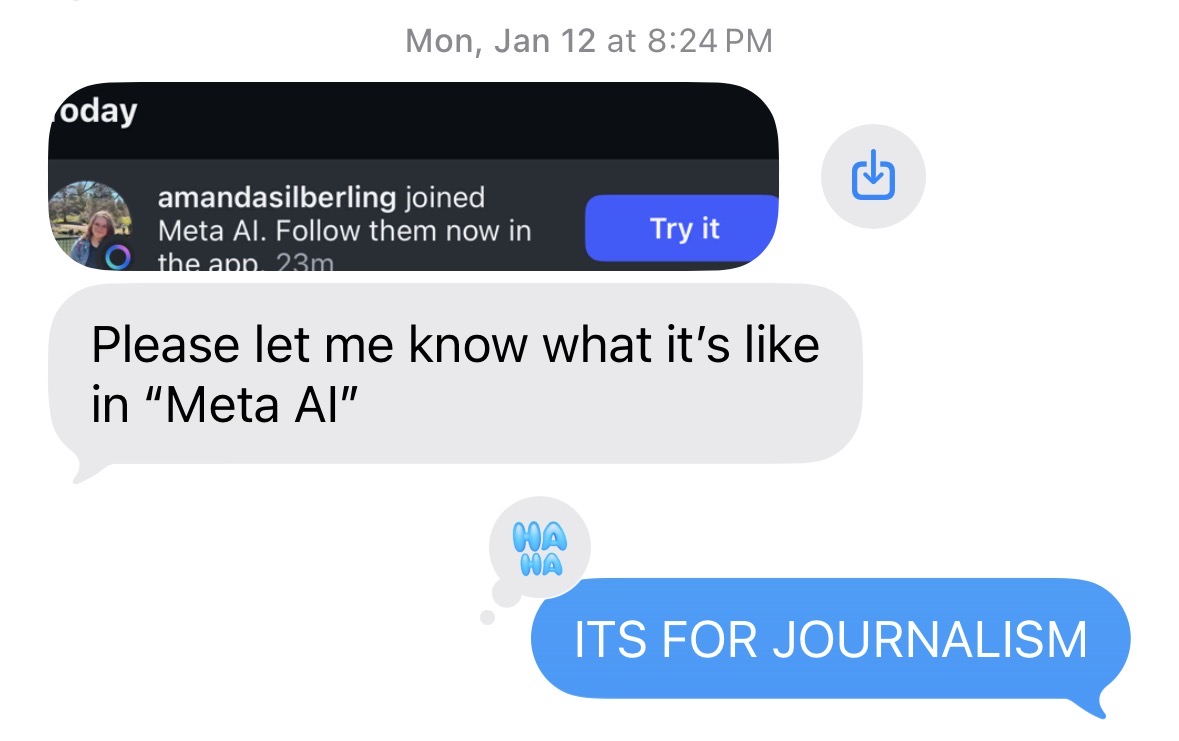
At some point, Meta started notifying people via Instagram about which of their friends were using the Meta AI app, likely to encourage them to download it. It’s been nearly a year, and I still receive texts from friends notifying me that Instagram informed them of my app usage. This behavior is generally viewed as uncool.
In its first month and a half on the App Store, only 6.5 million people downloaded the app, according to market intelligence from Appfigures. While that’s a considerable number, it’s not substantial for a company that engages an estimated 42% of the world’s population as daily users of its apps.
Maybe that’s why, in the early days, I stood out on my friends’ Instagram notification feeds. Your friends receive a notification of your app usage, prominently displayed like a new follower alert.
Things are improving for the Meta AI app, though. It is experiencing a surge in downloads after launching its revamped chatbot, now at No. 5 on the U.S. App Store, up from No. 57, according to Appfigures. This improvement is also why I must warn you about the potential issues you might face if Instagram shares your app usage with friends.
Although I don’t want people to know I installed an app with an AI-generated “vibes” feed, the issue runs deeper. Meta’s apps are so interconnected that it’s challenging to track what data we’re sharing, where, and with whom. Why would I expect my Instagram acquaintances to know I use the Meta AI app? (At least X didn’t inform people that I used Grok’s anime waifu — which was also for work.)
To use the Meta AI app, you must log in with a Meta account, so I joined using the account I’ve had since my teenage years, which connects to my Instagram and Facebook. Meta will continue to leverage my activities on Instagram, Facebook, and now the Meta AI app to serve targeted ads. So, if I were to discuss a personal issue like menstruation with Meta AI, Instagram might show me ads for period-related products.
The Meta AI app never requested permission to notify others or use my AI chats for advertising. Yet, it likely didn’t need to, as I probably consented implicitly in some unread terms of service. Similarly, I learned through Instagram about my brother’s unusual interest in Eurovision last year, as we see each other’s liked Reels. We know too much about each other, and Meta knows even more.
In some ways, I’m fortunate that the only information shared about my Meta AI usage was my app presence. Some users inadvertently shared much more incriminating details: their AI chatlogs.
As an experienced user of the Meta AI app, I can say that in the past (over the summer), Meta tested a Discover feed in the app. Meta didn’t consider that many older users might struggle with technology, and since AI isn’t human, people might use chatbots for topics too private to share otherwise. This potential for error led to problems.
Soon, individuals like a16z partner Justine Moore noticed the Discover feed was filled with older users accidentally sharing AI conversations. These shared chats were sometimes benign: one user with a Southern accent inquired, “Hey, Meta, why do some farts stink more than others?” In other instances, people disclosed personal details, such as home addresses, medical issues, and marital concerns.
To Meta’s credit, these users had to press publish manually on shared chats. However, given that many seemed to share personal information by accident, a design issue was evident. (Meta has since removed the Discover feed.)
If the Meta AI app becomes a popular trend, I might relish being an early adopter. But I wouldn’t bet on that future. The “Vibes” feed remains a potential issue.