
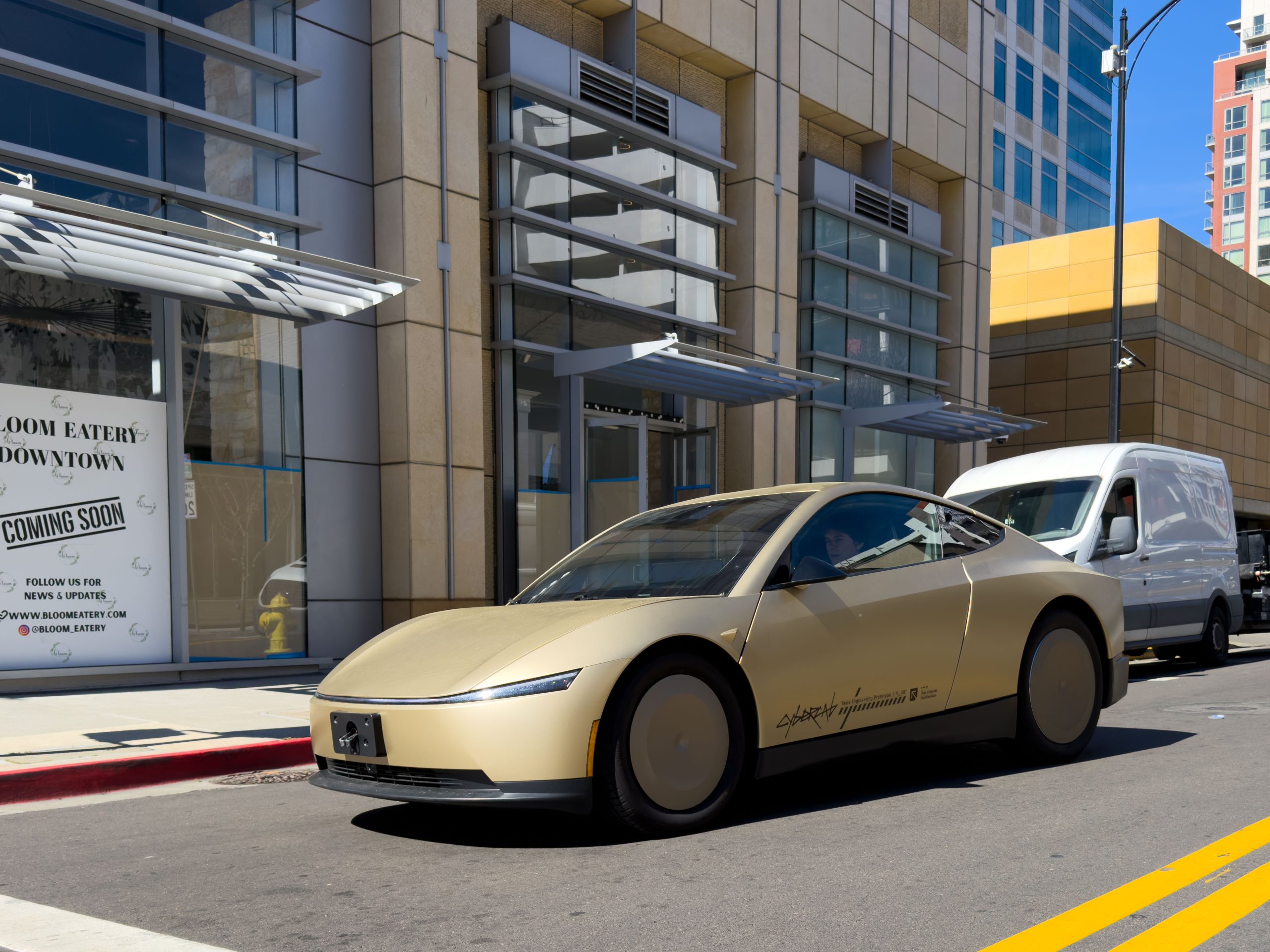

Tesla and Lucid are making waves with their two-seater autonomous vehicles. However, the requirements for EVs in ride-hailing fleets differ from those of retail buyers, and this distinction is significant.
When Tesla introduced the Cybercab in 2024, many were puzzled by its two-seater configuration. My own reaction at the LA Auto Show was similar: a taxi with only two seats seemed impractical. The thought of such a taxi, beyond a basic tuktuk, seemed absurd.
For a year and a half, this viewpoint prevailed. Social media users debated the usefulness of a two-seat robotaxi, with some joking about options for more passengers. Nonetheless, Tesla has started producing the Cybercab, and prototypes are undergoing tests on public roads and at their Austin, Texas plant.
Now, there’s another entrant in the two-seater arena: Lucid Motors unveiled a concept car, the Lucid Lunar, at their Investor Day in New York City. This two-seat robotaxi, showcased with an open interior to highlight space and luggage capacity, mirrors some elements of Tesla’s Cybercab.
Lucid’s CEO, Marc Winterhoff, announced a deal in a conversation with Uber’s Andrew Macdonald: Uber plans to purchase 20,000 Lucid Gravitys equipped with Nuro’s robotaxi systems. A similar agreement is on the horizon for an upcoming Lucid EV model.
Conversations with Lucid executives changed my perspective on two-seat robotaxis. They might appeal to ride-hailing companies worldwide if they prove safe, reliable, reduce urban congestion, and are more cost-effective than vehicles with human drivers.
In practice, using two-seat robotaxis would require ride-hailing apps to ask users the number of travelers to ensure adequate seating. Likely, users wouldn’t mind this small step if the two-seaters offered lower costs.
The Lucid Lunar concept, similar in display to the Lucid Cosmos but without a steering wheel, is built on a compact version of the midsize platform, shared with forthcoming models. It prioritizes energy efficiency and cost-effectiveness.
During Lucid’s Investor Day, it was noted that many Uber rides involve one or two passengers. Lucid’s chief engineer, Zach Walker, highlighted that ride-hailing operators’ needs differ from those of personal car owners.
A two-seat EV has the advantage of being smaller and lighter, leading to reduced costs for purchase and operation. Efficiency is key, and smaller batteries equate to more cost savings. Walker explained that a 1-kWh battery reduction could save $1,000 annually for robotaxi operators traveling 100,000 miles.
Lucid anticipates the two-seat robotaxi could achieve efficiency ratings of 5.5 to 6 miles per kilowatt-hour, surpassing today’s most efficient EVs.
Walker also discussed the benefits of engineering for specific uses, explaining how optimized suspensions for comfort allow for cost and weight reductions. The structural design of robotaxis can prioritize efficiency over handling, unlike models tailored for individual buyers.
Despite their compact appearance, both Tesla’s and Lucid’s two-seaters benefit from streamlined aerodynamics for high-speed efficiency, though this is less impactful for urban-focused trips.
The robotaxi format, akin to a two-door coupe, sparked discussions on entry and exit limitations. Alternatives, like the upright design proposed by designer Giorgetto Giugiaro for a modern taxi, could overcome these challenges. Some industry voices argue for such shapes, emphasizing their suitability for urban travel.
The unveiling of Lucid’s Lunar concept evoked thoughts of a potential sporty EV coupe if equipped with a steering wheel. Though entertained by the idea, Lucid’s focus remains on their robotaxi initiative.