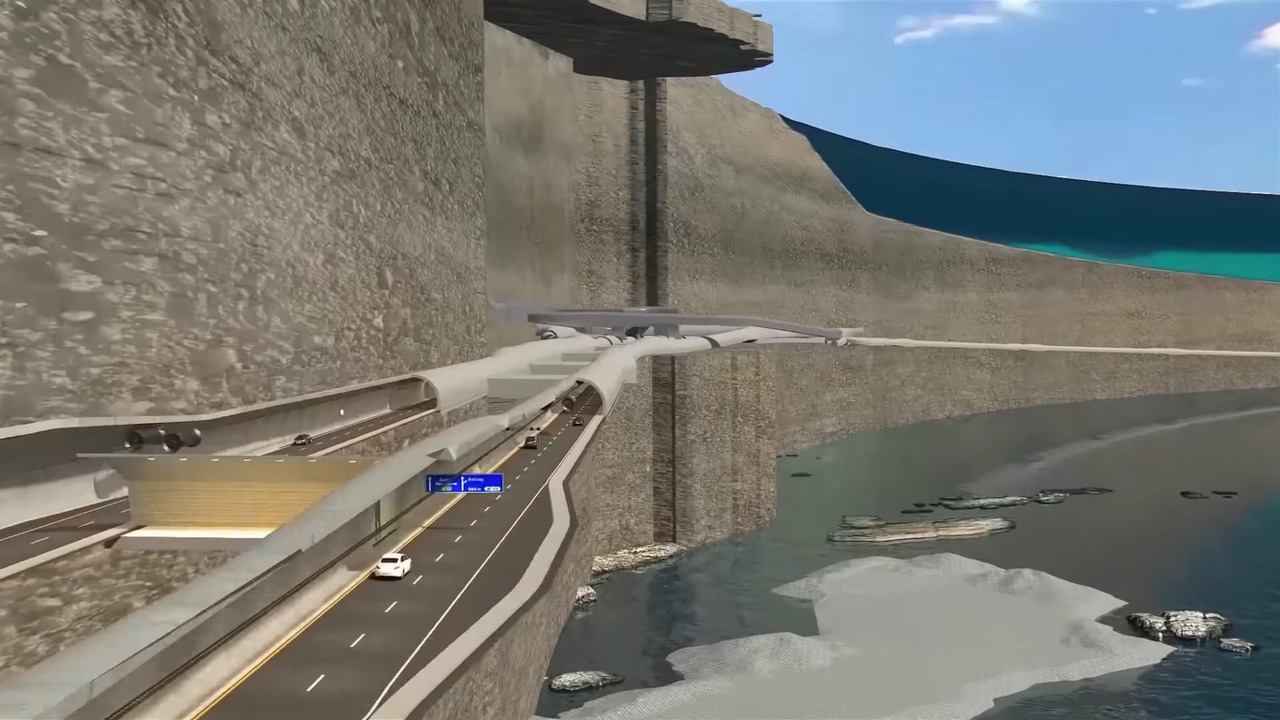
It will just be a matter of time until Norway hosts the longest and deepest undersea road tunnel in the world. The tunnel is known as “Rogfast,” derived from “Rogaland fastforbindelse” — named after the region where it is located and the Norwegian phrase for “fixed link.” Once finished, Rogfast is projected to be 17 miles in length and 1,286 feet below sea level. Currently, the world’s longest passenger tunnel is the Gotthard Base Tunnel located in Switzerland.
A primary objective of this construction initiative is to eliminate the requirement for ferry transport between the Norwegian cities of Bergen and Stavanger. The tunnel is designed to decrease travel duration by approximately 40 minutes and will feature two distinct tube structures — each containing two traffic lanes — along with a central roundabout that connects drivers to an additional tunnel leading to Kvitsøy island.
Rogfast is merely a component of the comprehensive E39 coastal highway renovation project. At present, traversing the 684-mile E39 highway takes about 21 hours and involves seven ferry crossings. Sometime before 2050, engineers aim to completely eradicate ferries through the construction of tunnels and bridges.
CNN reports that Anne Brit Moen, a project manager at Skanska — the international construction company charged with the northern section of the tunnel — stated: “The tunnel will greatly enhance connectivity along the Norwegian west coast by establishing a quicker and more dependable link between the Stavanger and Haugesund areas.”
Engineering Norway’s Rogfast tunnel
The construction of Rogfast has proven to be an intriguing challenge thus far. The project actually commenced in 2018 but faced a setback in 2019 due to budget overruns, prompting a project reorganization and the cancellation of several contracts. Work resumed in 2021, and the tunnel system is now expected to be finished by 2033. The anticipated cost is projected to reach 25 billion Norwegian kroner, which is approximately $2.4 billion.
Rogfast is being constructed by two firms: the previously mentioned Skanska in the north, and a partnership between Implenia and Stangeland Maskin for the central and southern segments. The northern and southern construction teams are working concurrently, aiming to meet at the midpoint.
The teams have a margin of error of only 1.97 inches, necessitating precise engineering. Such high accuracy levels require advanced construction tools, including a rotating laser scanner designed to collect data points throughout the tunnel. This facilitates the creation of a digital replica of the tunnel, which contractors can compare against the construction plans for discrepancies.
The project has already faced various challenges, including numerous saltwater leaks. Builders must also consider how to prevent air pollution from affecting drivers and are actively developing a sophisticated ventilation system powered by jet fans to expel harmful air from the tunnel.
With that in mind, we wonder if this might encourage more drivers to transition to one of the top electric vehicles, which would help maintain cleaner tunnel air.
Where innovation meets the ocean floor
Norway’s talent for innovation extends beyond underwater endeavors: The city of Bergen has discovered an ingenious way to manage waste by utilizing vacuum tubes that essentially extract garbage from the city, significantly reducing diesel emissions by as much as 90% due to a decrease in garbage truck usage.
While it’s anticipated that the construction of Rogfast will mark the end for numerous ferry-related jobs, this new roadway may positively influence other professions, schooling, and public services. Rogfast should also benefit the seafood industry and local economy, as vendors will have the capacity to operate over a broader area.
The Rogfast initiative is advancing steadily. By 2033, all the hours invested in meticulous planning, measuring, and recalibrating will culminate in an efficient transportation system that will allow Norwegians to travel from A to B more swiftly than ever. Perhaps this creativity will be infectious, leading other congested urban areas and coastlines to begin constructing their own underwater highways.
