


Richard Juilliart/Shutterstock
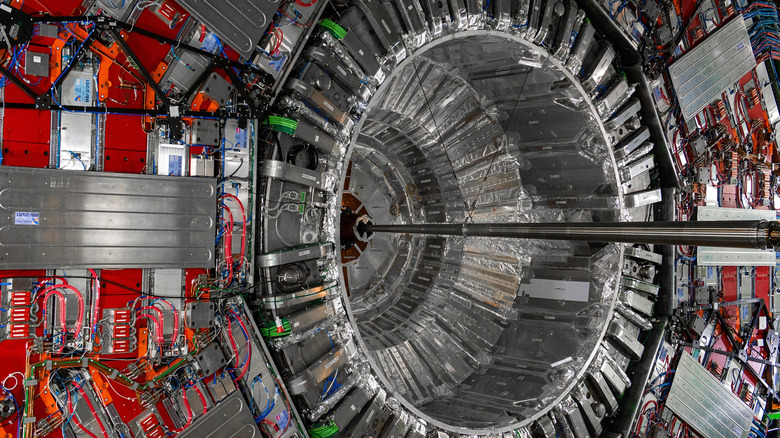
Intended to be the largest particle accelerator globally, China’s Circular Electron Positron Collider (CEPC) was designed to span approximately 100 kilometers or 62 miles. This is significantly larger than CERN’s Large Hadron Collider (LHC), which has a circumference of around 27 kilometers — or nearly 17 miles. These facilities, particularly the LHC, are crucial for investigating how the universe originated during the Big Bang.
The CEPC’s development commenced in 2012, coinciding with CERN’s discovery of the Higgs boson particle; however, it seems that the multibillion-dollar initiative is currently on hold. It was omitted from the country’s upcoming five-year plan set for 2026 to 2030, indicating that it is viewed as a lesser priority by the government — leading to reduced funding and resources. Wang Yifang from the Institute of High Energy Physics verified this update, noting that despite the rejection of a recent proposal for inclusion in China’s five-year plan, the team intends to reapply for the CEPC proposal in 2030.
While not officially confirmed, the projected cost for the CEPC is around $5.1 billion, which the country may prefer to allocate elsewhere. In such a scenario, Wang states that if the European Future Circular Collider (FCC) — the next-generation collider that would essentially succeed the LHC with a significantly larger circumference of 90.7 kilometers (or 56 miles) — receives approval before the 2030 proposals, a collaboration with the respective teams is likely.
In summary, China’s CEPC has been sidelined, likely due to financial and resource demands, yet the European FCC still holds promise, and the Chinese physicist team might collaborate if the FCC proposal is approved before the subsequent cycle of China’s plans.