

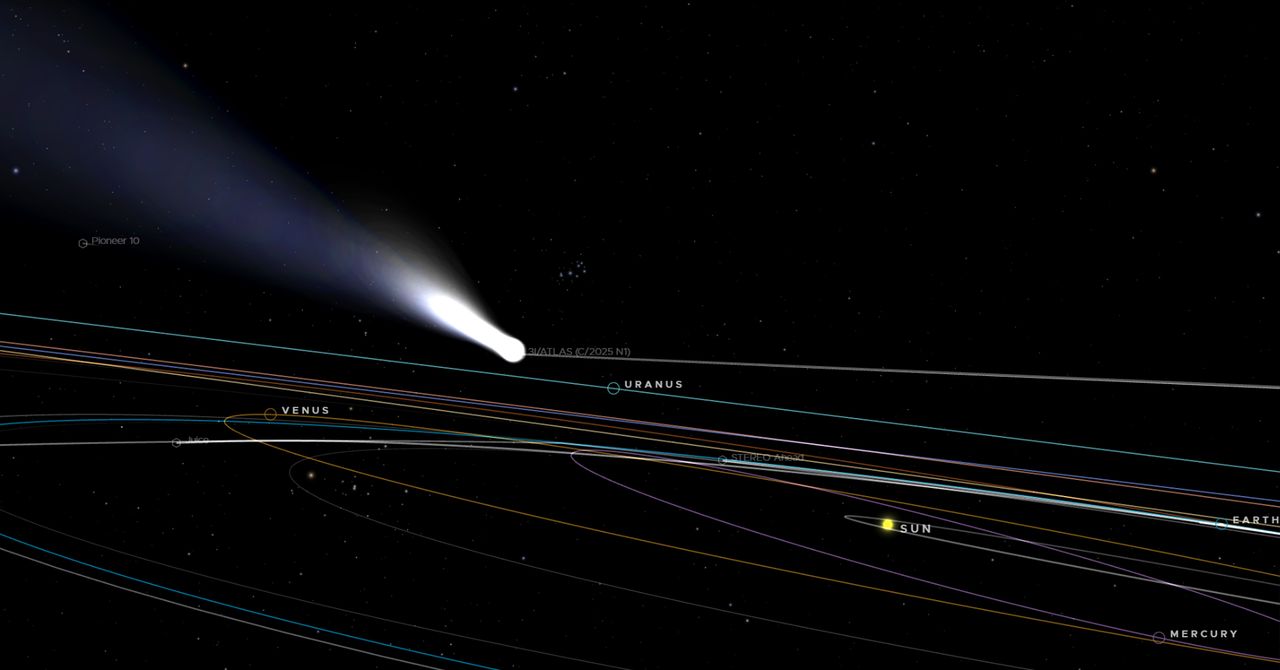
several analysts suspected that 3I/ATLAS was of alien origin. However, a recent publication may shed light on the true nature of this peculiar object. Spoiler alert: It probably isn’t extraterrestrial.
Submitted to the Research Notes of the AAS, the study compares the behavior of 3I/ATLAS to other comets traversing our solar system, associating its unusual flight paths with a phenomenon known as outgassing, which can alter speed, rotation, and orbital trajectory. The paper’s author, Marshall Eubanks, stated that the team assessed the object’s non-gravitational acceleration using two interplanetary spacecraft. The findings, according to Eubanks, indicated that the object exhibited typical behaviors of other comets moving through our solar system.
This paper largely dispels months of conjecture, during which a contingent of Harvard astrophysicists theorized that 3I/ATLAS could be a fragment of extraterrestrial technology. Avi Loeb, a Harvard astrophysicist, even entertained the idea on the Joe Rogan podcast after publishing a draft paper on the topic in July 2025. Concerns heightened in late December when astronomers noted that the comet was emitting an unusual radio signal. However, this isn’t the first occasion that Loeb and others have raised the alien possibility in recent times. For instance, in 2017, the comet Oumuamua passed through the solar system displaying comparable traits. This time, though, interplanetary spacecraft enabled astronomers to perform innovative experiments, measuring the comet’s non-gravitational acceleration without tracking multiple orbits. Therefore, the comet’s legacy may serve as a glimpse into the makeup of distant solar systems, rather than evidence of visitors from beyond.