

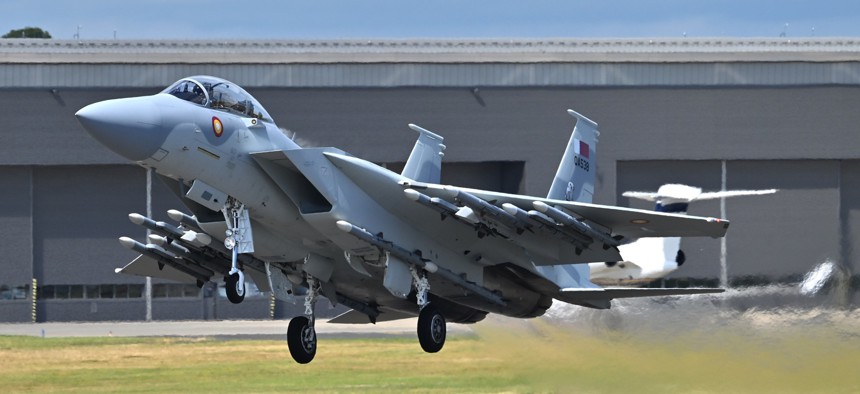
With the continuous evaluation of military drones by the U.S. Department of Defense, air combat is evolving swiftly. Nonetheless, the U.S. military seems to have discovered a method to enhance fighter pilot safety. Particularly by outfitting fighter jets such as the F-15 with deployable unmanned systems capable of utilizing their own air-to-air missiles in battle. The essence of this new superweapon is an aircraft referred to as LongShot by the Defense Advanced Research Projects Agency (DARPA).
This initiative is a result of a partnership between DARPA and General Atomics Aeronautical Systems. DARPA asserts that it anticipates a substantial impact on aerial combat once LongShot becomes operational. For the time being, however, the agency indicates it is observing promising developments from the concept, and it aspires to achieve flight readiness soon. There is no specific timeline available regarding how long this may take, as the LongShot weapon is still progressing towards fulfilling all necessary milestones for its integrated flight-test campaign.
A new superweapon for F-15 fighter jets
LongShot is being engineered to operate with the F-15 platform, one of the primary fighter jets of the U.S. Air Force. Nonetheless, DARPA expresses intentions to create a system that is platform agnostic, enabling integration with various fighters and bombers, thus allowing multiple aircraft to benefit from the unique attributes of the superweapon.
The main objective of the LongShot initiative is to enhance conventional air combat operations, rather than solely substituting them with unmanned fighters. This is because LongShot will necessitate human pilots to guide the weapon, recently designated as X-68A, closer to its target instead of depending exclusively on drones to carry out the entire mission. This implies that fighter pilots will still face some risk, though with LongShot’s involvement, the military aims to reduce their direct exposure to frontline combat. The exact extent to which the system will depend on artificial intelligence remains uncertain, but it is evident that AI is significantly transforming military operations in various ways.
Colonel John Casey, the DARPA LongShot program manager, states that “LongShot mitigates considerable technical risk and offers a feasible route for military services to enhance air combat range and effectiveness from uncrewed, air-launched platforms.” This is achieved by permitting pilots to launch the unmanned device and then withdraw as it engages in combat, utilizing onboard missiles and additional functionalities.
When LongShot will be ready
While DARPA is making consistent strides towards achieving the milestones necessary for LongShot’s flight readiness, it anticipates this may not occur until late 2026 at the earliest. The agency still has to complete ground and integration testing, after which it can proceed to flight-readiness trials. This could transpire swiftly, depending on any issues encountered during testing. However, once testing concludes, the LongShot program’s X-68A seems well-positioned to support pilots in combat situations.
It will be deployable from larger aircraft, allowing it to fly ahead of the main force to confront enemy targets. This capability could prove advantageous for reconnaissance missions in tightly controlled airspace, as well as for safeguarding bombers during critical operations. With numerous other nations advancing toward incorporating drones and unmanned robots into their strategies — exemplified by China’s robot dog armed with a rifle — it is reasonable for the U.S. military to explore unmanned vehicles to enhance effectiveness and safety for its fighter pilots.