

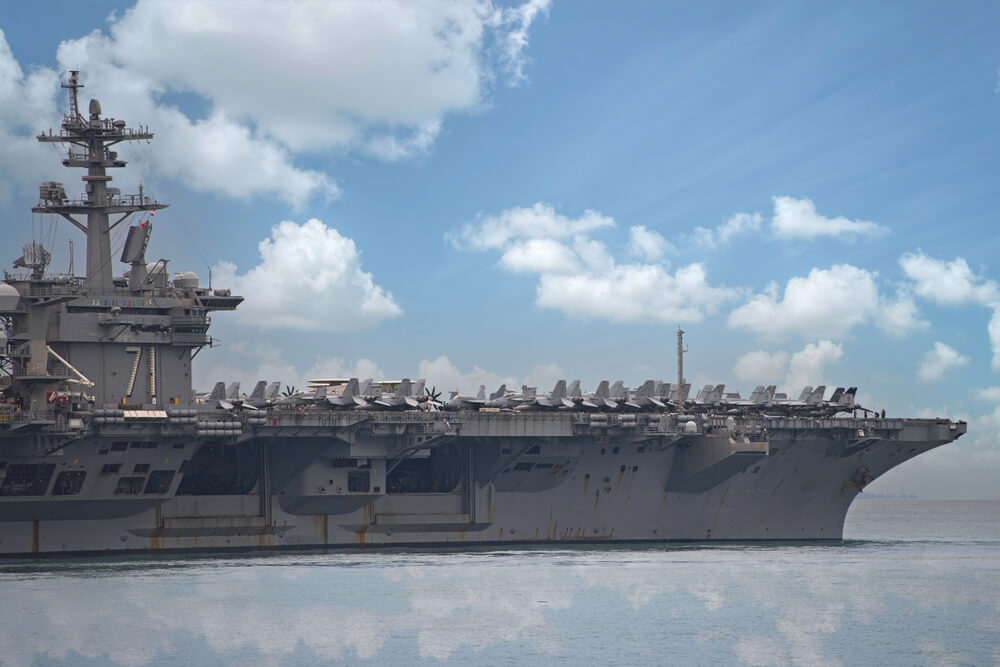
the U.S. Navy is developing a new supercarrier that is set to join the fleet in 2027. Should the United States dispatch another Navy supercarrier to the Middle East, one might wonder how long the journey would take.
The contemporary supercarriers of the U.S. Navy are nuclear-powered giants that can weigh upwards of 100,000 tons. The USS Gerald R. Ford stands as the largest warship in the world and exemplifies the capabilities of a supercarrier. A Ford-class aircraft carrier can achieve a maximum “flanking speed” of around 30 knots (about 35 miles per hour). Ships departing from Naval Station Norfolk in Virginia must cover more than 5,900 miles to arrive at the Suez Canal. The canal measures 120 miles in length, and vessels then need to traverse the 1,200-mile Red Sea and the 920-mile Gulf of Aden to access the Arabian Sea, where the U.S. military is active in the Middle East.
This implies that a Navy supercarrier traveling at 35 mph could reach the Middle East from the United States in under 10 days without any hindrances. A nuclear-powered supercarrier could complete the 8,140-mile trip to the Arabian Sea without stopping or concerns regarding fuel. It may take decades before these carriers need to consider refueling, even though refueling a supercarrier can be a lengthy process when necessary.