
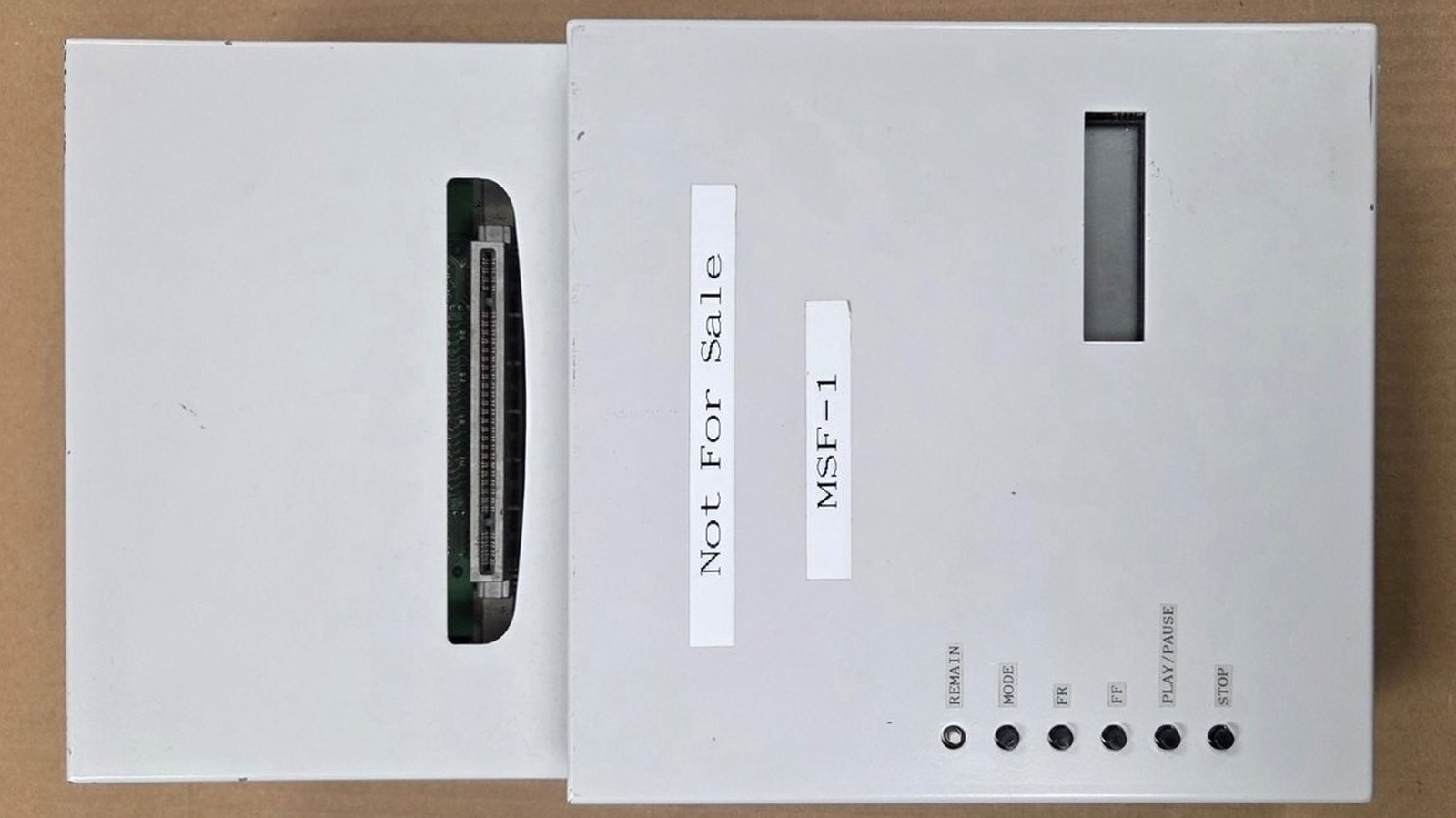

The National Videogame Museum has announced its acquisition of a much-talked-about and iconic piece of video game heritage — the Nintendo PlayStation console, also known as the Sony MSF-1. This is the earliest known model of the collaborative console and, at present, the only unit believed to exist. It’s a bulky, unappealing device that bears little resemblance to what one would anticipate from a contemporary console. To comprehend the background, we need to travel back in time.
The original Sony PlayStation transformed the gaming landscape in 1994-1995 and set the foundation for modern gaming. It was the first to offer real-time rendering of intricate 3D environments and transitioned from cartridge-based game distribution to compact discs. However, a lesser-known aspect of the console’s early concepts, or rather its initial design, is that it was a joint effort between Nintendo and Sony. At that time, the industry was largely controlled by Nintendo and Sega, making a collaboration with Nintendo quite logical. As part of this partnership, the Sony console under development would have accommodated both the company’s soon-to-be hallmark CDs and Nintendo-style cartridges, while significantly enhancing the SNES’s processing power. Nintendo eventually withdrew from the agreement, and Sony proceeded to create the console known today as the PlayStation.
The Sony MSF-1 is an early prototype of the Super Nintendo CD add-on, which never reached final production nor underwent a more consumer-friendly design update. The National Videogame Museum now displays it at its facility in Texas, where those interested can view it up close. Additionally, the museum boasts the incredibly rare Atari Cosmos console, paired with a vast assortment of renowned video game displays.
The Sony MSF-1 is technically not a console
One of the first things you might notice, especially from the side angle, is that the MSF-1 oddly does not resemble a console at all, although it could align with the form and style of a traditional Nintendo console, like the SNES. This is due to the fact that it was initially intended to be an attachment. In the side view, you can spot a connector that likely would have plugged into the console’s cartridge port. On top of the MSF-1 is an additional cartridge port, alongside a separate compact disc slot at the front. This unit would have been referred to as the “Play Station,” or the SNES-CD.
Naturally, it boasts a completely different design than the Nintendo PlayStation Superdisc, or the original prototype held by one of the PlayStation co-creators, which was auctioned for $200,000. Consumer electronics often undergo numerous prototype stages to refine and test designs before their official launch. Interestingly, you can observe the various phases of this process in the early models of the Nintendo PlayStation, from the add-on for SNES to the operational console prototypes that are equally rare. It indeed raises questions about how circumstances might have unfolded if the Sony and Nintendo partnership had succeeded. The fallout of the collaboration is frequently cited as a catalyst for Norio Ohga, President of Sony, and Ken Kutaragi, Sony’s lead engineer, to significantly accelerate the development of the Sony PlayStation project. This is particularly noteworthy considering that the Sony PlayStation 5 has now sold over 50 million units and achieved tremendous success.