
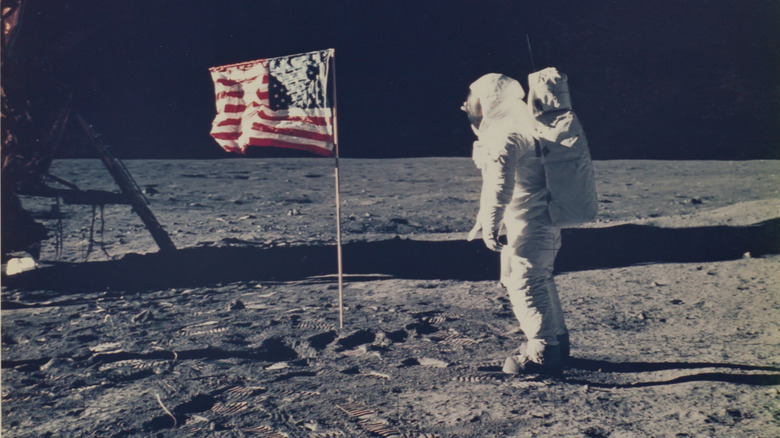

vacate the ISS in the event of a medical crisis, but what happens when astronauts are in lunar orbit? The Moon is considerably more distant. Nevertheless, NASA had strategies in place to extract astronauts — to some extent. It ultimately relied on the Command and Service Modules (CSM) that initially transported astronauts to the Moon.
As reported by Wired, the firm that constructed and designed the CSMs for the Apollo Missions, North American Aviation (NAA), developed proposals for a “one-man CSM mission” capable of rescuing stranded astronauts. NAA offered a general outline regarding how a single astronaut would occupy what was labeled a “rescue CSM” and, in case of an emergency, implement “adjustments” that would allow it to dock with the Apollo Lunar Excursion Module (LEM). NAA’s designs also incorporated extra space for rescued astronauts and umbilicals that would enable them to connect their oxygen supplies to the CSM’s (no point in rescuing them if they lack breathable air). The concept was that the rescue CSM would be on standby during each expedition, situated atop a Saturn V rocket and poised for launch at a moment’s notice.
NAA put forth two “programs” to produce the necessary rescue CSMs. One initiative entailed modifying two existing CSMs and preparing them by 1969, followed by constructing one per year; the alternative initiative would have NAA fabricate nine CSMs each year.