

From “Star Wars” films to a multitude of video games, ambulatory vehicles feature prominently as a staple of sci-fi and action narratives. In these stories, such vehicles are typically portrayed as advanced armored tanks that trudge across battlefields while unleashing beams of laser fire on defenseless targets. Nevertheless, considering how many real-life innovations have drawn inspiration from science fiction, you might question whether any actual counterparts to these vehicles exist — or if they ever will.
It appears that several prominent entities in the automotive and electronics sectors have looked into the creation of walking vehicles in the past. Some delved into this idea decades ago, while others have been developing walking vehicle prototypes as recently as a few years back. Although these machines have yet to see widespread use, the ongoing experimentation and advancements indicate that legged vehicles could one day step off the silver screen and into our everyday lives.
Organizations such as GE and Hyundai have been involved in walking vehicle experimentation.
General Electric itself conceptualized a walking tank prior to moviegoers encountering the notion in “Star Wars: The Empire Strikes Back.” Footage showcasing the vehicle, which GE named the “Pedipulator” (also known as the Quadruped), illustrates a human operator controlling the four legs of the machine via a hydraulic system that mimics the operator’s limb movements. The narration in the video clarifies that GE designed this walking tank for the U.S. Army with the intention of supplying a vehicle capable of assisting troops in maneuvering across challenging terrain. Only one unit was produced, as budget reductions prevented any additional development of the Pedipulator.
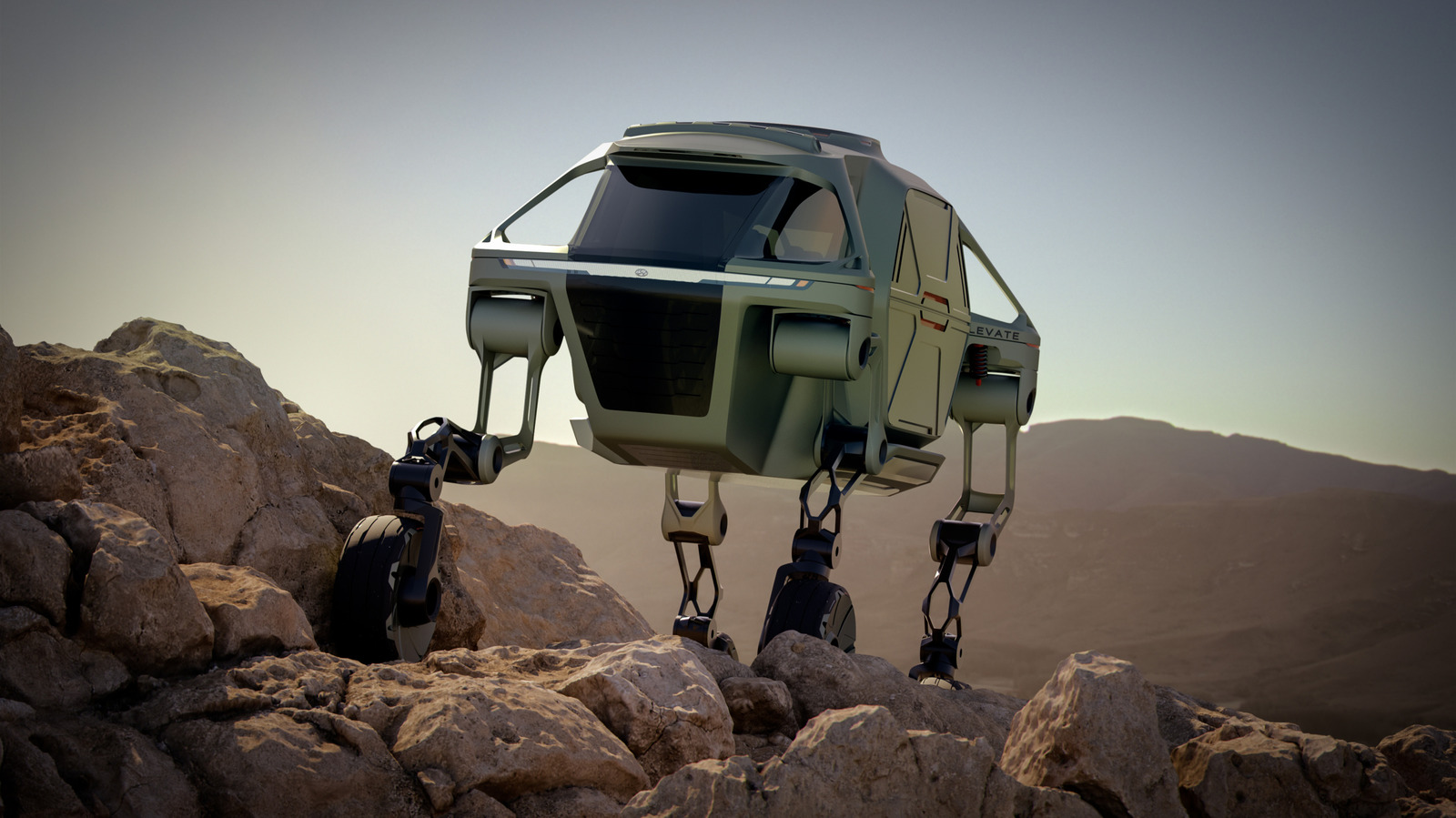
Fast forward to 2019, a similar concept from Hyundai seems to have faced a related outcome. In a 2019 press announcement, the company disclosed that it was developing what it described as “the first Ultimate Mobility Vehicle (UMV),” known as “Elevate.” A concept video depicts how the vehicle would feature a chassis equipped with four extendable legs, enabling various “walking modes” when driving becomes ineffective or impossible due to terrain. The announcement mentioned that the vehicle could aid first responders in navigating debris fields without having to proceed on foot and could serve as an accessible cab that elevates — pun unintended — its chassis, allowing a passenger in a wheelchair to board. Unfortunately, apart from this press release, no updates regarding Hyundai’s Elevate have surfaced for nearly five years.
These examples highlight just two walking vehicles that remained largely in the concept phase, although other walking vehicles have been created in the past. For instance, the Finnish firm Timberjack constructed a walking harvester several decades ago, and the U.S. Forest Service even provides an image of such a prototype.
Reasons walking vehicles haven’t gained traction
The presence of walking vehicles in both sci-fi films and real-world design ideas underscores our evident fascination with them. So, why haven’t they entered the mainstream? The intricate nature of walking itself provides some answers.
To a degree, walking vehicles hold an edge over wheeled counterparts because they can traverse terrain impassable by wheels. However, beyond this advantage, walking vehicles tend to be unwieldy and slow due to the challenges inherent in replicating a walking motion; this limitation hinders their potential for broader adoption. Simply put, they are complex to design, construct, and operate.
That said, these vehicles may not be permanently confined to fiction. Not long ago, the concept of autonomous vehicles was purely speculative. Presently, robotaxis are operational in cities throughout the United States. Likewise, spider-like robots have emerged from our nightmares into reality. As technological advancements progress, walking vehicles might one day become genuinely practical.