
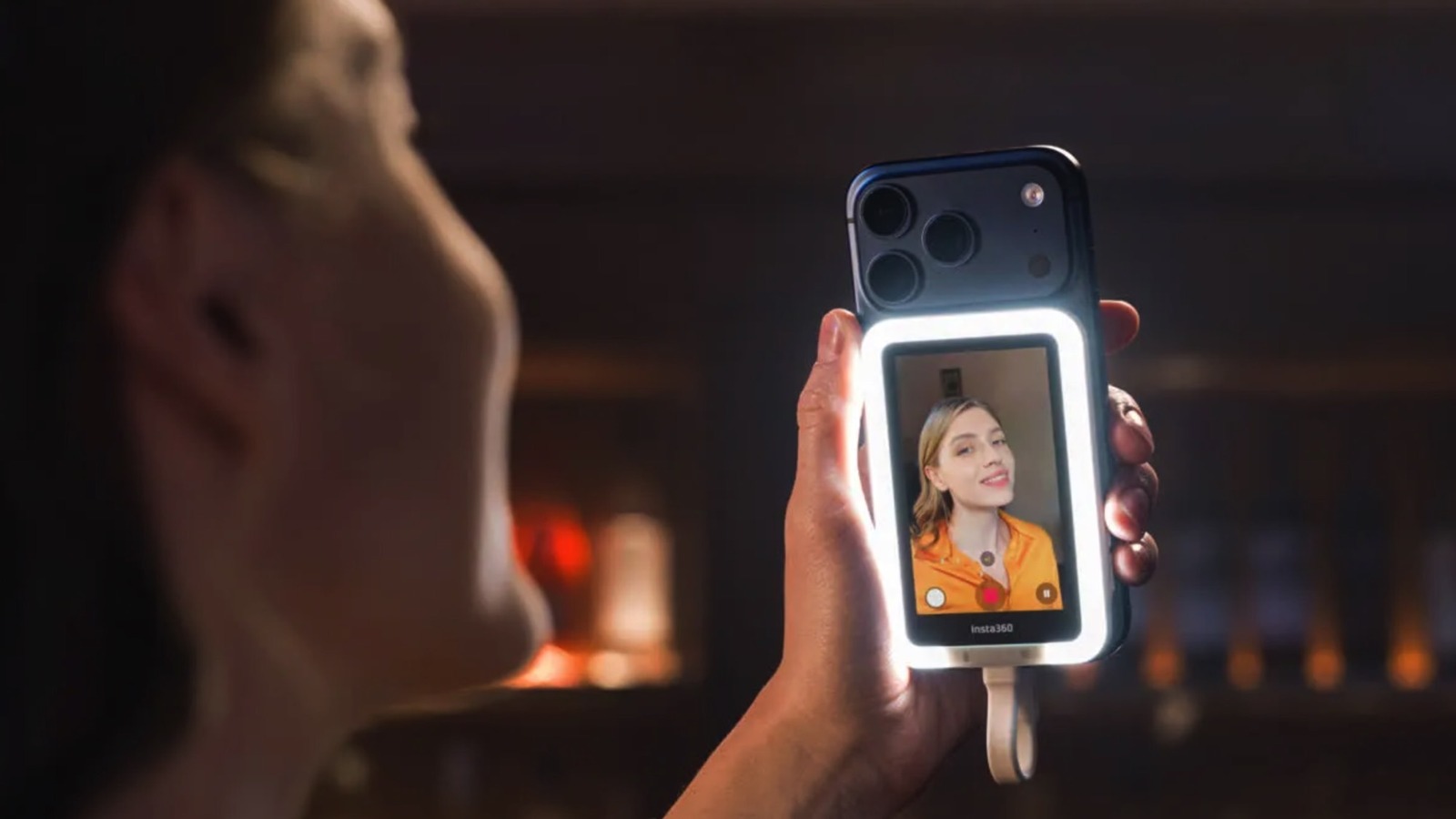

The iPhone 17 series has brought a selfie camera enhancement through a square sensor, enabling users to capture higher-quality selfies than before. Remarkably, users can take selfies in both portrait and landscape orientations without the need to rotate the phone. This minimizes the hassle of adjusting the device for the ideal shot. However, iPhone users who frequently take selfies and film themselves with the front camera might prefer utilizing the superior main sensor located on the back of the phone instead of the selfie camera. This is where an innovative new accessory from Insta360 proves beneficial. The Insta360 Snap Selfie Screen is a 3.5-inch magnetic display that attaches to the back of the phone, allowing users to employ the rear camera for selfies. Its ability to securely connect to the iPhone’s MagSafe ring is the reason most Android devices can’t easily utilize it.
If the Insta360 Snap seems recognizable, it’s due to a recent viral Kickstarter campaign proposing a similar idea to enhance iPhone selfies. The Selfix case is designed for iPhone 17 Pro users, featuring a small round display on its back. Although the Insta360 Snap is thicker than a case, it is compatible with more iPhone models. This magnetic monitor works with iPhone 15 models or later and is available for immediate purchase, so users won’t have to wait for a crowdfunding initiative to finish.
What can the Insta360 Snap accomplish
The Insta360 Snap will undoubtedly attract content creators, especially those who film themselves. It also appeals to iPhone users who frequently take selfies. Since it doesn’t have its own battery, the Snap draws power from the iPhone while connected. It includes a built-in USB-C cable, which is how it connects to the iPhone once it’s magnetically attached to the back of the device. According to Insta360, the monitor utilizes approximately 6% of battery life during 10 minutes of continuous use, so it’s advisable to turn the screen off or detach it from the phone when it’s not in use.
The Insta360 Snap features a 3.5-inch display with 550 nits of brightness and an 800×480-pixel resolution. The touch screen enables users to operate the camera app just as they would when using the iPhone’s screen. You can switch between cameras, zoom in and out, and take a picture. As the monitor mirrors the iPhone’s display, the Insta360 Snap is compatible with other camera apps as well, not just the iPhone’s pre-installed Camera app. Additionally, the Insta360 Snap comes with a protective cover that can fold over the iPhone display to prevent unintended screen taps.
Insta360 is presenting two variations of the Snap – a basic version and one with a light ring surrounding the display for those who frequently photograph in low-light conditions. The standard model begins at $79.99, whereas the Insta360 Snap Selfie Screen with Light costs $89.99. The more affordable option weighs 75.5 grams and is 7.3 mm thick, while the variant with a light ring is somewhat thicker and heavier at 8.2 mm and 88.6 grams.
What about support for Android?
Insta360’s promotional materials, images, and videos predominantly showcase iPhone devices, indicating that the Snap Selfie Screen is primarily aimed at Apple users. This is due to MagSafe being the crucial iPhone feature that ensures the Insta360 Snap remains securely attached. The monitor needs to be firmly affixed to the rear panel of the handset to allow use without the concern of it shifting. This is why Android devices are not represented in Insta360’s announcements or presentations, as they typically lack magnetic rings on their backs. However, the Google Pixel 10 series supports Pixel Snap, making them compatible.
Nevertheless, Insta360 has devised a solution for Android users who wish to take selfies utilizing the rear camera module with the Snap monitor’s assistance. The device includes a magnetic ring that can be affixed to the back of any Android phone. Alternatively, utilizing a MagSafe-compatible case with your phone is another option. Once properly set up, any phone can connect to the monitor as long as it supports screen casting via USB-C.