
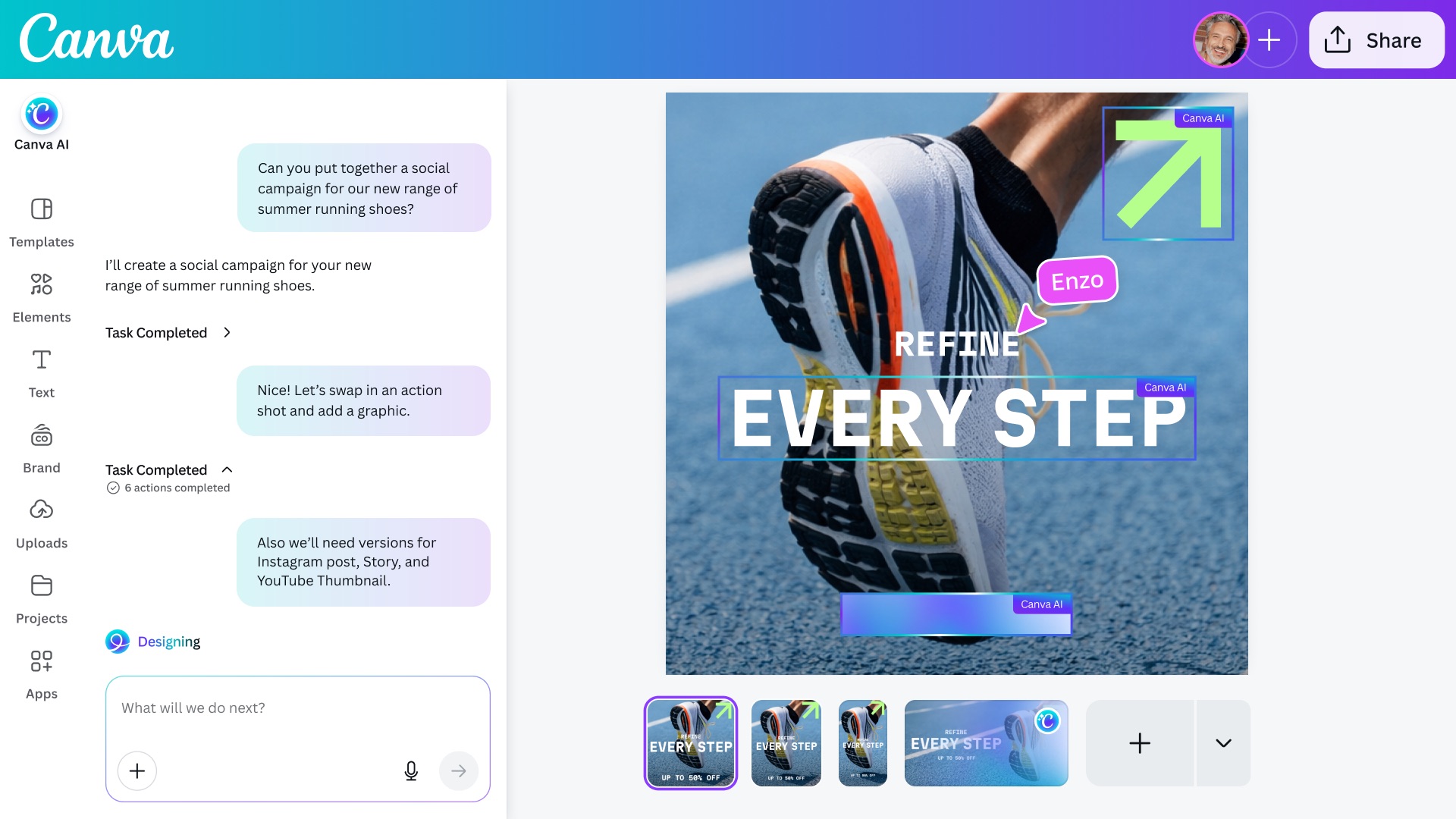

The key promise of emerging AI platforms is allowing users to outline tasks, with the AI handling planning, using necessary tools, and learning preferences for future tasks. This is crucial for design professionals seeking automated workflows for content and media creation.
Canva is embracing this approach in its latest Canva AI assistant update, which employs AI to enable users to craft editable designs through text prompts. Users describe their desired outcome, and the assistant activates appropriate tools to generate several options. The design process involves layers, giving users the ability to adjust different elements of the final product as they wish.
This update aligns with Canva’s efforts to integrate its AI assistant into user workflows and expand its capabilities to include image and website generation.
Competitors are pursuing similar advancements. Adobe introduced a Firefly AI assistant for task execution through its apps, and last month, Figma integrated AI agents into its platform with MCP server support.
Cliff Obrecht, Canva’s co-founder and COO, emphasized that while many firms seek to integrate workflows, businesses often prefer final editing and publishing in Canva. He stated, “Many small businesses rely entirely on Canva for their workflows. We collaborate well with Anthropic, Google, and OpenAI, enabling users to engage Canva for content creation within these platforms, but the final stages of editing, collaboration, and deployment remain our strength.”
Canva’s revenue primarily comes from individuals and small teams, but its enterprise sector has grown 100% yearly. Obrecht noted that Canva, recently valued at $42 billion per PitchBook, may go public next year.
The update also includes integrations with Slack, Gmail, Google Drive, Calendar, and Zoom, allowing the AI to build context by accessing emails, conversations, files, and meeting data. A web research feature will enable the AI to perform internet tasks. Additionally, a scheduling feature lets users set repeatable tasks to run in the background, creating drafts for review and posting.
Canva enhances its AI tools with an AI code generator now capable of importing HTML and creating spreadsheets through text prompts. The company reported improved AI model performance, stating its Lucid Origin image-generation model is now 5x faster and 30x cheaper, while the 12V image-to-video model is 7x faster and 17x cheaper.
Canva AI 2.0 launches in research preview this week and will soon be available to all users.