

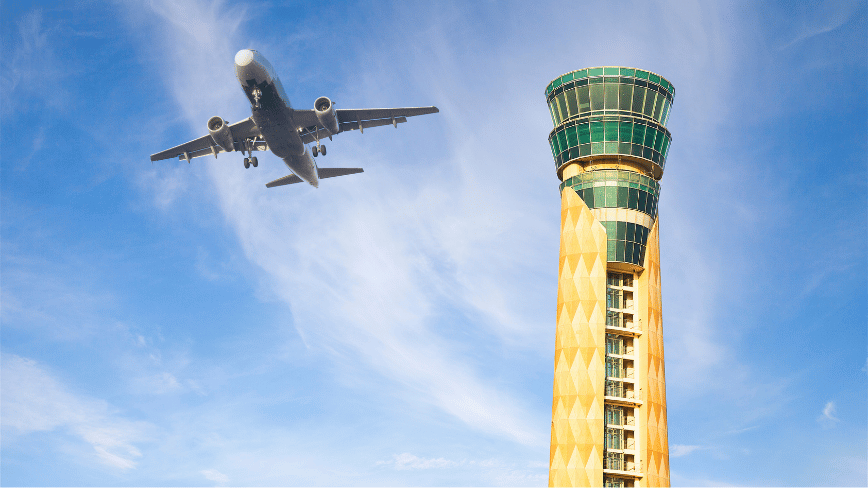
The FAA is working on SMART (Strategic Management of Airspace Routing Trajectories), an AI system to enhance air traffic conflict prediction from 15 minutes to two hours. Palantir, Thales, and Air Space Intelligence are in contention for the contract. This initiative follows a crash at LaGuardia that highlighted controller overwork and outdated systems. It is part of a $32.5 billion modernization effort by the agency, aimed at replacing 612 old radar systems and hiring 1,200 new controllers in fiscal 2026.
The Federal Aviation Administration is creating an AI system called SMART to enable air traffic controllers to predict and address flight issues up to two hours in advance, improving on the current 15-minute planning window. Palantir, Thales, and Air Space Intelligence are competing for the contract. Transportation Secretary Sean Duffy announced the project and the bidders on April 17, with further details to come on April 21.
SMART, short for Strategic Management of Airspace Routing Trajectories, employs high-fidelity 4D modelling to foresee bottlenecks and schedule conflicts before takeoff. This system aims to shift air traffic management from reactive to predictive, tackling the core issue of infrastructure designed for fewer flights and dependent on real-time decisions by controllers with limited future visibility. The FAA forecasts that the system could be operational in some capacity this year.
The three bidders
Palantir Technologies has the deepest government connections among the competitors. Its projected revenue for 2026 is around $7.2 billion, a 61% growth, spurred by a $10 billion Army contract and partnerships with GE Aerospace and Airbus. Its government revenue surged 70% year over year in Q4 2025. Palantir’s aviation AI proposal expands on its main business of processing extensive operational data into actionable decision-support interfaces.
Thales, a European aerospace and defense firm, has over 85 years of supplying air traffic systems to the FAA and Department of Defense, with over 99% of US airport instrument landing systems using its equipment. Its TopSky platform is already part of existing aviation infrastructure, providing it an advantage in integrating SMART.
Air Space Intelligence, a Boston-based startup backed by Andreessen Horowitz, is the smallest but potentially the most pertinent competitor. Its Flyways AI already oversees over 40% of US air traffic, utilizing the 4D modelling and optimization needed for SMART. ASI recently teamed with Joby Aviation to integrate electric air taxis into national airspace.
Why this matters now
SMART’s development is driven by necessity. On March 22, Air Canada Express Flight 8646 collided with a fire truck on a LaGuardia runway. The controlling air traffic officer was managing dual roles, and the automated safety system failed due to track creation issues. This incident spotlighted ongoing warnings of controller overwork and outdated technology, with diminishing error margins as traffic increases.
The FAA has received $12.5 billion from Congress for air traffic control modernization and estimates an additional $20 billion needed to complete the overhaul. The agency is replacing 612 outdated radar systems, moving the NOTAM system to the cloud, and is rapidly hiring controllers, having recruited nearly 1,200 new ones in fiscal 2026, fulfilling about half of its annual target. FAA Administrator Bryan Bedford, confirmed by Congress last July, has prioritized SMART in the modernization agenda.
DOGE, Elon Musk’s Department of Government Efficiency, is also involved with FAA improvements. DOGE staff have visited air traffic control sites for operational evaluations, with Musk indicating “rapid safety upgrades”. Project Lift is also reallocating FAA funds for enhancing network communications. DOGE is expected to conclude on July 4, with a successor entity continuing its work.
The contract dynamics
The competition between Palantir, Thales, and Air Space Intelligence showcases three distinct approaches to government AI procurement. Palantir provides a versatile platform for various government applications, supported by security clearances and institutional links. Thales offers unmatched domain expertise and an established base beneficial for SMART integration. ASI presents a tailor-made aviation AI platform already handling substantial traffic the FAA seeks to manage.
The FAA’s record with tech modernization is mixed. The NextGen program took over a decade and went over budget. The air traffic control workforce is wary of automation changing established processes, and government aviation procurement