
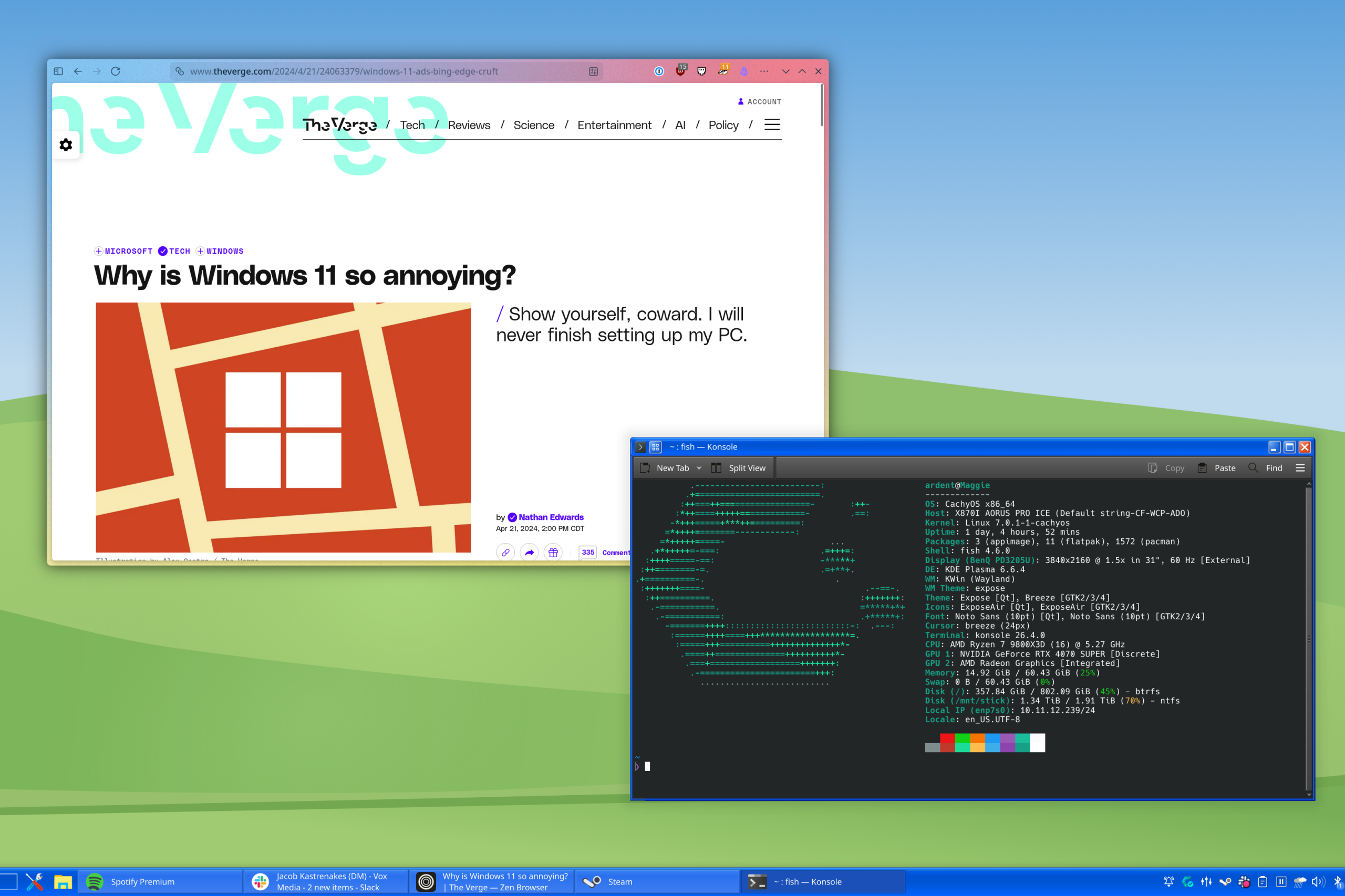

I regret nothing.
In January, I fulfilled my promise to install Linux on my desktop and see how far I could get using it as my main computer without prior research or extensive troubleshooting. I’ve booted into Windows twice since, once for scanning a multipage document and once for printing a photo urgently. It took me three months to write the next installment in my Linux diary because nothing has gone terribly wrong.
My Linux setup quickly transitioned from feeling new and exciting to just being my computer. It’s less annoying than Windows, but it isn’t exactly like it. The transition has been easier than expected, with mostly smooth processes for finding and installing apps, though some are missing on Linux. I’ve encountered a few fun bugs and frustrating moments, but the experience is more robust and calmer than expected. Troubleshooting is surprisingly satisfying.
Fortunately, any issues have been minor and often amusing, stemming from my hardware choices or my deliberate selection of a rolling Arch-based distribution over something like Ubuntu. For example, the HP OfficeJet 8720 printer has been problematic, and my gaming mouse only works in games.
The built-in utility Snapper in CachyOS provides system snapshots, but my boot partition ran out of space quickly, forcing me to resize it. It was a tedious but straightforward task.
Another challenge was that my ethernet connection wouldn’t retrieve an IP address after waking from sleep unless I connected to Wi-Fi first. After much troubleshooting, I discovered an old networking switch setting called STP was the culprit, resolving both the ethernet issue and a Sonos speaker problem.
My current issue is the mic on my Logitech Brio webcam, which frequently fails during meetings, likely due to EasyEffects. I have alternatives, so it’s not a pressing concern.
Some problems solve themselves with time. I wanted text extraction for screenshots, and after a week, the feature appeared in a KDE Plasma update.
Previously, I lamented the absence of the Arc browser, but readers recommended Zen, an open-source Firefox-based alternative, which has been satisfactory. I’ve also found a Spotify client and set up various tools like git and ZMK firmware on Linux.
Facial-recognition unlocking with howdy is less secure than Windows Hello, so I opted to continue typing my password. Biometric solutions are better implemented in Windows and macOS, given their substantial investment in the technologies.
Gaming on Cachy has been stable for non-competitive titles, and the Keychron M5 mouse has replaced my old gaming mouse and trackball.
Despite some quirks, I enjoy troubleshooting Linux more than Windows, as the challenges arise from my choices rather than imposed changes. Linux embodies the Unix philosophy of modular, single-purpose tools, making it like a box of Lego, encouraging skill development.
I still use Windows on my laptop, particularly enjoying the Surface Pro. While Microsoft acknowledges its issues, the fun of using Linux on my desktop outweighs the frustrations, so I’ll continue.