
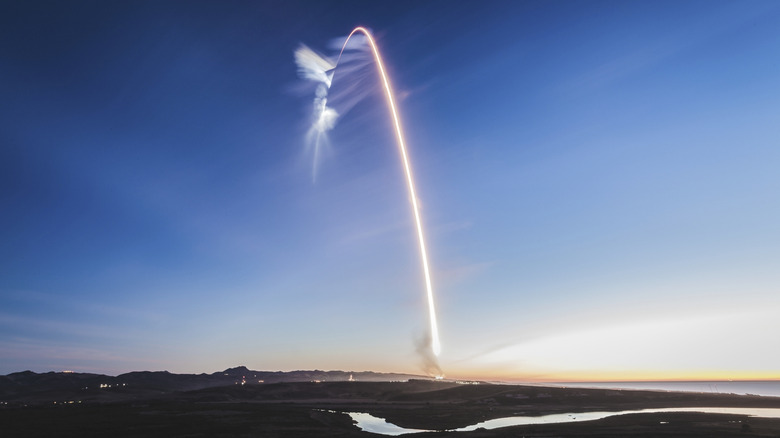

At various times in your life, you have likely observed a rocket taking off vertically into the heavens. You may have even seen Artemis II’s Orion spacecraft swiftly ascend to space, initiating NASA’s most significant mission in decades. However, you may have also observed that, following liftoff, the rocket does not remain upright. As the spacecraft ascends, it starts to arc, giving the impression of flying horizontally, parallel to the Earth. This might seem counterintuitive for a vessel aimed at escaping the atmosphere and venturing into outer space, but it is actually a crucial aspect of a rocket’s voyage. And it involves fuel.
Rockets, similar to other aerial vehicles, contend with gravity. They require maximum thrust for their initial ascent, which is why they begin in a vertical position. Nevertheless, this also leads to a substantial consumption of fuel. Maintaining that stance for an extended period would deplete their reserves and cause them to plummet back to Earth. Such an event would be catastrophic for both the crew and anyone unlucky enough to be at the crash location, hence rockets must curve to conserve fuel, combat gravity, and attain orbit.
Rockets employ a gravity turn to achieve orbit
Once they penetrate through the densest layers of the atmosphere where gravity is most potent, rockets curve to harness it to their advantage. This is referred to as a gravity turn. It is vital to understand that the Earth’s gravity pulls objects towards its core, not merely downward. By tilting until the denser side is oriented towards the ground, rockets can enhance their acceleration by utilizing gravity rather than relying solely on fuel to reach orbit.
In technical terms, orbit is achieved when the spacecraft’s horizontal acceleration and the gravitational pull equate, essentially falling without making contact with the ground. For numerous missions, that is the objective. However, for Artemis II, which transported astronauts to the moon for the first time in over half a century, Orion required an additional maneuver known as the translunar injection burn to escape Earth’s gravity and enter deep space. Subsequently, the spacecraft utilized the moon’s gravity to adjust its course back to Earth, enabling the four Artemis II crew members to return home safely with vibrant new findings.