author

How to Recognize the Poisonous Ants Infiltrating the Southeastern U.S.

The climate is at last getting warmer, and shortly it will be time for short-sleeve attire, outdoor picnics, and cooling drinks in coolers — all essentials for enduring the summer. However, warmer weather brings along insects, including invasive ant species. Sadly, one such species is gradually invading southeastern regions of the United States. If you happen to be stung by one, you may face a significant amount of discomfort.

Brachyponera chinensis, commonly referred to as the Asian needle ant, is a type of ant originating from various Asian nations, such as China, Japan, and the Koreas. Although this ant was first recorded in the U.S. in the 1930s, it has only recently begun to spread across the American Southeast in states like Florida, Georgia, South Carolina, and Tennessee. Reports have also emerged of sightings in Wisconsin, Washington, and Texas.

As an invasive species, Asian needle ants present a threat to our native ant populations, which play a crucial role in local ecosystems. Furthermore, Asian needle ants are problematic as they belong to the limited group of insects that are venomous to humans. While the sting of the common fire ant is intensely painful and can even result in scarring, life-threatening allergic reactions are infrequent. In contrast, stings from Asian needle ants not only cause considerable pain but also appear to be more likely to trigger severe allergic reactions. Bee stings are less likely to provoke allergic responses than those from Asian needle ants.

How to recognize an Asian needle ant

Ants are quite small, making it easy for many to appear indistinguishable to the untrained observer. Nevertheless, if you’re aware of the specific characteristics to look for, you can identify whether the ant you’re about to step on is an Asian needle ant without needing to be stung first.

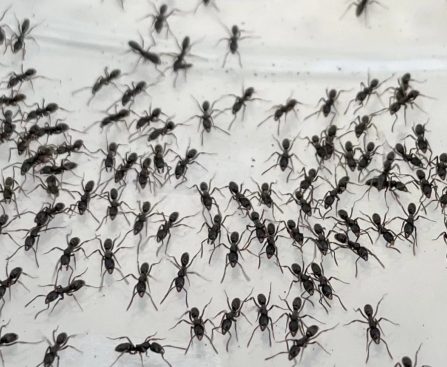
Asian needle ants are particularly diminutive, typically measuring about one-fifth of an inch in length, and they are often dark brown or black with lighter-hued legs and mandibles. These ants enjoy establishing nests in homes and other locations with a dependable food source. If you encounter an ant within your home and are concerned it might be an Asian needle ant, attempt to trap it in a glass jar. If it can’t climb the sides, you are indeed dealing with an Asian needle ant — unlike many ant species, this kind cannot adhere to smooth surfaces like glass.

While Asian needle ants will gladly consume sugary treats they come across — yet another reason to invest in smart kitchen tools such as vacuum sealers and airtight storage containers — their actual preference lies in feeding on other insects. Termites seem to be among their favored meals, but they are also known to eat spiders, cockroaches, and centipedes. Therefore, if you’re facing an infestation of any of those pests, it may be worth consulting your local exterminator about a potential Asian needle ant issue.

Managing Asian needle ant stings and infestations

Per the USDA, Asian needle ant venom is strong enough to induce significant pain that lasts several hours. While most individuals only feel pain at the sting site, some have reported that the discomfort moves to various parts of the body. Hives, general redness, and itchiness are common symptoms; however, these stings can pose a serious risk for those who are allergic. A study published in The Journal of Allergy and Clinical Immunology noted that seven individuals in a 327-person sample from a specific area in Korea showed an allergic response to the venom of Asian needle ants. Among those seven, four — or 57% — experienced “potentially life-threatening anaphylaxis.” The occurrence of allergies and hypersensitivity to Asian needle ants in the U.S. population is not yet fully understood, but if you’ve been stung by one of these ants and have a history of sting-related allergies — or if the pain and redness continue for several days — seek medical attention immediately.

Since the Asian needle ant invasion is fairly recent, and because these pests tend to prey on other insects, exterminators have not yet figured out a dependable approach to deal with them. North Carolina State University suggests using “protein-based insecticide baits,” such as Extinguish Plus, Advion Fire Ant Bait, Potigard, and Maxforce FG. However, these products are intended for managing infestations rather than completely eliminating them. Orkin recommends sealing any entry points for the ants, minimizing indoor moisture, clearing outdoor leaves and plant debris to discourage nesting, and ensuring the home is free of accessible food (robot vacuums work well for picking up leftover crumbs). If these measures don’t succeed, reaching out to your local pest control service may be necessary.

Court Decides in Favor of iyO in Trademark Conflict with OpenAI and Jony Ive

The United States District Court for the Northern District of California has approved iyO’s request for a preliminary injunction, stopping OpenAI and Jony Ive’s new hardware initiative from utilizing the io branding. Here are the specifics.

### A Bit of Background

Last year, Sam Altman and Jony Ive revealed that their companies would collaborate under a new enterprise named io to create AI-driven products. Shortly thereafter, a company known as iyO initiated a lawsuit, claiming trademark violation. iyO obtained a temporary restraining order, leading OpenAI to remove references to the newly established venture from online sources.

In the subsequent weeks, iyO and OpenAI submitted several documents indicating that the companies had communicated before the io announcement, including product demonstrations. OpenAI contended that some of this outreach included unsolicited information and investment proposals from iyO, while iyO recently revised its lawsuit to claim trade secret theft.

Meanwhile, iyO also presented the findings of a consumer survey to the court, arguing that the brands were sufficiently similar to likely create confusion among consumers if OpenAI were to launch products too similar to its own, such as connected headphones.

OpenAI, for its part, asserted that its initial product would not be an AI-enabled wearable and mentioned earlier this year that it no longer intended to use the io branding at all, requesting the court to dismiss the lawsuit.

### Court Sides with iyO

In a ruling made yesterday, U.S. District Judge Trina Thompson granted iyO’s request for a preliminary injunction, effectively prohibiting OpenAI from utilizing the io branding. Judge Thompson was not persuaded by OpenAI’s choice to voluntarily discontinue the use of the io branding and raised concerns about whether the company might revert to using the mark in the future.

She noted that if OpenAI indeed does not intend to use the mark, an injunction should not pose an issue, but if it does, it offers protection to iyO. She also concluded that iyO “is likely to succeed on the merits of its Trademark Claim” and acknowledged that iyO could continue to experience “irreparable harm (…), including an inability to attract new investors, the depletion of its funding, and the appropriation of its brand equity.”

Following the injunction, the case is progressing further into discovery. In another ruling also issued yesterday, Judge Peter H. Kang instructed attorneys for both parties to meet and discuss ongoing discovery disagreements and report back to the court “no later than May 29, 2026.”

XChat: Fresh Capabilities Now Accessible in X’s Independent Messaging Application

### XChat has officially debuted on iPhone and iPad

As of Friday, April 24th, the XChat application has officially debuted, offering a standalone messaging solution from X. This new app is now accessible for download on the App Store for both iPhone and iPad users.

XChat sets itself apart from the official X app by adopting the iOS 26 design, featuring the updated iOS 26 keyboard, while the X app continues to use the older iOS 18 keyboard. Users who have depended on X or Twitter for direct messaging will discover XChat to be a considerable enhancement, elevating their communication experience.

The app includes a range of fun icons, facilitating personalization and a more captivating user interface. Users can adjust settings such as light/dark mode, message permissions, and tailor the left swipe interaction to either like a message or retrieve more information.

XChat is crafted for privacy and security, providing end-to-end encryption for all messages, and it is free from ads or tracking. The app enables users to engage in private conversations with anyone on X in a concentrated environment.

Key features of XChat encompass the ability to block screenshots, send disappearing messages, conduct group chats, and initiate video calls. Furthermore, the app supports joinable links for group chats, allowing users to generate public links that can be shared directly on their timelines, accommodating up to 350 members per chat.

XChat has been under testing since last year, and it is now ready for download from the App Store. This launch signifies the start of what X aspires to create for messaging, prioritizing speed and privacy in communication.

Apple Wallet Unveils Improved Digital ID Functionality with Broadened Application Choices

Apple’s Digital ID: A New Chapter in Age Verification

Last autumn, Apple introduced a new Digital ID feature within the Wallet app, enabling users to leverage it as a means of age verification on iPhones. This advancement marks a notable progression in digital identification, particularly as it achieves broader acceptance in diverse contexts.

Apple’s Digital ID was first implemented with TSA checkpoint approval, allowing users to display their IDs at more than 250 US airports for domestic flights. This functionality permits iPhone users to generate a Digital ID using data from their U.S. passports, offering a secure and private method to present identification.

In its efforts to broaden its use, Apple has now facilitated the application of Digital ID for age verification in Apple Accounts and services. This is especially pertinent given the ongoing debates regarding age verification legislation in the US and internationally. Users might be asked to verify their age when setting up new Apple Accounts, updating software, modifying safety settings, or buying apps with age limitations.

Digital ID acts as an accepted means for age verification, enabling users to validate their adult status without disclosing more sensitive forms of identification. This feature is anticipated to gain momentum as a larger number of users become informed of its existence and as age verification regulations progress.

In conclusion, Apple’s Digital ID is leading the way towards a more secure and user-friendly approach to age verification, aligning with the increasing demand for digital solutions in identity management.

“Robert Redford’s ’90s Movie: An Exceptionally Faithful Representation of Hackers”

a film that was so precise that it even foresaw the code-breaking potential of quantum computers long before their creation. It certainly helps that an extraordinary cast supports the movie’s rather authentic writing (by the writing pair behind “WarGames,” one of the earliest films to showcase hacking), featuring Robert Redford, Dan Aykroyd, Sidney Poitier, River Phoenix, and Ben Kingsley, resulting in a star-studded roster. Most impressively, Sneakers does not falter because of it, unlike numerous films with overflowing casts. Every actor delivers a quality, credible performance, enhancing the film’s hacking foundations.

Essentially, Sneakers is an adventure that anyone fond of hacker films ought to see; a delightful thriller-comedy that employs the physical and social aspects of hacking to advance its espionage narrative towards a captivating conclusion. In other words, it’s just as plausible today as it was upon its release.

Sneakers is a timeless film thanks to its concise plot grounded in reality

<div class="slide-key