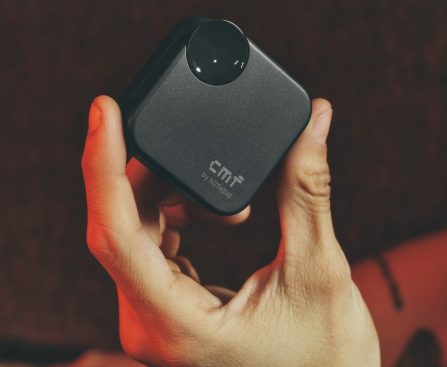
Itâs not every day you find a decent pair of wireless earbuds with active noise cancellation, a transparency mode, and app support for less than $20, which is why the current lighting deal on the CMF Buds 2A stands out. Now through 11:15PM ET today, April 7th, Nothingâs budget earbuds are available on Amazon in […]

The Possibility of Walking Vehicles in Upcoming Transportation
From “Star Wars” films to a multitude of video games, ambulatory vehicles feature prominently as a staple of sci-fi and action narratives. In these stories, such vehicles are typically portrayed as advanced armored tanks that trudge across battlefields while unleashing beams of laser fire on defenseless targets. Nevertheless, considering how many real-life innovations have drawn inspiration from science fiction, you might question whether any actual counterparts to these vehicles exist — or if they ever will.
It appears that several prominent entities in the automotive and electronics sectors have looked into the creation of walking vehicles in the past. Some delved into this idea decades ago, while others have been developing walking vehicle prototypes as recently as a few years back. Although these machines have yet to see widespread use, the ongoing experimentation and advancements indicate that legged vehicles could one day step off the silver screen and into our everyday lives.
Organizations such as GE and Hyundai have been involved in walking vehicle experimentation.
General Electric itself conceptualized a walking tank prior to moviegoers encountering the notion in “Star Wars: The Empire Strikes Back.” Footage showcasing the vehicle, which GE named the “Pedipulator” (also known as the Quadruped), illustrates a human operator controlling the four legs of the machine via a hydraulic system that mimics the operator’s limb movements. The narration in the video clarifies that GE designed this walking tank for the U.S. Army with the intention of supplying a vehicle capable of assisting troops in maneuvering across challenging terrain. Only one unit was produced, as budget reductions prevented any additional development of the Pedipulator.
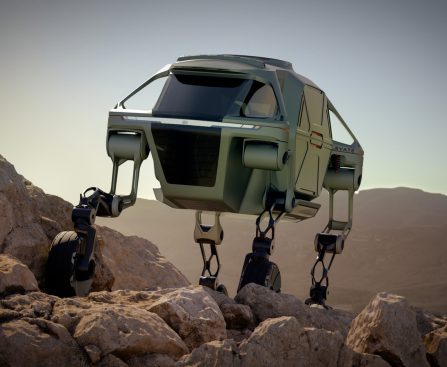
Fast forward to 2019, a similar concept from Hyundai seems to have faced a related outcome. In a 2019 press announcement, the company disclosed that it was developing what it described as “the first Ultimate Mobility Vehicle (UMV),” known as “Elevate.” A concept video depicts how the vehicle would feature a chassis equipped with four extendable legs, enabling various “walking modes” when driving becomes ineffective or impossible due to terrain. The announcement mentioned that the vehicle could aid first responders in navigating debris fields without having to proceed on foot and could serve as an accessible cab that elevates — pun unintended — its chassis, allowing a passenger in a wheelchair to board. Unfortunately, apart from this press release, no updates regarding Hyundai’s Elevate have surfaced for nearly five years.
These examples highlight just two walking vehicles that remained largely in the concept phase, although other walking vehicles have been created in the past. For instance, the Finnish firm Timberjack constructed a walking harvester several decades ago, and the U.S. Forest Service even provides an image of such a prototype.
Reasons walking vehicles haven’t gained traction
The presence of walking vehicles in both sci-fi films and real-world design ideas underscores our evident fascination with them. So, why haven’t they entered the mainstream? The intricate nature of walking itself provides some answers.
To a degree, walking vehicles hold an edge over wheeled counterparts because they can traverse terrain impassable by wheels. However, beyond this advantage, walking vehicles tend to be unwieldy and slow due to the challenges inherent in replicating a walking motion; this limitation hinders their potential for broader adoption. Simply put, they are complex to design, construct, and operate.
That said, these vehicles may not be permanently confined to fiction. Not long ago, the concept of autonomous vehicles was purely speculative. Presently, robotaxis are operational in cities throughout the United States. Likewise, spider-like robots have emerged from our nightmares into reality. As technological advancements progress, walking vehicles might one day become genuinely practical.
Mac Studio and Mac Mini Stock Significantly Restricted in 2026
MacRumors has reported that acquiring a Mac Studio or Mac mini in the short term is nearly unfeasible, with enhanced RAM versions of these devices expected to have delivery times of up to 4-5 months.
While it is feasible to obtain the base-model Mac Studio featuring 36GB of RAM and the M4 Max chip within a relatively acceptable timeframe, it and the $599 entry-level Mac mini equipped with the M4 chip and 16GB of RAM are both anticipated to take almost a month for delivery. However, it appears that Apple might be hoarding its RAM for upcoming products, as current speculations suggest that the company may be aiming to refresh the Mac mini and the Mac Studio around WWDC 2026.
Furthermore, with the recent discontinuation of the Mac Pro, the company must provide a new, “ultimate” enhancement to the Mac Studio to establish it as the preferred choice for high-end professionals. They were already opting for the Mac Studio, but now realize there are no comparable options left within the Mac ecosystem.
Upcoming Macs, but will they be accessible?

I Can’t Help Cheering for Arcee, the Small Open Source AI Model Creator
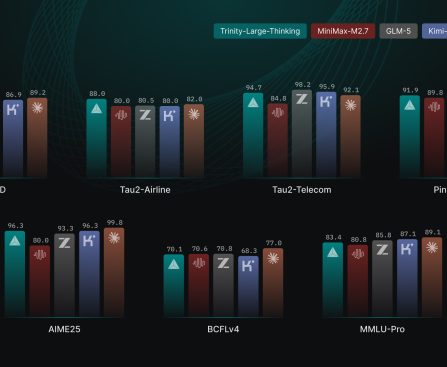
Arcee is a tiny 26-person U.S. startup that built a high-performing, massive, open source LLM. And it’s gaining popularity with OpenClaw users.
Spotify’s Prompted Playlists Help Discover New Podcasts
On Tuesday, Spotify expanded its Prompted Playlists feature to include podcasts, an update that could make it easier for Premium users to find new shows to listen to. Prompted Playlists were originally launched as a beta feature in December, but previously only worked for music. You can use the feature to effectively generate customized Discover […]

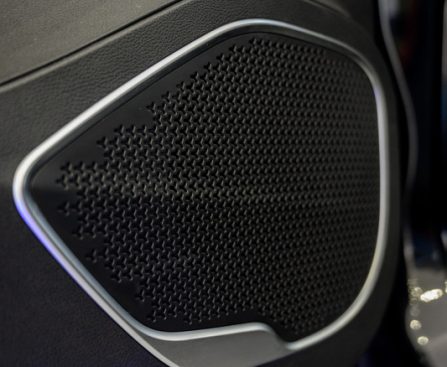
Reasons for Speaker Distortion in Vehicles at Elevated Volume Levels
Apple CarPlay and Android Auto simplify the process of streaming albums, artists, and playlists using just a smartphone and Bluetooth. Although the music may originate from your phone or another source, you remain dependent on your car’s audio system. They represent a category of consumer technology where the possibilities are endless, and spending thousands of dollars on a high-end speaker setup is not unusual. Nevertheless, even a new car with factory-installed speakers can encounter problems, notably the primary speaker culprit: crackling. Specifically, we refer to the kind of crackling that occurs as you increase the volume.
This typically takes place because your vehicle’s speakers are connected to the integrated stereo receiver of your car’s infotainment system. That receiver contains a built-in amplifier that supplies a limited amount of power to your car speakers. If the factory-installed sound system cannot provide sufficient power to each channel, the outcome is often a crackling, distorted sound emanating from one or more speakers.
Overusing your car speakers might even lead to physical damage to them, with a damaged cone or broken voice coil certainly introducing crackling. That being said, if you enjoy blasting music at maximum volume, it could be time to consider investing in an aftermarket amplifier and a dedicated subwoofer.
Speakers can handle only a limited amount of power, and car speakers are no different
Grasping the Function of the Ethernet Port on Your Display
MacBook Neo often bypasses built-in Ethernet ports completely. When connecting an Ethernet cable from your router to your monitor’s docking station, the monitor is capable of relaying the signal to other devices linked to its USB ports. However, it’s important to remember that not every monitor featuring USB-C or USB-A docking capabilities comes with Ethernet connectivity. The value of utilizing your monitor’s Ethernet port is determined by your specific use cases and connectivity needs.
The advantages of utilizing a monitor with an Ethernet port
The primary advantage of employing an Ethernet monitor as your external display lies in its dock-like features while providing wired internet access to your laptop. Numerous users find Ethernet connections to be more dependable than Wi-Fi; they provide reduced latency and increased connection speeds, particularly in households filled with multiple electronic devices. If your monitor comes equipped with an Ethernet port, it can significantly enhance your wired networking capabilities without the need for extra accessories, such as docking stations or USB-to-Ethernet converters, the latter allowing you to attach an Ethernet cable directly to your computer’s USB ports.
If you prefer Ethernet over Wi-Fi, utilizing the LAN port on an external monitor or a <a href="https://www.bgr.com/2105850/best-docking-station-gaming-laptops-

iOS 26 Unveils Fresh iPhone Ringtone: Tune In Now
### ‘Dreamer’ in iOS 26 is an Elegant Reinvention of the Standard iPhone Ringtone
My iPhone usually remains on silent, yet a fresh iOS 26 ringtone has significantly encouraged me to reconsider that decision because it’s such a delightful melody. Here’s my current favorite iPhone ringtone.
I recall the days before smartphones when ringtones were highly significant. As cell phones were limited to making calls, sending texts, and perhaps hosting a few games, the selection of ringtones was a notable aspect. Nowadays, ringtones are overshadowed by the countless other functionalities an iPhone provides. However, that hasn’t deterred Apple from sometimes introducing new ringtone selections.
In iOS 26, the iPhone acquired seven entirely new ringtones. All but one are entertaining variations on the default ‘Reflection’ ringtone, alongside a completely distinct ‘Little Bird’ option. I appreciate that Apple opted to reimagine the default iPhone ringtone instead of solely presenting completely different sounds.
The ‘Reflection’ ringtone has become iconic, and each of the six new options is elegantly crafted—not mere inexpensive remixes. While I relish all of the new additions, my clear favorite is **Dreamer**. It still retains hints of the default tone, but with an enjoyable lo-fi twist.
All the other Reflection alternatives are fantastic as well. A couple more favorites of mine are Surge and Reflected. To explore all the ringtones and modify yours, navigate to Settings ⇾ Sounds & Haptics ⇾ Ringtone.
Have you experienced any of iOS 26’s new ringtones yet? Which one do you prefer? Share your thoughts in the comments.

PSG vs. Liverpool 2026 Livestream: Watch the Champions League for Free
How to watch Champions League for free. Live stream PSG vs. Liverpool in the Champions League for free.

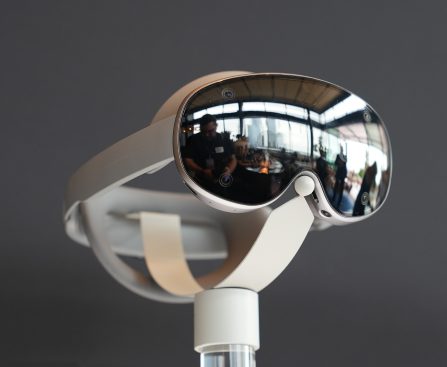
Transform 2D Apps into 3D with the Galaxy XR Headset
Android XR is getting a new feature that turns 2D apps, websites, images, and videos into “3D experiences.” The feature, which Google calls “auto-spatialization,” was initially announced last year, and it’s launching on Tuesday as an experimental feature for Samsung Galaxy XR headsets. Here’s a video from Google that gives you an idea about how […]