
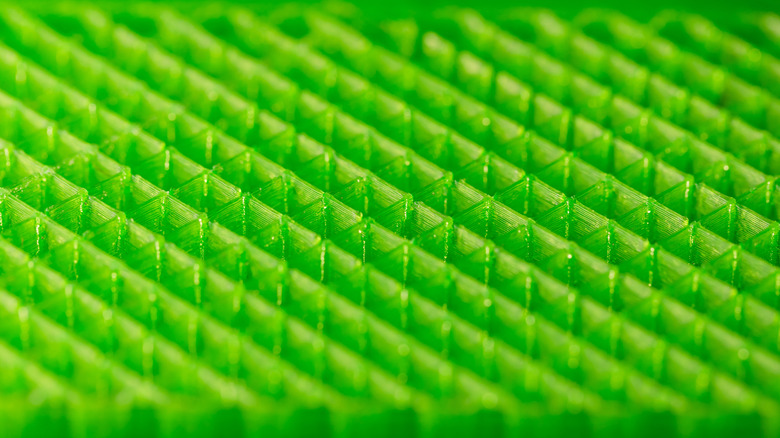

As remarkable as the 3D printing process can be, it may also require a significant amount of time. After all, you are generating something from scratch, and your printer must dispense and layer every inch of the final product. Professionals in 3D printing concur on strategies such as allowing the system to operate at a slower rate to prevent complications. Nonetheless, there are techniques you can utilize to accelerate the process without compromising quality — primarily by opting for a simpler infill pattern.
In addition to the fundamental shapes of a project, your 3D printer dispenses filament to complete the internal framework of flat surfaces. Similar to the main components that constitute the final product, the printer meticulously draws those patterns, and depending on their complexity, you might find yourself waiting all day to finish one side of a cube. Choosing simpler infill patterns that concentrate on straight, uniform lines enables your printer to move in rapid, sweeping motions, saving you both time and filament in the overall print.
Infill patterns contribute to the strength and stability of 3D printed projects
Let’s briefly discuss what an infill pattern contributes to your 3D printing project. You might think that given the slowdown caused by complex patterns, the best course of action would be to eliminate them entirely. However, infill patterns provide the essential structural support for your prints. If you printed a flat object without an infill pattern, it would possess very little rigidity, making it unsuitable for anything that is meant to stand independently.
If you were 3D printing a device for daily use, it’s likely that it wouldn’t be durable without this internal structure. Creating surfaces with an infill pattern enhances its resistance against physical force. A flat, featureless sheet bends easily, whereas a textured sheet is stronger and more resistant to bending beyond its designed shape. Utilizing an infill pattern is also a quicker and more effective approach than crafting solid, heavy blocks of material, as it maintains the same level of structural integrity without consuming excessive filament.
Simpler infill patterns necessitate less 3D printing time
Considering that the infill pattern constitutes the structure of a 3D print, it is logical that a more intricate pattern would yield greater support. This is technically accurate, but it carries a caveat: While more elaborate patterns enhance your prints’ sturdiness, they also demand more material to produce and extend processing times.
If you’re frustrated with the duration of your prints, a practical solution is to adopt a simpler pattern. Essentially, any infill pattern that does not require your 3D printer nozzle to zigzag or execute complex movements will significantly reduce print time. For a quick, straightforward 3D print, an infill pattern composed of single-direction straight lines allows your printer to create the piece with a few swift motions.
The drawback of this pattern is that it offers stability only along a single axis. For something with a bit more strength, consider a lightning pattern utilizing a structure resembling tree branches to deliver enhanced support where it’s necessary while reinforcing thinner, weaker areas of the print. Keep in mind that you can also adjust the density of the infill pattern if you’re looking to use less filament, though this will reduce overall integrity. Also, note that regardless of how robust your infill patterns are, there are still certain objects that should never be 3D printed.