
Nazarii_Neshcherenskyi/Shutterstock
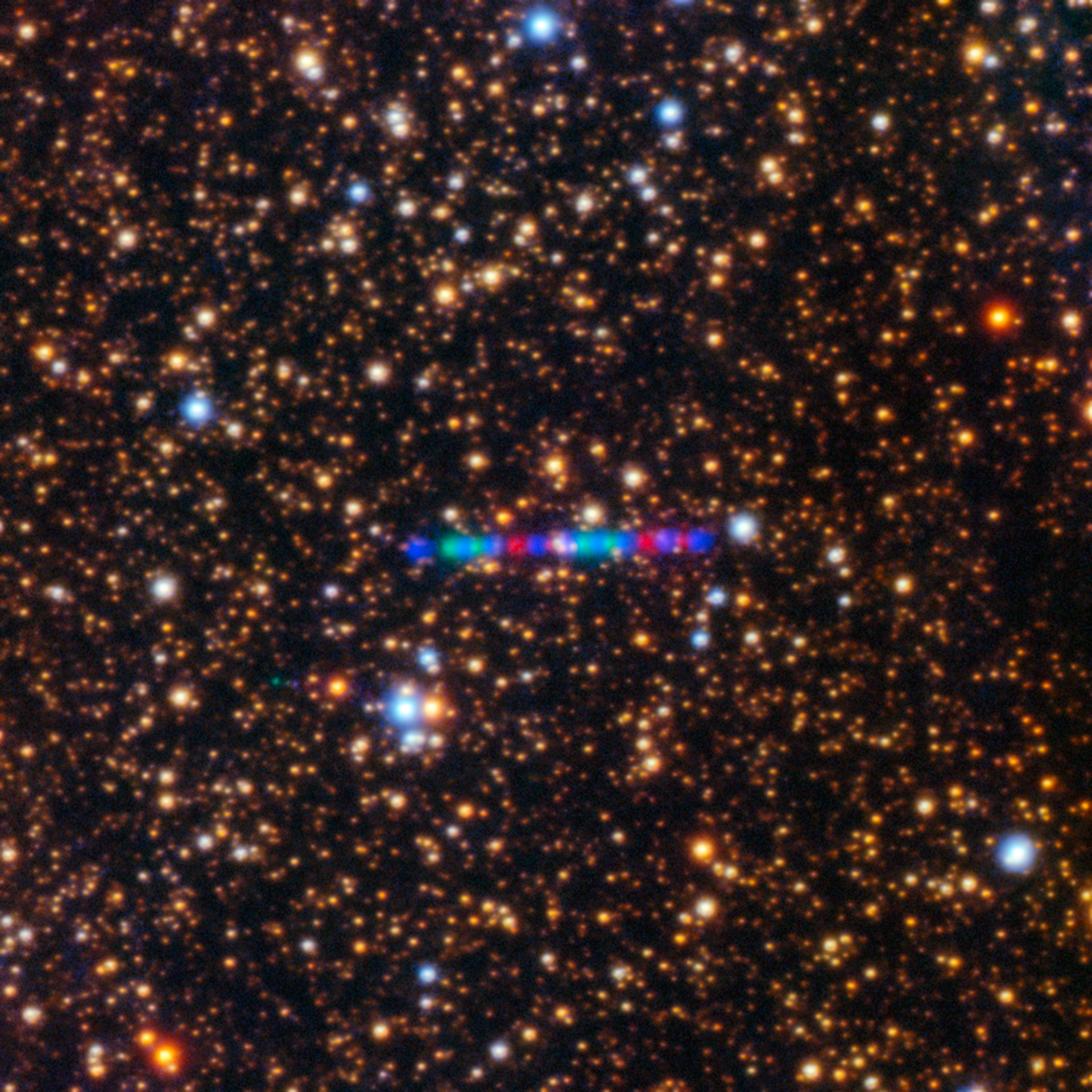
This year’s most remarkable tale for astronomers has been the identification of comet 3I/ATLAS, which was initially noticed on July 1, 2025, by NASA’s Asteroid Terrestrial-impact Last Alert System (ATLAS). While comets frequently fly by Earth, with Halley’s Comet being the most renowned, there is something exceptionally intriguing about this recent discovery. Comets like Halley’s and others well-recognized have their origins within our solar system, formed from the same disk that created the sun, Earth, and all other planets. The fascinating aspect of 3I/ATLAS is that it has its origins from beyond our solar system, having traveled through interstellar space to reach us. As if that discovery wasn’t thrilling enough, a radio telescope has detected that the comet is emitting something.
The MeerKAT radio telescope, located in South Africa, captured signals from 3I/ATLAS in late October as the comet approached its closest proximity to the sun. This observation was widely shared as radio emissions from 3I/ATLAS, leading conspiracy theorists to conjecture that the object might be a fragment of alien technology. However, this interpretation is not quite correct. In reality, all objects emit electromagnetic radiation, and what MeerKAT detected wasn’t an acoustic signal similar to what we hear on car radios. Instead, it identified gaps in the radio spectrum due to the absorption of radio waves by OH molecules, known as hydroxyl radicals. OH molecules — the byproducts of water broken down by solar radiation — are typically seen in comets that come within Earth’s vicinity, which essentially addresses any notions that 3I/ATLAS is anything but a comet. Nonetheless, it leaves open the inquiry into the origins of 3I/ATLAS.
Astronomers still aren’t certain about the origins of 3I/ATLAS
The identification of 3I/ATLAS represented just the third occasion where astronomers have spotted an interstellar entity traversing our solar system. The “3I” in its designation stands for “third interstellar” for this reason. The earlier two interstellar objects detected by researchers were 1I/’Oumuamua and 2I/Borisov, found in 2017 and 2019 respectively. The reality that all recognized interstellar visitors to our solar system have been discovered in the last ten years indicates substantial progress