

The International Space Station (ISS) stands as the pinnacle of human endeavors in space exploration. Spanning the length of a football field, it accommodates a rotating team of approximately seven astronauts engaged in numerous scientific experiments. Recently, however, the ISS became the site of an unintended case study illustrating that humanity may not be as prepared for interplanetary journeys as we believed.
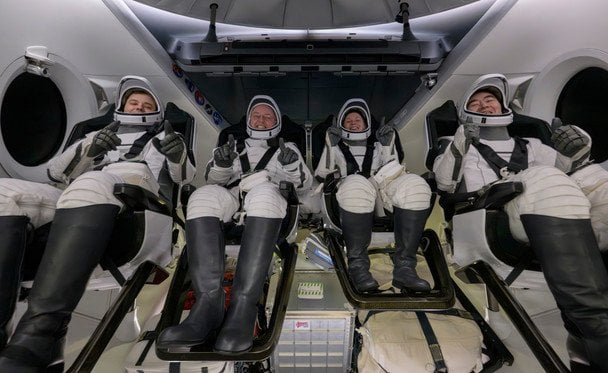
On January 7, the official NASA account on X disclosed that astronaut Mike Fincke faced a medical emergency. Although Fincke didn’t provide specific details, he acknowledged that it “required immediate attention” but was swiftly addressed through the “quick response and the guidance of our NASA flight surgeons.” Following this alarming incident, Fincke returned to Earth ahead of schedule on January 15. According to sources like CNN, Fincke’s splashdown represented the first instance of a NASA astronaut needing to truncate their ISS stay due to medical issues.
If this information seems recognizable, it’s because on January 7, NASA announced that an ISS spacewalk was deferred due to a “medical concern with a crewmember.” It is likely unnecessary to mention that the medical emergency which led to the cancellation of the spacewalk is the same situation affecting Fincke.
In the vacuum of space, there is no one to operate on your appendix.
NASA upholds stringent health criteria for astronauts to reduce risks in space, yet Mike Fincke’s recent crisis underscores that no amount of preparation can foresee or accommodate every possible scenario. We remain unaware whether Fincke merely stubbed his toe, which became infected, or if he experienced a severe bout of appendicitis. Was his emergency something that could have been prevented, or was Fincke a latent crisis waiting to unfold while in orbit? Regardless, it is fortunate that he received a prompt return trip, unlike Suni Williams and Butch Wilmore during the 2024 Starliner incident.
While NASA anticipates beginning to dispatch colonists to MARS in the 2030s, unless engineers innovate a quicker propulsion system, astronauts will endure lengthy missions confined to their shuttles for no less than seven months. In the event of a medical emergency, they are left to their own devices and may have to endure months before accessing a hospital — assuming a return is even feasible. Should a vital team member, such as a pilot or medical professional, face a health crisis, it could spell disaster for the entire mission.
Crewmembers aboard the ISS regularly deal with serious health challenges like motion sickness and muscle deterioration, equipped with the medical resources and strategies to counteract most of these issues. However, Fincke’s experience illustrates that even those who plan for every possible contingency in space can find themselves vulnerable to the limitations of the human body.