
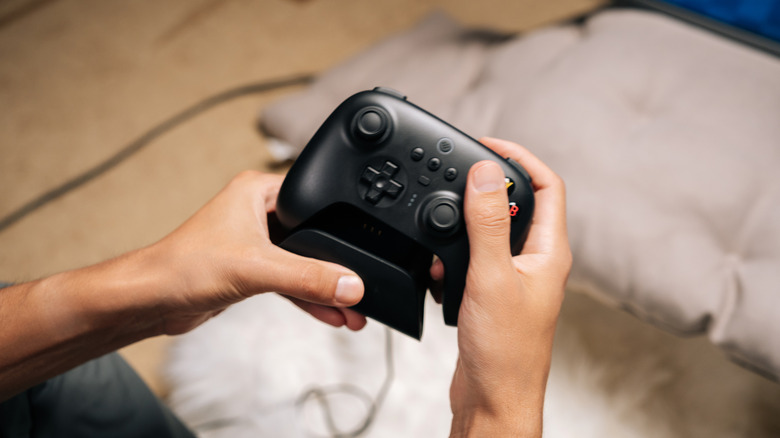

cable-less gaming headphones to wireless gamepads. Concerning those game controllers, there exist two primary wireless connectivity choices for linking a gamepad to either a console (whether a stationary unit or a portable like the Steam Deck) or PC: Bluetooth and 2.4GHz. Each of these connectivity techniques has its advantages and disadvantages, but typically, a serious PC gamer should avoid Bluetooth, particularly for fast-paced, online multiplayer games.
Wireless gamepads that operate on the 2.4GHz frequency range generally come with a small USB receiver. This kind of wireless technology is known as USB-RF (with RF denoting radio frequency), and it is significantly better than Bluetooth in terms of input delay and total bandwidth. Traditionally, Bluetooth features a considerably lower polling rate (measured in hertz, indicating how quickly the controller communicates input information to a console or PC) compared to 2.4GHz through USB-RF.
The maximum polling rate achievable with Bluetooth is 125Hz (the limit of the protocol), while USB-RF can provide polling rates of up to 1,000Hz or more. Higher polling rates mean reduced input delay that gamers must face. Furthermore, all USB-RF controllers are proprietary, meaning the USB receiver will not have to share its wireless link with products from different brands.